
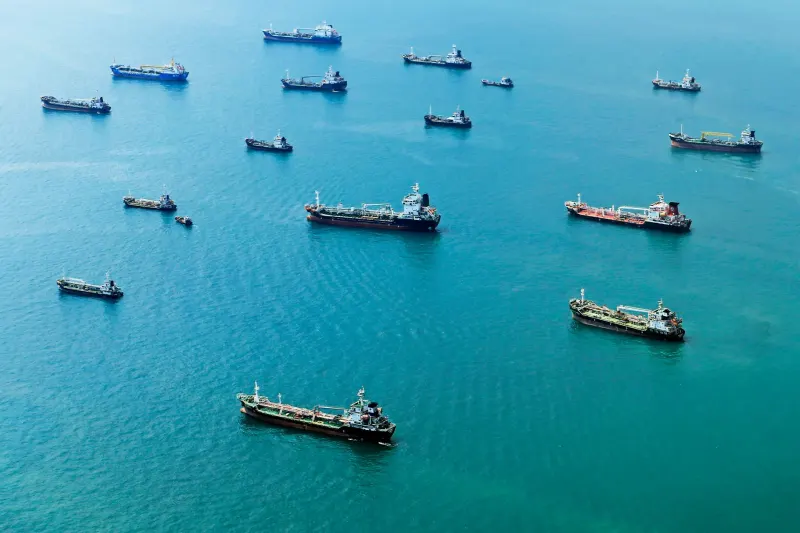
A newly emerged startup called Drogue is setting out to tackle the growing energy demands of artificial intelligence by turning to the open ocean. Founded six months ago in Washington, D.C., the company has raised $20 million in funding from investors including XYZ Venture Capital, Toyota Ventures, Tamarack Global, Dream, FDVC, Garuda Ventures, Flexcap, Boost VC, and Slow Ventures. Drogue is developing a system that harvests heat from the ocean to power data centers housed on floating vessels, with a multi-megawatt prototype slated to hit the water in early 2028.
Co-founded and led by CEO Sam Sipe, a former U.S. Navy pilot who flew E-2D Hawkeyes off aircraft carriers, Drogue aims to bypass the lengthy timelines associated with traditional land-based data center deployments. Sipe noted that the data center industry typically operates on eight- to ten-year real estate timelines for utility and power grid interoperability, a pace completely incompatible with the tenfold increase in AI demand witnessed over the past three years. By placing data centers directly on the ocean, the startup hopes to deploy server infrastructure much faster.
Key takeaways
- Drogue was founded six months ago in Washington, D.C. and has raised $20 million in funding.
- The company builds floating data centers powered by ocean thermal energy conversion (OTEC).
- A multi-megawatt prototype will be installed on an oceangoing ship and launched in early 2028.
- The system uses a temperature differential between warm surface water and cold deep water to generate electricity via a closed-loop ammonia turbine.
Harnessing Ocean Thermal Energy Conversion
Drogue’s technology relies on ocean thermal energy conversion, or OTEC, a concept first developed in the 1950s and tested in the 1980s before being largely set aside due to economic and manufacturing hurdles. Sipe explained that modern advancements in manufacturing techniques for pipes and heat exchangers make the approach viable today. The system functions essentially as a heat pump run in reverse, utilizing the temperature difference between warm surface waters heated by the sun and much colder deep-sea water averaging 39 degrees Fahrenheit.
The operational cycle draws in warm surface water to cool the onboard data centers. That warmed water is then redirected to boil ammonia, a chemical that turns into gas at -28 degrees Fahrenheit. The resulting ammonia gas drives a turbine to generate electricity before passing through a condenser. Cold water drawn from a depth of 1,000 meters passes over the condenser's fins to absorb the heat, and is subsequently pumped back down to 1,000 meters to dissipate into the ocean. The sealed-loop ammonia then returns to the start to repeat the cycle.
Logistics and Future Outlook
Placing data centers at sea solves a major logistical hurdle for OTEC technology: finding an immediate consumer for the power without building expensive, lengthy underwater transmission cables back to shore. Data centers are compact relative to other industrial equipment, and transmitting data off the platform is exceptionally cost-effective. Each floating vessel is designed to operate at sea for approximately a decade.
Drogue has already secured an approval in principle from the American Bureau of Shipping, which establishes safety standards for marine vessels. Following the initial prototype on a traditional oceangoing ship in 2028, future iterations of the platform are planned to resemble offshore oil platforms. Sipe compares the concept to orbital data center proposals by finding an abundant, cheap power source and positioning servers directly next to it, while avoiding the exorbitant rocket launch costs associated with space-based infrastructure.






Comments