
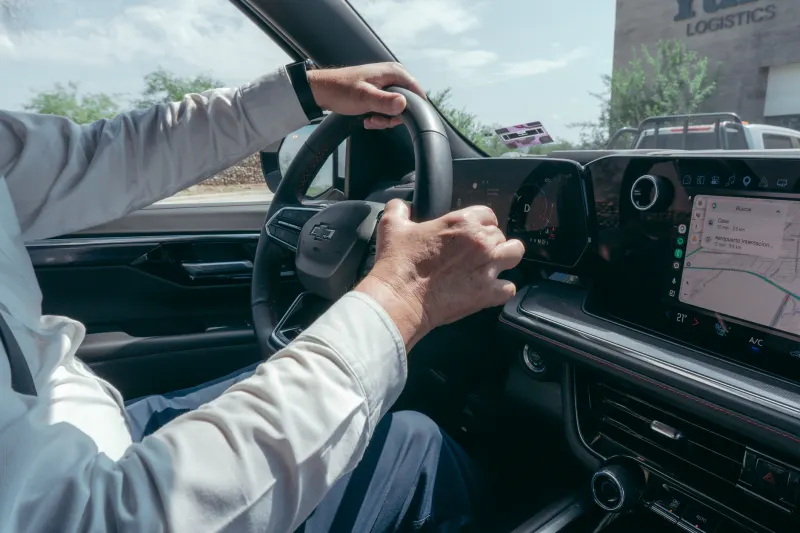
Artificial intelligence is shifting away from text-based models and toward sophisticated systems that simulate real-world physics in three dimensions. While large language models focus on predicting the next word in a sentence, world models analyze a visual state and predict the next visual state of an environment. This emerging technology relies on visual inputs to generate digital training grounds that simulate physical spaces, making it a critical foundation for the future of home robotics and autonomous vehicles.
Key takeaways
- Niantic sold Pokémon Go and pivoted to world models to reconstruct the real world using spatial data.
- World models predict future visual states and simulate physical laws, cause and effect, and interactions.
- Startups like Wayve use dashcam footage to train autonomous car systems on hazardous road conditions.
- High-profile industry developments include AMD acquiring Fei-Fei Li's startup World Labs for over $8 billion.
The Evolution From Mixed Reality to Spatial AI
The foundation for modern world models traces back years, often built on unexpected data sources. Niantic, the creator of the popular 2016 mixed-reality game Pokémon Go, sold the title and pivoted heavily into world models. Brian McClendon, chief technology officer at Niantic Spatial, notes that the company focuses on reconstructing the real world by leveraging vast troves of spatial data gathered over the years. By turning environmental scans into digital replicas, companies can build the groundwork for advanced automation.
Oliver Cameron, CEO of Odyssey, an AI lab focused on world models, explains the fundamental mechanics of the software. Instead of generating text, these systems take a visual input and map out how the environment will change next. These 3D generations function as simulations that closely mimic reality, allowing developers to test and train systems without physical constraints.
Applications in Robotics and Autonomous Driving
Robotics and driverless car development stand to benefit immensely from the expansion of world models. McClendon points out that someone can take photos of an intended operating environment, generate a 3D model, and let the software run millions of simulations. This allows robots to practice tasks and understand spatial parameters entirely in a virtual space before operating in physical settings.
For autonomous vehicles, split-second software reactions are paramount. Jamie Shotton, chief scientist at Wayve, emphasizes that a functional world model must understand physics, cause and effect, and how other people and objects alter their actions in response to a vehicle. Wayve utilizes generative world models powered by dashcam footage to recreate hazardous roads and unsafe conditions that would be impractical and dangerous to test physically.
Industry Investment and Labor Market Impacts
Major tech players and venture capital firms are pouring billions of dollars into the space. Tencent is investing in world models for video game physics and 3D rendering, while prominent researchers launch heavily funded ventures. Yann LeCun recently raised over a billion dollars for his Advanced Machines Intelligence startup, and AMD acquired Fei-Fei Li's World Labs for over $8 billion.
This rapid development is also creating new forms of gig work. To build accurate simulations of physical spaces, AI labs require extensive real-world video recordings. People are increasingly participating in data collection by recording daily chores such as folding laundry, washing dishes, and handling household items, feeding human behavior into the digital architectures that will power future machines.





Comments