
Tsutomu Nihei’s acclaimed sci-fi manga series Blame! has long held a revered status among comic storytelling enthusiasts. Initially known to many through Polygon Pictures’ CG film adaptation on Netflix, the source material offers a far more expansive and harrowing journey through a desolate, sprawling environment. While the protagonist Killy and his legendary weapon often steal the initial spotlight, the true masterpiece of the series lies within its staggering, oppressive architecture and the liminal spaces that define its unforgettable world.
Key takeaways
- The story follows protagonist Killy as he wanders through a massive, infinite man-made city that could rival the size of our solar system.
- Killy wields the iconic Gravitational Beam Emitter, a powerful firearm whose name serves as the manga's thunderous onomatopoeia title.
- The narrative features extreme elements of horror, including severe time dilation where simple separations can span decades for secondary characters.
- Themes of identity are explored through consciousness reuploading, memory wipes, and the forcible takeover of physical vessels.
The Allure of the Gravitational Beam Emitter
Before reading the manga, many fans encounter the series through its reputation for featuring an absurdly cool weapon known as the Gravitational Beam Emitter. Named after the thunderous sound it makes when fired—often sending Killy flat on his back or tearing his arm clean off—the firearm solves nearly every obstacle in Killy's path. Its name easily ranks alongside the most iconic weapons in comic and sci-fi history. Early expectations often center entirely around uncovering the mystery of where the weapon came from, how it operates, and why neither Killy nor his H.R. Giger-inspired adversaries fully understand it.
Yet, the initial obsession with the weapon quickly fades upon experiencing the full breadth of the series. While action sequences featuring the beam gun breaking through obstacles remain thrilling, the weapon ultimately takes a back seat to the astonishing environment it is fired within. The sprawling panels and double spreads consistently redirect attention away from combat mechanics and straight into the staggering scale of the surrounding world.
Architectural Horror and Liminal Spaces
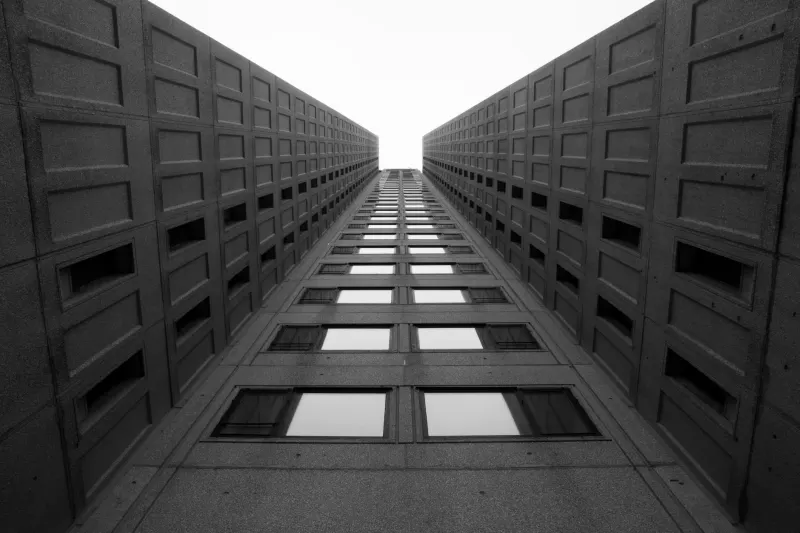
The true star of Blame! is the massive, brutalist megastructure that Killy navigates endlessly. Nihei designs this colossal setting as a giant man-made city potentially as vast as our solar system, echoing the claustrophobic dread of liminal spaces. For long stretches, Killy travels through corridors with fleshy dead ends, rarely encountering other people or the automatons tasked with maintaining order on its infinite floors. The architecture feels less like impossible human design and more like an unempathetic, living organism operating entirely out of indifference.
As Killy climbs higher, the environment slowly reveals its alien nature, prompting a sense of discovery comparable to uncovering hidden maps in video games. This deafening silence is periodically shattered when biomechanical apparitions burst through floors or swarm like locusts. Alongside physical threats, the narrative introduces severe psychological horror, such as time dilation. In one instance, a brief separation that feels like a minor climb to Killy results in a 30-year absence from his ally's perspective, with elevator rides occasionally demanding up to 800 hours to reach their final destination.
Identity and Environmental Storytelling
Beyond the architectural terror, the manga explores deep philosophical questions surrounding identity and consciousness. Characters are capable of having their consciousnesses reuploaded after their physical bodies are destroyed, sometimes forcefully taking over new vessels while suffering from complete memory wipes. These existential themes compound the pervasive sensation that every environment existed for a millennium before Killy arrived and will continue stretching into infinity long after he departs.
Ultimately, the lasting impact of Blame! stems not from completely untangling its circuitous narrative threads, but from the haunting experience of moving aimlessly through its colossal world. Alongside Nihei's other series, Tower Dungeon, the environmental storytelling remains peerless in its ability to captivate readers through sheer scale, architectural dread, and atmospheric isolation.







Comments