
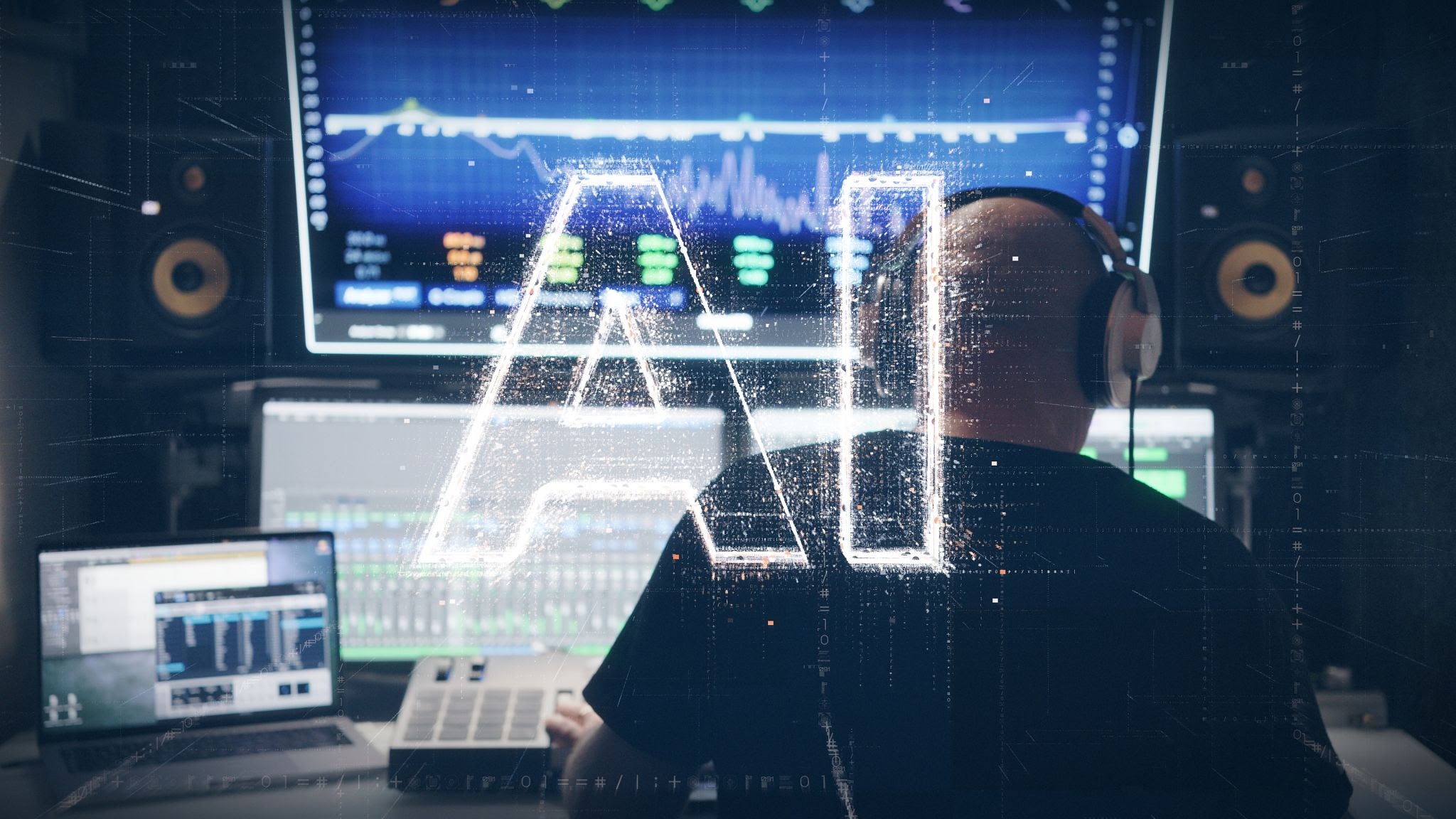
For generations, recording music was a highly gate-kept, capital-intensive endeavor. To make a high-fidelity record, artists needed access to massive commercial studios packed with million-dollar analog mixing consoles, acoustic live rooms, and highly trained tape engineers. The home studio was a compromise—a space for rough demos, not commercial hits.
Today, that infrastructure has completely dematerialized into software. The music production sector is undergoing a profound democratic expansion driven by artificial intelligence, cloud-based collaboration, and spatial computing. The modern bedroom producer armed with a laptop can access sonic capabilities that surpass what Abbey Road could offer the Beatles, shifting music from an exercise in physical tracking to one of digital synthesis.
Generative AI and Algorithmic Composition
Artificial intelligence is evolving rapidly from a basic utility into an active assistant—and in some cases, a standalone creator—within the music lifecycle.
- Stem Separation: Historically, if you lost the original multi-track session of a song, you could never isolate the vocals from the drums. Modern machine learning models utilize neural network demixing to split a single stereo MP3 into pristine, isolated "stems" (individual instrument tracks) in seconds, completely revolutionizing sampling culture and remixing.
- AI Assistants and Co-Writing: Producers are utilizing tools like Orb Producer or text-to-audio models to break creative blocks. An artist can feed an AI a baseline chord progression, and the system can instantly generate dozens of complementary baseline options, complex synth melodies, or intricate drum patterns based on specified genre parameters.
- Automated Mastering: Mastering—the final acoustic polish required to make a song sound balanced across everything from iPhone speakers to club sound systems—was a highly specialized art. Cloud platforms like LANDR use deep learning to analyze the frequency spectrum of a track and instantly apply custom equalization, compression, and stereo-imaging, delivering commercial-grade masters in minutes for a fraction of the cost of a human engineer.
The Virtual Instrument and DSP Renaissance
Digital Signal Processing (DSP) and computational power have advanced to a point where physical analog hardware can be modeled down to the behavior of individual vacuum tubes and capacitors.
- Physical Modeling Synthesis: Instead of relying on static audio samples, modern virtual instruments use complex mathematical physics equations to simulate the real-world acoustic behavior of instruments. A virtual piano plugin doesn't just play a recording of a middle C; it calculates the exact resonance of a virtual wooden soundboard, the string tension, and the room acoustics dynamically.
- Accessible Orchestration: Armies of film composers and bedroom producers can now load a 100-piece symphony orchestra directly into their computer's RAM. High-fidelity sample libraries capture every articulation of elite orchestral players, allowing a single producer to score a Hollywood-grade cinematic soundtrack from a home desk.
Spatial Audio and Immersive Soundscapes
Stereo sound (left and right channels) has dominated the consumer music experience since the 1960s. The industry is currently executing its biggest physical shift in half a century: the migration to spatial audio.
- Object-Based Audio: Technologies like Dolby Atmos move away from rigid speaker channels. Instead, audio engineers mix music in a 3D hemisphere. The vocal can be placed ten feet "above" the listener, a synth can swirl dynamically "around" their head, and the drums can sit firmly "in front."
- Binaural Rendering for Headphones: While true spatial audio historically required complex 7.1.4 multi-speaker studios, advanced DSP can now decode these 3D audio environments into standard headphones using HRTF (Head-Related Transfer Function) algorithms. This creates a hyper-realistic illusion of 3D space, mimicking how human ears naturally process directional sound waves.
Cloud Collaboration and Decentralized Teams
The process of making a record has become entirely asynchronous and borderless, uncoupling production from geographic limitations.
- Real-Time Remote Sessions: Software like Audiomovers allows musicians to stream pristine, uncompressed, ultra-low-latency DAW (Digital Audio Workstation) audio globally. A vocalist in London can sing into a microphone, and a producer in Los Angeles can record that take directly into their session in real-time with zero loss in quality.
- Smart Version Control: Cloud platforms act like GitHub for musicians. Multiple producers can work on the same project file simultaneously across different locations, with the system managing version control, tracking changes, and automatically syncing heavy audio stems in the background.
The Outlook
Technology has transformed music production into an ultra-fluid, borderless canvas. As generative AI handles the technical complexities of editing, tuning, and mixing, the role of the modern producer is shifting from a technical coordinator to a pure conceptual director—empowering anyone with a creative vision to orchestrate professional-grade sonic landscapes.




Comments