
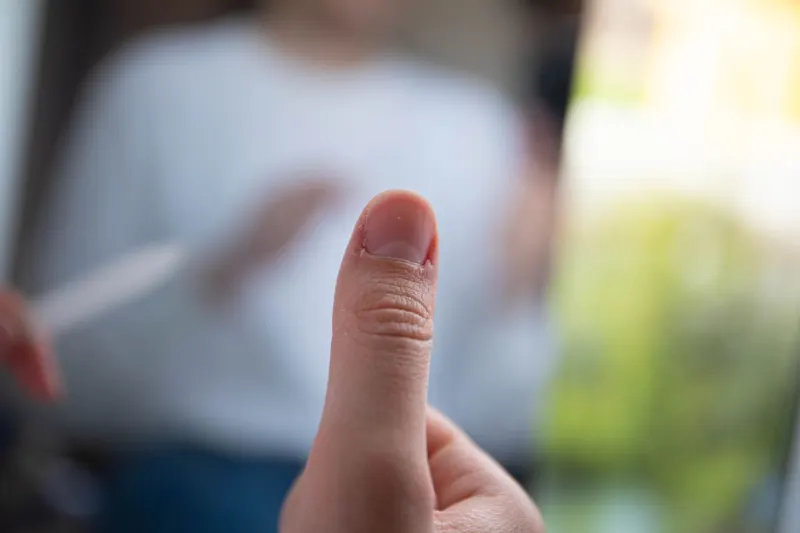
A growing controversy has engulfed more than a dozen peer-reviewed journal articles and conference papers that claim artificial intelligence models can accurately predict a human's blood type simply by analyzing fingerprint scans. Over the past three years, these studies have promised a revolutionary alternative for individuals who harbor an aversion to needles and blood draws. One such study, published in 2025 in the journal Franklin Open, hailed the technological advancement as a non-invasive, pain-free, and efficient alternative for blood group classification. However, two academic researchers in Australia have discovered that several of these widely cited papers rely entirely on a flawed public dataset that never actually linked fingerprint data to blood types.
Key takeaways
- Over a dozen conference and peer-reviewed papers claim AI can predict blood type from fingerprints.
- Australian researchers traced the studies to a dataset that never contained blood-type information.
- Publishers Elsevier and IEEE are currently investigating the contested papers.
- Medical researchers in India previously found no biological correlation between fingerprints and blood types.
Unraveling the fabricated datasets
The integrity of these artificial intelligence studies came to light through the investigative work of mechanical engineer Lars Kooijman, an adjunct research fellow at Monash University in Melbourne, and Stephanie Summersby, a postdoc and adjunct with the University of New South Wales. The pair issued a joint statement to the nonprofit watchdog Retraction Watch, declaring that the papers were produced under false pretenses with fake data and should therefore be retracted. Their investigation revealed that the studies sourced their training material from a collection known as the Sokoto Coventry Fingerprint Dataset, or SOCOFing, which originally contained 6,000 fingerprints from 600 subjects but included zero blood-type information.
Instead, the authors of the contested studies pulled data from a secondary collection posted to Google's Kaggle platform called the Fingerprint Blood Group Classification Dataset, which falsely connected those specific prints to various blood types. Computer scientist Sanivarapu Prasanth Vaidya, who served as a lead author on the Franklin Open study, confirmed to Retraction Watch that his research team sourced their fingerprint and blood-type information from Kaggle. Vaidya defended his team by stating that they were entirely unaware of the source inaccuracies and utilized the data in good faith.
Publisher investigations and medical skepticism
Following the findings brought forward by Kooijman and Summersby, major academic publishers have launched formal inquiries into the published literature. Elsevier, the publisher behind Franklin Open, confirmed that an investigation is currently underway and declined to share additional information while the review proceeds. Meanwhile, the Institute of Electrical and Electronics Engineers stated that it is actively evaluating the affected papers, which were published as part of conference proceedings archived within its IEEE Xplore database.
Independent medical evaluations have further undermined the premise that machine learning can bridge the gap between dermatoglyphics and hematology. Physiologists at the GMERS Medical College in Gujarat, India, conducted their own analysis on 224 test subjects in 2024, comparing actual blood tests with physical fingerprinting. Their findings, published in the European Journal of Cardiovascular Medicine, concluded that there is no biological correlation whatsoever between fingerprint patterns and blood types in either males or females.






Comments