
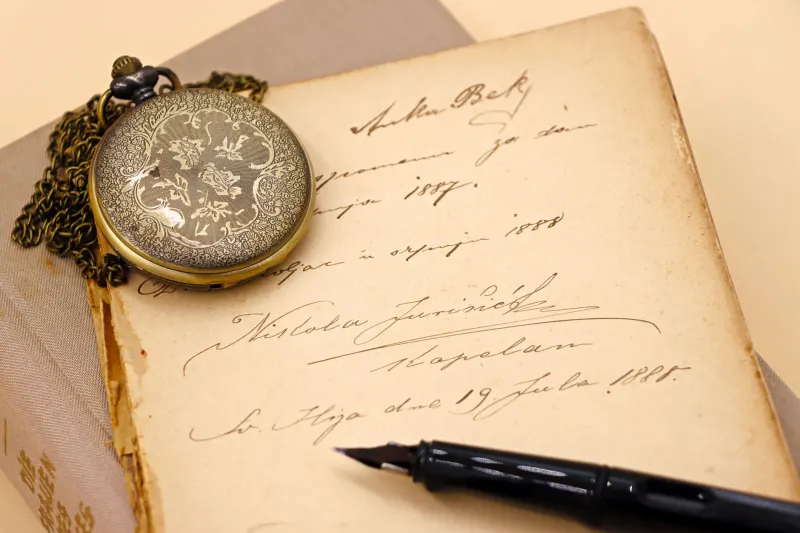
An anonymous 1808 sketchbook held at Yale University's Beinecke Library has finally been attributed to its original creator, thanks to an advanced artificial intelligence model. Wilfrid Laurier University history professor Mark Humphries utilized the GPT-6.2 Astra model in ChatGPT to investigate the document, which depicts a journey from Montreal to Fort William and back. With minimal prompting, the AI successfully identified the artist in a mere 22 minutes using primary and secondary sources available on the web.
According to the AI's findings, the sketchbook is the work of French aristocrat Louis-Guy-Charles-Guillaume de Rohan-Chabot, a minor figure who lived from 1780 to 1875 and spent most of 1808 in Canada as a British Army officer. Humphries described the outcome as a significant historical discovery, noting that the task required the AI to read through vast amounts of sources, build a hypothesis from limited evidence, and formulate an argument. The historian stated that it is unlikely a human researcher could replicate the feat in such a timeframe.
Key takeaways
- The GPT-6.2 Astra model identified an anonymous 1808 sketchbook creator in 22 minutes.
- History professor Mark Humphries prompted the AI using publicly available web sources.
- The artist was determined to be French aristocrat Louis-Guy-Charles-Guillaume de Rohan-Chabot.
- A microfilmed diary from Cleveland State University provided handwriting and itinerary matches to confirm the discovery.
Uncovering the evidence
The journey recorded in the sketchbook covers locations that have since been destroyed, leaving few clues for historians who spent years trying to solve the mystery. The artist could have been any one of several thousand people, given that there were only four dated and labeled images in the entire collection. Rather than relying on a linear search, the AI was able to tackle the problem from both ends simultaneously. It worked forward from the scant facts of the 1808 journey and backward from the immense pool of surviving data regarding 1808 British North America.
To test the hypothesis generated by the model, Humphries ordered copies of a little-known microfilmed diary of Chabot's trip located in the Special Collections of Cleveland State University. When the scans arrived, the handwriting matched the captions in the sketchbook, and the itinerary aligned precisely with the dated drawings. Conclusive proof emerged from an entry dated June 18, 1808, where Chabot wrote that he took a sketch after his canoe reached Fort St. Joseph, describing the exact view captured in the drawing.
Implications for historical research
The recovered journal spans 162 notebook pages and represents a major find for Canadian and fur trade history, as it was previously unknown to specialists in the field. Attached to the journal was another trove of documents, including excerpts from long-destroyed North West Company papers, journals, and letters. Humphries acted primarily as a research assistant, restricting copies of the paper documents requested by the system while the AI conducted the investigation end-to-end.
This breakthrough suggests that research and discovery processes seen in verifiable domains like mathematics are beginning to generalize to non-deterministic fields like history. Humphries noted that over the past year, these models have progressed from learning to read handwriting and understanding undergraduate essays to making real contributions to human knowledge autonomously. While the exact workings inside the ChatGPT black box remain opaque, the capability of AI agents to connect disparate data points points toward a shifting landscape for archival research.







Comments