
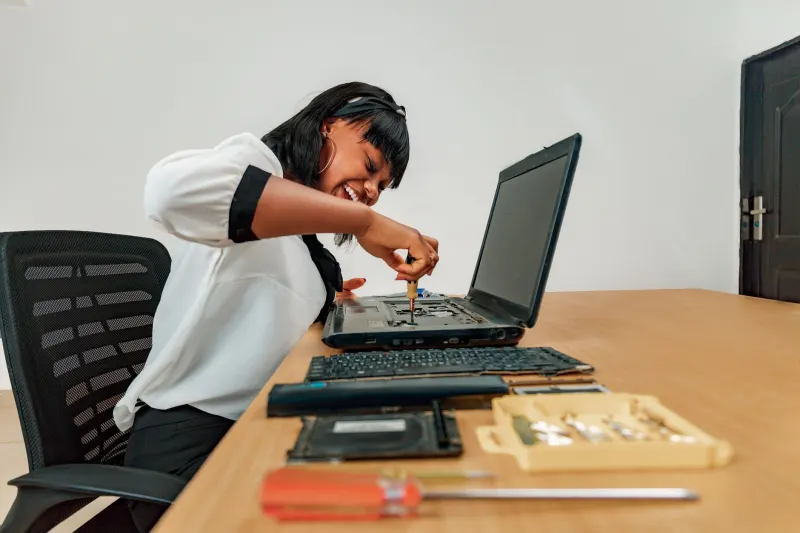
Few technology problems can disrupt a workday faster than when a MacBook keyboard suddenly stops responding. Whether an owner is dealing with a single stuck key or an entire board that refuses to register inputs, the immediate assumption is often a costly hardware failure requiring a professional fix. However, software glitches or small particles of dirt trapped underneath the keys frequently cause these frustrating malfunctions. Investigating these simpler issues before panicking can save valuable time and eliminate the need for unnecessary repair expenses.
Before tinkering with deeper system settings, the most basic troubleshooting step is to reboot the computer by selecting the Apple menu and clicking Restart. Users working with a wired external keyboard should unplug it and reconnect it securely, while those using wireless peripherals should turn the device off and back on. Going into System Settings, navigating to Bluetooth, unpairing the device, and pairing it again can also clear temporary connection glitches. Low battery power remains another frequent culprit, meaning rechargeable wireless boards must be plugged into a charger while models with replaceable batteries require fresh cells.
Key takeaways
- Restarting your Mac or power-cycling external keyboards can quickly resolve temporary connection glitches.
- Checking accessibility settings ensures features like Sticky Keys or Slow Keys are not accidentally altering keystroke recognition.
- Cleaning physical debris with compressed air held at a 75-degree angle can fix malfunctioning keys without damaging delicate mechanisms.
- Booting into safe mode or running Apple Diagnostics helps determine if third-party software or failing hardware is causing the interference.
If basic reboots and power checks fail to resolve the problem, specific macOS configuration settings require close inspection. Owners should open System Settings, select Accessibility, and click on Keyboard. Verifying that toggles for features like Sticky Keys or Slow Keys are disabled is crucial, as these options fundamentally alter how the operating system recognizes standard keystrokes. Within this exact same menu, users can enable the Accessibility Keyboard to bring up an interactive on-screen keyboard operated via the mouse cursor, allowing them to type while troubleshooting continues.
To isolate whether the built-in hardware itself is faulty, connect a separate external keyboard to the MacBook. Booting the machine into safe mode can also clarify whether a third-party application is interfering with normal typing operations. To enter safe mode, shut down the Mac normally from the Apple menu rather than putting it into sleep mode, press and hold the power button until loading startup options appear, select the startup disk, press and hold the Shift key, and click Continue in Safe Mode. Running built-in Apple Diagnostics provides an additional layer of testing.
When only one or two individual keys are malfunctioning, the most likely root cause is physical debris stuck inside the tiny key mechanism. Owners can attempt cleaning the keyboard by holding the MacBook at a 75-degree angle and using compressed air, then rotating the laptop and repeating the cleaning process. Another technique involves turning the MacBook upside down and gently tapping the back cover to dislodge trapped dirt. Users must never attempt to remove keycaps on their own, because the components are extremely small and delicate, and manual removal can permanently damage the mechanism. If all else fails, the final resort is booking an appointment with Apple Support for a specialist examination to determine if a replacement is needed, keeping in mind that older MacBooks released between 2015 and 2019 are notorious for problems with the butterfly keyboard design.






Comments