
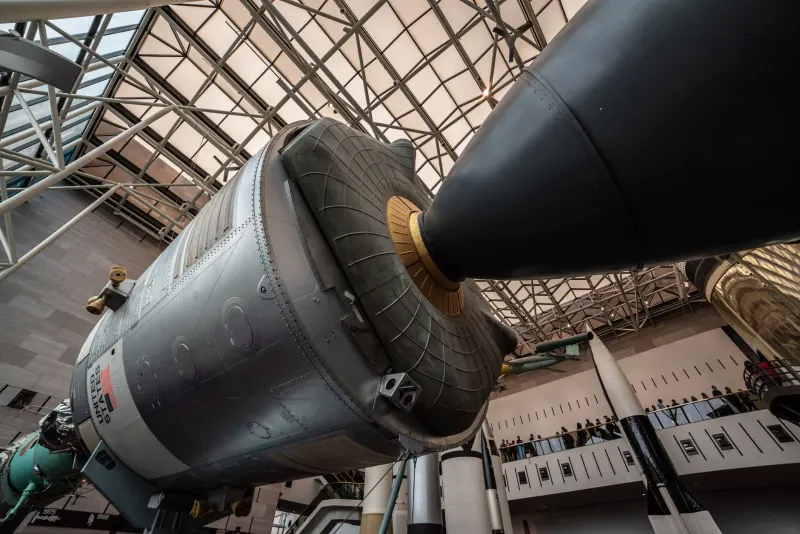
Humanity relies extensively on orbital infrastructure, including GPS satellites orbiting 12,550 miles above sea level, far more than during the Apollo era. Researchers are now discovering the atmospheric consequences of multistage rocket launches designed for deep-space Moon missions. According to a new study from researchers at Taiwan's National Cheng Kung University, the historic launch of NASA's Artemis 2 last April generated three sets of traveling ionospheric disturbances capable of producing GPS errors several meters off target.
The study, released as a preprint via ESS Open Archive while awaiting peer review, highlights how rocket engine burns can tear serious holes in the ionosphere. These disturbances lower electron density across patches of this charged atmospheric layer and briefly confuse ground-based GPS receivers. The research team noted this marks the first instance of a single space mission producing three separate ionospheric disturbances over the same region during successive orbit maneuvers.
Key takeaways
- Artemis 2 generated three sets of traveling ionospheric disturbances during its launch.
- The disturbances caused GPS receivers to produce positioning errors several meters off target.
- The second-stage burn left a 3,107-mile streak of disturbed electrons across the continental United States.
- Researchers utilized data from over 3,500 ground stations tracking GPS, GLONASS, and Galileo satellites.
Tracking atmospheric disruptions with ground stations
To measure the impact, Charles Lin's team at National Cheng Kung University collaborated with NASA's Goddard Space Flight Center. They compiled data from more than 3,500 ground stations across the United States that receive signals from GPS, GLONASS, and Galileo constellations. Similar earthbound GPS receivers have previously been used by seismologists to monitor minute geological activity prior to earthquakes, as well as ionospheric disruptions caused by seismic events.
Lin's team applied these methods to analyze how Artemis 2 rockets altered signals between satellites and ground stations, successfully reconstructing burn-stage perturbations through GPS communication time lags. The most surprising finding centered on the rocket's less powerful second-stage burn, initiated at an altitude of approximately 115 miles above Earth's surface as the vehicle blasted higher into the ionosphere.
A 3,100-mile tear across the United States
The apogee-raise maneuver left a massive 3,107-mile streak of disturbed electrons as the vehicle accelerated over the continental United States. This created a tear stretching from the Great Plains to the Atlantic Ocean, moving at nearly the spacecraft's own speed of roughly 5.1 miles per second. The research team stated that this represents the first documented report of such huge, elongated disturbances generated during a spacecraft launch.
While rocket launches have previously affected the upper atmosphere, the Artemis 2 event stands out as the most dramatic officially recorded. In 2017, Lin and colleagues recorded a 559-mile hole carved into the ionosphere by a SpaceX Falcon 9 rocket launched from California. Additionally, a September 2023 U.S. Space Force launch of the Victus Nox satellite left a visible red glow across the night sky, indicating significant ionospheric disruption.
According to Lin, these findings confirm that major future lunar and Martian missions will serve as a distinct and repeatable source of anthropogenic space weather. As space exploration accelerates, these atmospheric impacts are expected to become much more significant. A positioning error of just a couple of meters, Lin noted, poses strong implications for autonomous vehicles changing lanes and drone positioning systems.






Comments