
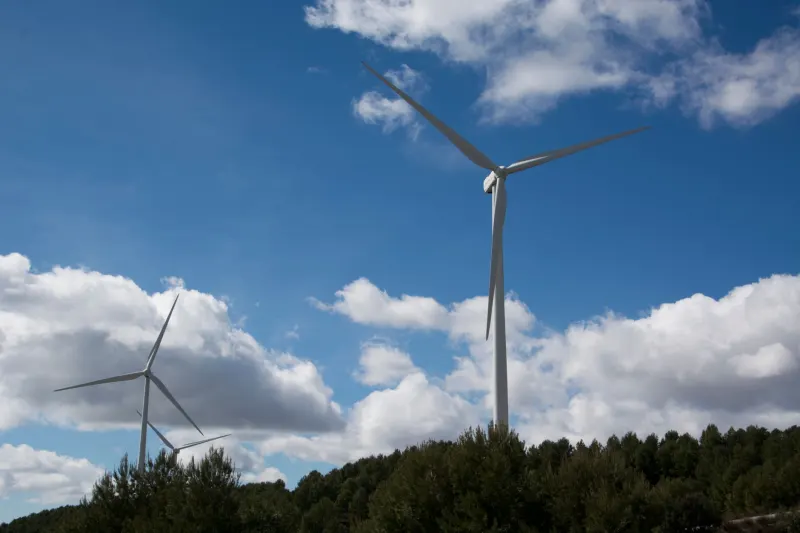
Durability remains a core challenge in wind turbine engineering, as giant blades must withstand harsh environmental elements for decades. However, once these massive structures reach the end of their operational lifespan, that same durability transforms into a major recycling obstacle. Disposing of retired blades in landfills consumes vast amounts of space and squanders potentially useful materials. In a study published in the Cell Press journal Chem Circularity, researchers present a novel approach that could overcome these persistent recycling hurdles by rapidly heating blade waste using brief bursts of energy to extract silicon carbide and graphene.
Led by Hao Bi, an environmental engineer at Tsinghua University in Beijing, the research team sought to upcycle low-value waste into high-value components that can enhance the mechanical and thermal properties of new turbine blades. Compared to existing recycling techniques such as chemical dissolution and heat recovery, this new approach reduces greenhouse gas emissions by 92 percent and 83 percent, respectively. The method transforms fiberglass and carbon-rich polymer resins into highly sought-after industrial compounds through controlled thermal reactions.
Key takeaways
- Researchers used flash Joule heating with brief bursts of high-current electrical pulses to heat pulverized blade waste to 2,000 degrees Celsius in milliseconds.
- The process successfully converted blade waste into a composite of silicon carbide and graphene, which can reinforce new blade resin.
- Adding just 0.3 percent by weight of the extracted composite improved resin resistance to deformation by 27 percent under tension and 9 percent when bent.
- Commercial-scale recycling could potentially turn a profit of about $80 per ton of blade material, contrasting with costly conventional pyrolysis and chemical dissolution methods.
Extracting Graphene and Silicon Carbide Through Flash Heating
Wind turbine blades typically consist of fiberglass containing silica alongside a carbon-rich polymer resin. When exposed to extreme temperatures, carbon reacts with silica to form silicon carbide, an extremely hard and heat-resistant compound. Simultaneously, carbon atoms reorganize into a honeycomb-like lattice known as graphene, which is prized for its exceptional strength and thermal and electrical conductivity.
To extract these materials, the researchers utilized a technique called flash Joule heating. This method applies a high-current electrical pulse to conductive raw materials, raising their temperature to 2,000 degrees Celsius or higher within milliseconds. While flash Joule heating has previously converted plastic and biomass wastes into graphene and nanostructured carbons, the new study proves its efficacy on wind turbine blade waste. By mixing pulverized blade waste with nearly pure elemental carbon, the experiments successfully converted about 56 percent of the mixture into a silicon carbide and graphene composite consisting of 34 percent silicon carbide and 66 percent graphene.
Reinforcing Future Turbine Blades
Integrating the recovered materials back into manufacturing yields immediate structural improvements. Incorporating a minuscule amount of the silicon carbide and graphene composite—just 0.3 percent by weight—into standard resin makes the material stiffer and stronger. Furthermore, at 0.1 percent by weight, the resin experiences a 41 percent increase in thermal diffusivity, which measures how quickly heat disperses throughout the substance. These enhancements mean that retired wind turbine components could directly supply the ingredients required to build stronger, more heat-dispersive blades for future renewable energy generation.
Overcoming Scaling and Commercialization Challenges
Despite the promising laboratory results, scaling the process from experimental batches to commercial operations presents significant hurdles. The research team initially tested tiny batches of the blade waste and carbon mixture, with the largest weighing a mere 10 grams. To address this limitation, Bi and his colleagues have already designed and built a larger reactor capable of processing a 200-gram batch, though it still requires optimization. Ensuring uniform heating and consistent product quality across the larger reactor remains an ongoing challenge. While commercialization is still distant, the economic incentives are clear, as profitable recycling could replace costly traditional waste management fees and foster a truly closed-loop manufacturing cycle.





Comments