
The Ethics of AI: Who Is Responsible When It Goes Wrong?
Artificial intelligence is
making more consequential decisions than ever — about who gets a loan, who gets
bail, whose medical images get flagged. When these systems cause harm, who is
accountable? The ethics of AI is one of the most important and unresolved
questions of our time.
The Problem of Algorithmic Bias
AI systems learn from historical
data — and historical data reflects historical inequalities. AI hiring tools
have been shown to discriminate against women. Facial recognition systems
perform worse on darker skin tones. Predictive policing algorithms disproportionately
target minority communities. When AI systems encode and amplify existing
biases, they can cause systematic harm at scale.
The Black Box Problem
Many of the most powerful AI
systems — particularly deep learning models — are essentially opaque. They
produce outputs without providing human-interpretable explanations of how they
reached their conclusions. When an AI denies your loan application or flags
your medical scan, you may have no way of knowing why.
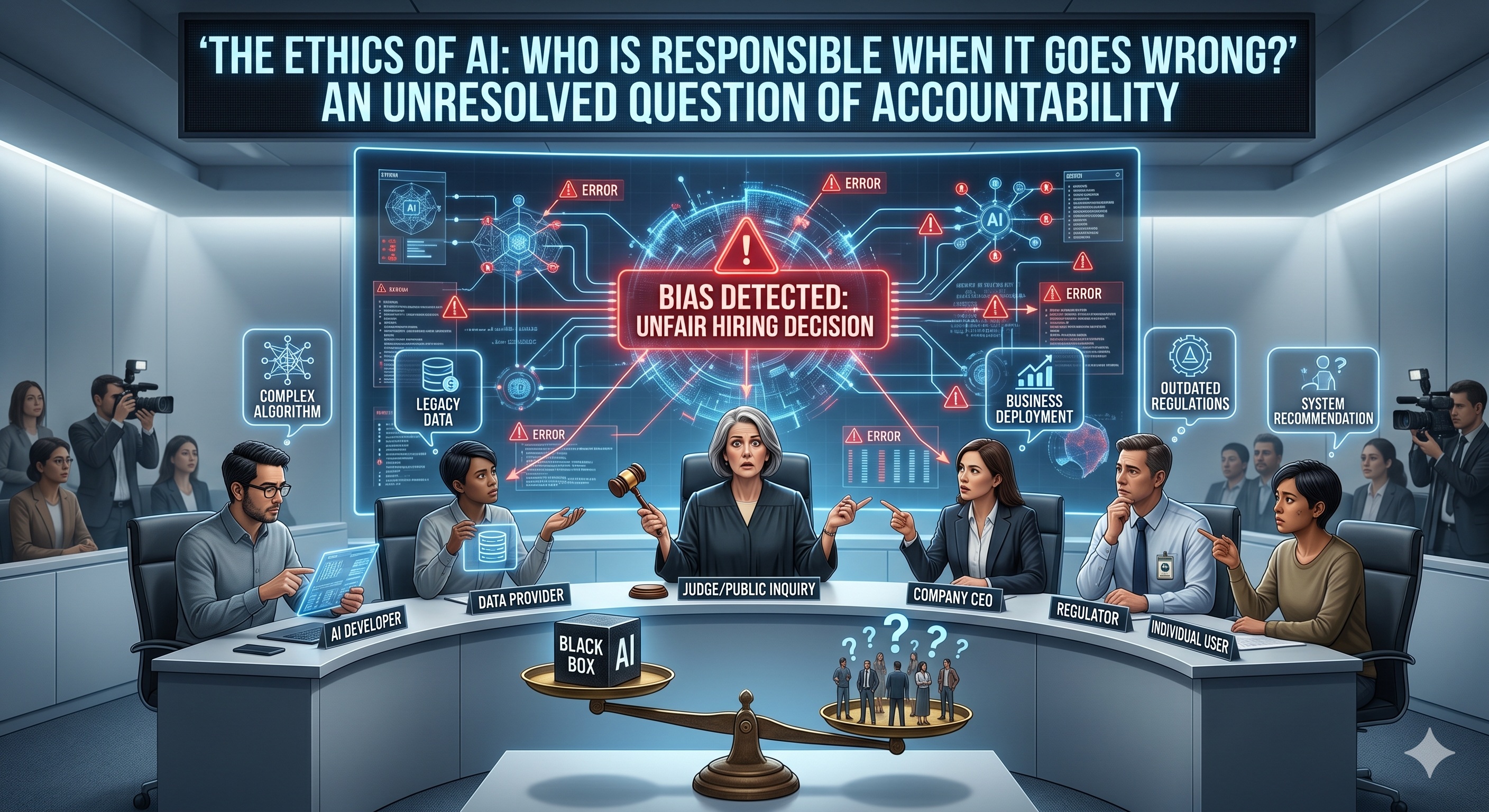
Who Is Responsible?
Responsibility is genuinely
murky. The developer who created the model? The company that deployed it? The
organization that provided the training data? The regulator who approved it?
The individual who acted on its recommendation? Current legal frameworks
weren't designed for AI decision-making and often struggle to assign clear
accountability.
Autonomous Systems and Moral Decisions
As AI systems become more
autonomous — self-driving cars deciding who to swerve toward in an unavoidable
accident, AI weapons systems making targeting decisions — the question of
machine ethics becomes urgent. Who programs the values into these systems? Whose
values?
Regulation and Governance
The EU's AI Act is the world's
most comprehensive AI regulation, categorizing AI systems by risk level and
imposing requirements accordingly. Other jurisdictions are developing their own
frameworks. But regulation struggles to keep pace with technology, and global
coordination remains elusive.
What We Need to Do
We need diverse teams building
AI systems — diversity catches blind spots. We need explainable AI that can
justify its decisions. We need robust testing for bias before deployment. We
need clear legal accountability frameworks. And we need ongoing public
conversation about what values we want AI systems to embody.





Comments