
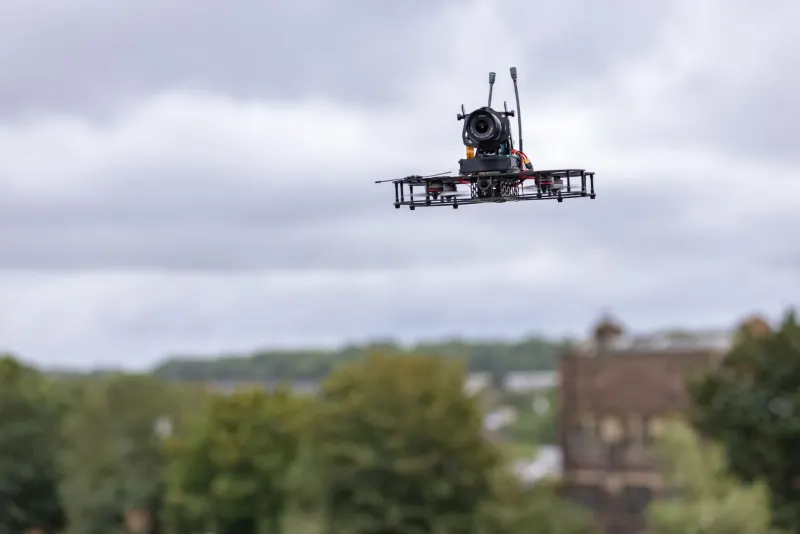
Amazon is expanding its home and business security lineup beyond fixed hardware with the introduction of Ring Robotics. Announced on Tuesday by Ring Founder Jamie Siminoff, the new category launches with two autonomous surveillance devices: the Ring Drone Cam and the Ring Rover Cam. Both units are powered by Ring's custom-built AI Pilot system, which maps indoor environments, suggests patrol points, and navigates around obstacles without manual intervention.
Key takeaways
- The Ring Drone Cam costs $249.99 and is scheduled to begin shipping on January 27, pending FCC approval.
- The Ring Rover Cam is designed for commercial patrols, retailing at $999.99 with a December 16 shipping date.
- Both devices feature encryption systems called TAKE and physical privacy indicators such as sleep modes and LED recording lights.
Inside the Ring Drone Cam and Rover Cam
The Ring Drone Cam is designed for indoor residential use, enabling users to check on rooms without placing fixed cameras in every corner. Users can schedule automated flights along predetermined paths or dispatch the drone on demand to investigate specific areas. It integrates directly with existing Ring cameras, sensors, and alarms to respond automatically when a connected security device triggers. The drone captures 2K video and rotates 360 degrees, though engineering constraints limit its active flight time to between five and eight minutes before it must return to its dock to recharge. It is slated to ship on January 27 for $249.99, subject to pending approval from the Federal Communications Commission.
Conversely, the Ring Rover Cam targets commercial environments as a wheeled patrolling robot. The unit can execute scheduled patrols, investigate specific rooms, and automatically react when another Ring security device detects suspicious activity. Equipped with a periscope camera to peer over counters and shelves, the Rover Cam records up to 4K video and features an integrated siren and flashing lights to deter intruders. Functioning as a security-focused successor to Amazon's earlier Astro robot from 2021, the Rover Cam is expected to begin shipping on December 16 for $999.99.
Privacy features and security encryption
Autonomous mobile surveillance devices introduce notable privacy and security questions for consumers and businesses alike. To mitigate these concerns, Ring implemented physical safeguards, including a power-down state when the drone is docked and a sleep mode on the Rover Cam that retracts its camera and disables the microphone. Both machines incorporate LED indicators to signal active recording.
Furthermore, the devices utilize Ring's encryption architecture known as Throw Away the Key Encryption, or TAKE. This system protects video recordings with unique encryption keys that rotate regularly. Temporary copies of these keys reside in a secure cloud enclave used exclusively to process features like Smart Alerts, Video Search, and Video Descriptions. Ring permanently deletes its cloud copy of the keys after 24 hours, leaving the decryption keys stored solely on authorized customer devices. Ring notes that for users enabling TAKE or end-to-end encryption, the company can only supply non-video metadata such as basic subscriber information in response to valid legal demands such as warrants or subpoenas.





Comments