
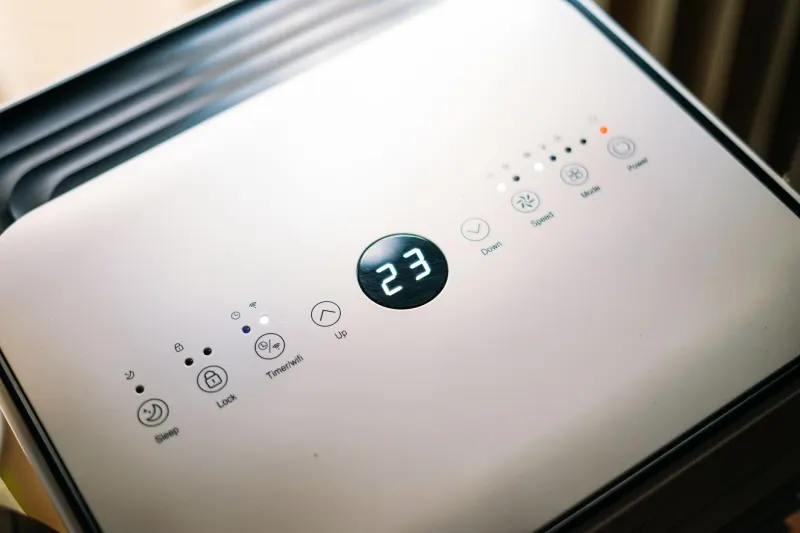
With extreme temperatures and rolling heat waves sweeping the globe, 2027 is shaping up to be the hottest year on record. Air conditioners and electric fans account for approximately 20 percent of electricity used in buildings worldwide, generating 3 to 4 percent of total greenhouse gas emissions. As demand for home and office cooling grows, the total number of active AC units could reach 5.5 billion by 2050, forcing manufacturers to rethink how appliances manage energy.
Key takeaways
- Air conditioning and electric fans currently account for about 20 percent of worldwide building electricity use.
- New appliances from Samsung, Dyson, LG, and Midea utilize radar sensors and AI to track human movement.
- Samsung and Midea claim that their AI and radar tracking features can achieve energy savings of up to 30 percent.
- Experts note that structural changes like compact heat pumps and natural refrigerants are also required for true sustainability.
The Rise of Intelligent, Motion-Tracking Air Conditioners
Major consumer electronics companies have introduced targeted, intelligent air conditioning systems throughout the year, ranging from Samsung's Bespoke AI lineup to Dyson's Find+Follow feature for its Purifier Cool fan. LG's latest DualCool AI AC features a 5-meter radar sensor for human detection that targets airflow based on everyday movement patterns. Similarly, Hisense's Companion Living AC pulls data from smart home sensors to identify and precool target paths within a home according to established user routines.
Dyson takes a different visual approach with its Find+Follow purifier and fan, utilizing a low-resolution camera to feed anonymous 17-point person detection coordinates into an on-device algorithm. The unit can oscillate 350 degrees between up to six people in a space while completely deleting data to preserve privacy. One hour after detecting that a room is empty, the device switches to an automatic mode with a considerably lower power draw.
Hardware Specifications and Energy Claim Validation
Samsung’s Bespoke AI WindFree Pro incorporates a motion radar sensor capable of recognizing and tracking two occupants simultaneously. Its AI Direct Wind feature follows users for immediate cooling, while AI Indirect Wind cools the space without blowing air directly onto a person. Samsung residential environment tests claim energy savings of up to 30 percent when the overall AI energy mode is active. Furthermore, integration with wearables like a Galaxy Watch or Galaxy Ring allows the system to detect when a user has fallen asleep and automatically trigger a gentler cooling mode overnight.
Midea’s VitaBreeze AC combines user-uploaded room photos with millimeter-wave radar sensors to build a 3D virtual grid of room and furniture positions. Millimeter-wave radar bounces short-wavelength radio waves between 1 and 10 millimeters to detect distance, angles, and micro-movements in real time. Manuel Seethaler, head of Midea's Residential Air Conditioning product strategy in Europe, states that this tracking technology can save more than 30 percent of energy in cooling mode compared to traditional units lacking these algorithms.
Broader Efficiency Challenges Beyond Smart Sensors
Despite impressive software capabilities, experts emphasize that target-based sensing provides only marginal gains in the grand scheme of global power consumption. Vincent Romanin, founder and CTO of San Francisco-based Gradient, notes that while performance improvements are possible when targeted AC is executed correctly, overarching efficiency requires deeper structural shifts. Gradient produces 120-volt all-weather window AC and heat pump units that use one-third less energy than standard window air conditioners.
According to Björn Palm, senior professor in energy technology at the KTH Royal Institute of Technology in Stockholm, achieving sustainable home cooling by 2050 requires three fundamental changes: affordable, compact heat pumps for all home sizes; the elimination of toxic synthetic refrigerants; and newly designed low-charge systems that guarantee safety. Leaking synthetic refrigerants account for roughly 720 million metric tons of CO2-equivalent emissions annually, making the adoption of natural alternatives like propane an essential, albeit engineering-heavy, priority for the industry.





Comments