
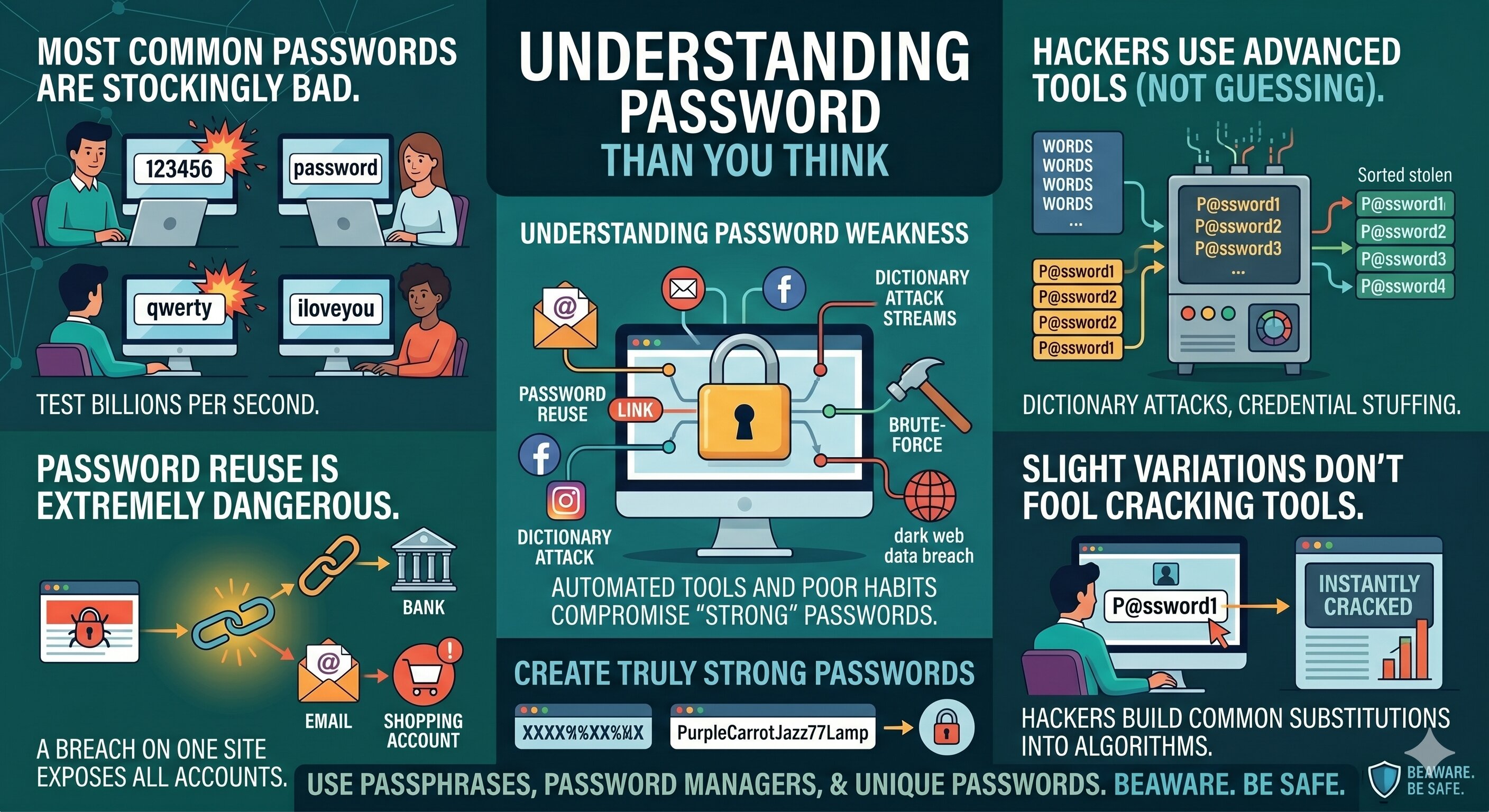
Why Your Password Is Weaker Than You Think
You might believe your password
is clever and secure. But billions of stolen credentials are traded on the dark
web every year — and many of them seemed 'strong' to their owners. Here's why
your password probably isn't protecting you as well as you think.
The Most Common Passwords Are Still Shockingly Bad
Year after year, lists of the
most common passwords include entries like '123456', 'password', 'qwerty', and
'iloveyou'. These can be cracked in under a second. But even people who
consider themselves security-conscious often underestimate how vulnerable their
passwords are.
Hackers Don't Just Guess — They Use Tools
Modern attackers use automated
tools that can test billions of password combinations per second. Dictionary
attacks, brute-force attacks, and credential stuffing (using passwords leaked
from other breaches) make short work of passwords that seem clever to humans.
Password Reuse Is Extremely Dangerous
If you use the same password
across multiple sites, a breach on one site gives hackers access to all of
them. This is one of the most common ways accounts get taken over — not through
sophisticated hacking, but through simple reuse.
Slight Variations Don't Help Much
Changing 'password' to
'P@ssword1' won't fool modern cracking tools. Hackers know about these common
substitutions and build them into their algorithms.
What Makes a Strong Password?
A truly strong password is long
(at least 16 characters), random, and unique to each account. A passphrase — a
string of random words like 'PurpleCarrotJazz77Lamp' — is both memorable and
strong.
Better yet, use a password
manager to generate and store unique, complex passwords for every site.
The Bottom Line
Your password is your first line
of defense. Make it count. In the next blog, we'll show you exactly how to
create passwords that are genuinely difficult to crack.





Comments