
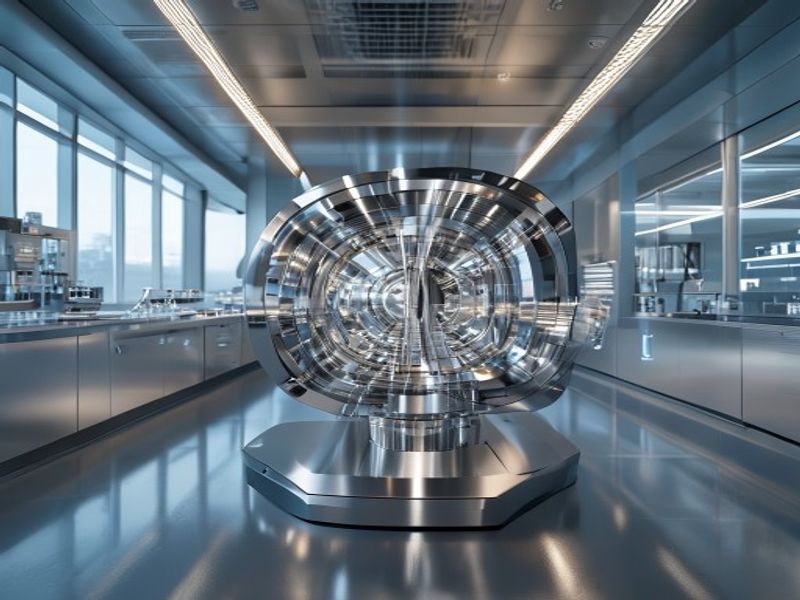
Thea Energy, a promising startup actively developing advanced fusion power technology, has secured a substantial $20 million federal award from the U.S. Department of Energy's Advanced Research Projects Agency-Energy (ARPA-E). This critical funding is specifically earmarked to accelerate the production and refine the design of the company's proprietary high-temperature superconducting (HTS) magnets, a core component in its innovative approach to commercial fusion reactors.
The Palo Alto-based company is pioneering a novel "stellarator" concept, a type of fusion device that uses complex magnetic fields to confine superheated plasma, where fusion reactions occur. Unlike the more common tokamak design, which relies on a powerful central magnet and often operates in pulsed modes, stellarators aim for continuous operation and intrinsic stability. Thea Energy's unique contribution lies in its development of a modular, planar magnet system, which promises a more compact and potentially cost-effective path to achieving net energy gain. Scaling the manufacturing capabilities for these advanced HTS magnets is paramount to moving from laboratory prototypes to a viable power plant.
ARPA-E, known for funding high-risk, high-reward energy technologies, has clearly identified Thea Energy's work as a potential breakthrough. The grant, part of ARPA-E's broader initiative to support transformational energy solutions, provides a significant financial injection that will enable Thea Energy to expand its engineering teams, invest in specialized manufacturing equipment, and advance its testing infrastructure. This federal backing not only validates the technical merit of Thea Energy's approach but also signals a broader commitment from the U.S. government to diversify its portfolio of fusion research and development.
The global race for commercial fusion power is intensifying, with both private ventures and national labs pushing the boundaries of plasma physics and engineering. Successful deployment of fusion energy promises a nearly limitless, carbon-free power source, free from the long-lived radioactive waste associated with nuclear fission. Thea Energy's focus on simplifying stellarator magnet construction, traditionally a major engineering hurdle, could significantly reduce the complexity and cost of future fusion reactors. While challenges remain substantial—including achieving sustained high-performance plasma confinement and proving long-term magnet durability under reactor conditions—this $20 million grant provides a crucial boost, moving the company closer to demonstrating a scalable and economically viable path to fusion energy.





Comments