
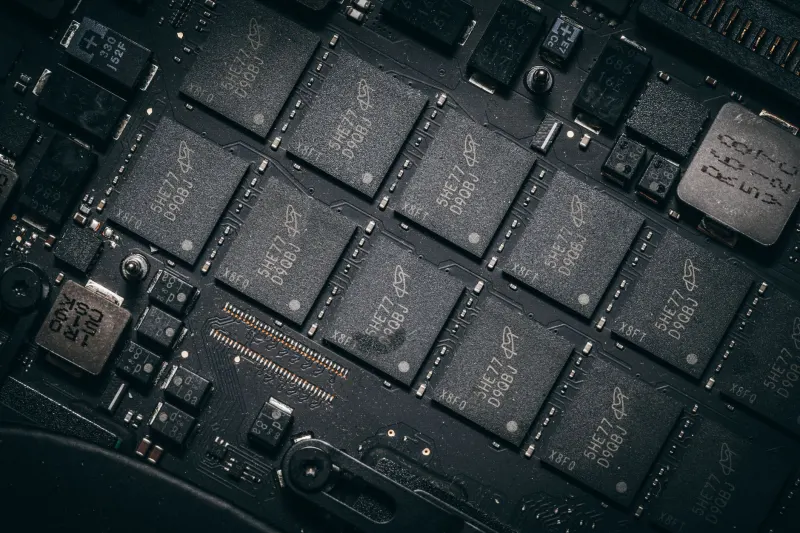
Massive buildouts of artificial intelligence data centers are continuing to strain global memory supplies, forcing GPU makers to pivot resources away from consumer hardware and leaving everyday buyers facing historic price hikes. This phenomenon, known colloquially as chipflation, has seen component price increases vastly outpace broader economy-wide inflation levels. According to a report published by JP Morgan, dynamic random access memory, or DRAM, prices will have risen by 400 percent between 2024 and the end of 2026. Tom's Hardware chips tracker illustrates this escalation clearly, noting that Nvidia's powerful consumer GPU, the GeForce RTX 5090, retails for $4,920 above the $1,999 suggested retail price it held when it launched in January 2025.
Key takeaways
- DRAM prices are projected to rise 400 percent from 2024 to the end of 2026.
- AI data centers are projected to consume roughly 70 percent of global DRAM supplies this year.
- Three companies account for about 90 percent of global DRAM production: Micron, Samsung, and SK Hynix.
- Industry executives warn that supply constraints and high demand could persist until at least 2030.
The root of the shortage and memory market dynamics
At its core, the ongoing GPU shortage is fundamentally a memory problem driven by the rapid expansion of AI infrastructure. While the tech industry was already navigating a transition from DDR4 to DDR5 memory formats, the massive appetite for high-bandwidth memory, or HBM, severely worsened the crunch. AI developers require HBM chips to train and run complex machine learning models, creating a demand that far outstrips current market capacities. HBM competes directly for the same wafer capacity as traditional DRAM products. Because suppliers can sell advanced HBM chips for roughly 30 percent more than standard DRAM, profit-driven manufacturers have consistently reoriented their production lines toward the lucrative data center sector. Furthermore, suppliers are actively transitioning to newer generations of memory, such as HBM4 and HBM4E, which introduces additional production bottlenecks. A Samsung executive told Reuters in September that HBM could account for nearly 30 percent of total DRAM production in 2027, up from 20 percent the prior year, with projections suggesting it could hit nearly 40 percent by 2029.
This concentration of manufacturing power further exacerbates the crisis. Today, three dominant players account for roughly 90 percent of global DRAM production: Micron Technology, Samsung Electronics, and SK Hynix. Despite making major expansions to their overall production capacity, all three companies continue to pivot toward data centers at the direct expense of consumer GPUs. Micron, for example, completely ceased direct-to-consumer sales last year to prioritize AI-related production lines. The resulting component shortages have also impacted foreign markets severely. In Japan, gaming GPUs have climbed roughly 41 percent higher than their American counterparts, while reports from JP Morgan and The Economist highlight concurrent price spikes for software accessories, video game consoles, and laptops.
Industry outlook and long-term projections
Top executives across the semiconductor sector paint a grim picture for near-term relief, with several warning that supply constraints could extend deep into the decade. Micron CEO Sanjay Mehrotra stated during an earnings call that supplies will remain much tighter throughout calendar years 2027 and 2028 compared to 2026. SK Hynix CEO Kwak Noh-jung echoed those sentiments in a July interview with Reuters, forecasting that next year will stand as the worst in the industry's history from a supply perspective. Meanwhile, SK Hynix chairman Chey Tae-won noted at an Nvidia event that building adequate wafer supply will take at least four to five years, leaving production lagging 20 percent behind market demand until at least 2030. Major manufacturers have already locked in massive advance sales. Micron has reportedly sold 75 percent of its 2027 HBM output at prices much higher than 2026 rates, while Samsung has sold nearly 80 percent of its 2027 memory output, with about 70 percent tied up in strict five-year contracts.
Despite the prevailing pessimism, a few dissenting voices point to potential market shifts. Acer CEO Jason Chen suggested to DigiTimes that prices could plateau next year due to a potential influx of inexpensive Chinese alternatives. Other market observers have questioned whether the AI industry can sustain enough growth to justify the massive manufacturing buildouts, with some analysts warning that a flood of new supply by 2029 could transform the market. However, industry leaders like Nvidia head Jensen Huang remain unfazed, noting that demand for memory is virtually limitless because systems can always utilize more of it.







Comments