
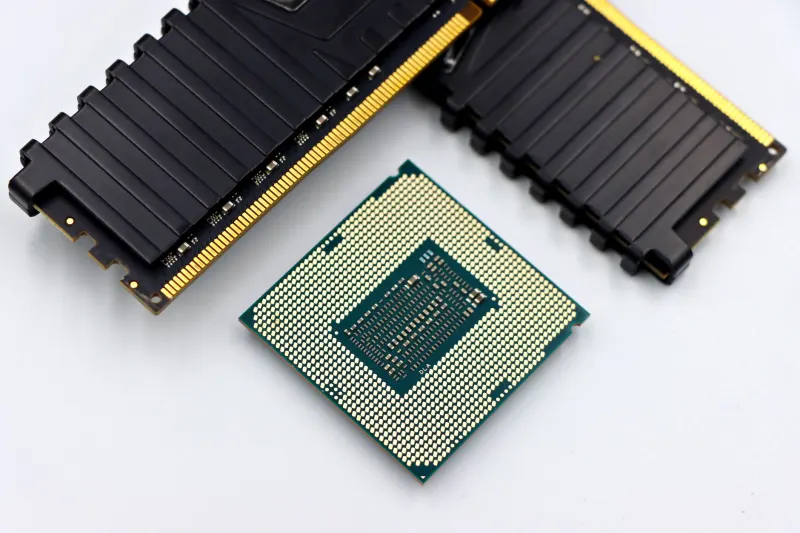
When PC gamers discuss processors, AMD typically takes the crown thanks to its popular X3D chips. Desktop CPU shipments analyzed by Mercury Research in the second quarter of 2026 reveal that AMD captured 34.9 percent of the desktop market, meaning Intel still secured roughly two out of every three desktop processors shipped during that timeframe. In the laptop space, Intel maintains an even larger lead. Choosing between these competing architectures depends directly on individual workloads, budget constraints, and long-term upgrade preferences.
Key takeaways
- AMD commands 34.9 percent of desktop CPU shipments as of mid-2026.
- AMD's Ryzen 7 7800X3D provides strong gaming value around $300 to $350.
- Intel dominates the laptop segment, shipping about seven out of ten notebook processors.
- AMD has extended its AM5 motherboard platform support through 2029.
Architectural Differences: Zen 5 Versus Arrow Lake
AMD and Intel approach processor design through distinct engineering choices that directly impact benchmark results. AMD's Ryzen 9000 series utilizes the Zen 5 architecture built with chiplets, packing smaller pieces of silicon into a single processor. The higher-end models like the Ryzen 9 9950X house two compute dies alongside an I/O die. AMD integrates massive amounts of L3 cache via its 3D V-Cache technology, stacking a 64MB cache die below the cores on X3D variants for a total of 96MB of L3 cache. This massive cache pool significantly accelerates gaming performance by reducing reliance on slower system RAM.
Conversely, Intel's Arrow Lake chips, sold under the Core Ultra 200S series and refreshed as the 200S Plus, rely on modular tiles mounted on a shared base. Intel combines performance cores for demanding single tasks with efficiency cores designed for background and parallel workloads. For instance, the Core Ultra 7 270K Plus features 8 performance cores and 16 efficiency cores for a total of 24 threads, but offers a smaller 36MB L3 cache. While AMD prioritizes ultra-fast cache memory that games demand, Intel focuses on higher core counts suited for video exports, code compilation, and heavy multitasking.
Desktop Pricing Tiers and Performance Realities
In the entry-level tier around $200, Intel's $199 Core Ultra 5 250K Plus delivers exceptional multi-core performance in productivity benchmarks compared to AMD's Ryzen 5 9600X. Moving into the midrange around $300, the Intel Core Ultra 7 270K Plus competes closely with much more expensive older silicon in rendering tasks. However, gamers shopping in this bracket often prefer the Ryzen 7 7800X3D, which typically sells between $300 and $350 and outperforms newer mid-range Intel options in frame rates while using substantially less power.
At the high-end tier ranging from $450 to $700, AMD's $479 Ryzen 7 9800X3D and $499 Ryzen 7 9850X3D dominate gaming benchmarks. The $699 Ryzen 9 9950X3D blends elite gaming capability with 16 cores for heavy creative work, whereas Intel's flagship $589 Core Ultra 9 285K is best reserved for users who rarely play games. Furthermore, hardware testers note that spending top dollar on a flagship chip often yields diminishing returns, as older options like the 7800X3D match high-end gaming performance at a fraction of the cost.
Laptop Dominance and Platform Lifespan
Intel continues to dominate the mobile landscape, securing roughly 70 percent of laptop processor shipments. Budget notebooks leverage Intel's Core Series 3 chips, while higher-end portable machines employ Core Ultra Series 3 processors, codenamed Panther Lake, which leverage Intel's 18A manufacturing process to deliver extended battery life. Apple's migration to custom silicon means modern Macs no longer feature Intel hardware, leaving Intel chips to run on older hardware supported through macOS Tahoe updates until September 2028.
Beyond raw performance metrics, AMD offers a distinct platform advantage through its commitment to the AM5 motherboard socket. By promising support for the AM5 platform through 2029, AMD ensures that users investing in a budget Ryzen build today can upgrade to faster processors years down the line without replacing the entire motherboard.






Comments