
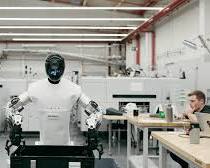
The past decade in robotics was defined by narrow automation: a robotic arm in a car factory that could perform one task millions of times with perfect precision, but could not adapt if a part was slightly out of place. We are now entering the era of "Physical AI," where the same breakthrough in foundation models that brought us Large Language Models is being applied to the physical world. Instead of hard-coding every movement, we are teaching robots to understand and interact with an unpredictable, unstructured environment.
Foundation Models for Robotics
Just as a LLM predicts the next word in a sentence, a "General-Purpose Robot Model" predicts the next physical action required to complete a task.
- Multimodal Learning: Robots are being trained on massive datasets that combine video, tactile sensor data, and language commands. This allows a robot to "see" a messy kitchen, "understand" the command "clear the table," and use its own learned physics engine to determine how to grasp different objects—like a fragile glass vs. a heavy plate—without needing explicit instructions for each one.
- Sim-to-Real Transfer: Training a robot in the real world is slow and dangerous. Instead, engineers use hyper-realistic physics simulators. They train the robot in this virtual sandbox for millions of hours, then use "Sim-to-Real" algorithms to transfer that learned muscle memory to the physical robot, allowing it to navigate real-world environments almost instantly.
The Humanoid Form Factor
While industrial arms are efficient, the world was built for humans. This is why the industry is betting on human-like robotic morphologies.
- Universal Tool Usage: A humanoid robot is designed to interface with the existing world—it can use the same doorknobs, staircases, and specialized tools (like power drills) that humans use. This makes them highly versatile for logistics, manufacturing, and eventually, domestic assistance.
- Safety and Collaborative AI (Cobots): The new generation of robots is equipped with "soft" sensors and reactive AI that can detect human presence. If a robot senses a human walking into its path, it stops or adjusts its trajectory in milliseconds, moving away from dangerous cages to work side-by-side with humans in open environments.
The Outlook
We are moving from a world of "machines" to a world of "agents." As Physical AI becomes cheaper and more capable, the robot will move from the factory floor into hospitals, construction sites, and homes, handling the physical tasks that are currently "too dull, too dirty, or too dangerous" for humans.





Comments