
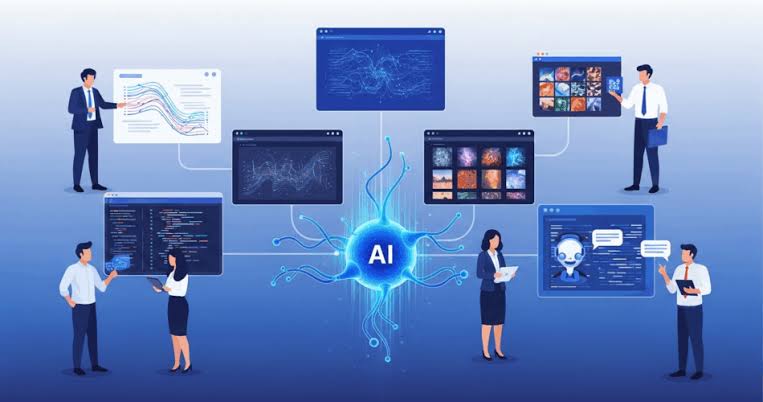
Generative Artificial Intelligence is rapidly transforming the business landscape by enabling organizations to automate complex tasks, accelerate innovation, and improve decision-making. As AI technologies continue to mature, businesses across industries are integrating generative AI into their operations to enhance efficiency, reduce costs, and deliver more personalized customer experiences.
Unlike traditional AI systems that primarily analyze existing data, generative AI can create original content, generate insights, produce code, summarize information, and assist with problem-solving. These capabilities are opening new opportunities for organizations seeking to modernize workflows and improve operational performance.
One of the most significant advantages of generative AI is increased productivity. Employees can automate repetitive tasks such as document creation, report generation, meeting summaries, and email drafting. By reducing time spent on routine work, organizations allow teams to focus on strategic initiatives and higher-value activities.
Customer service is experiencing major improvements through AI-powered virtual assistants and intelligent chatbots. Generative AI enables businesses to provide faster responses, personalized recommendations, and 24/7 customer support while handling large volumes of inquiries efficiently. Human support teams can then concentrate on resolving more complex customer issues.
Marketing departments are increasingly leveraging generative AI to accelerate content creation. AI tools can assist with generating blog articles, product descriptions, advertising copy, social media posts, email campaigns, and creative concepts. These capabilities help businesses maintain consistent communication while improving campaign efficiency.
Software development teams are benefiting from AI-assisted coding platforms that help generate code, identify programming errors, recommend optimizations, and automate documentation. Developers can complete projects more quickly while improving software quality and reducing development time.
Business analytics is becoming more intelligent with generative AI. Organizations can quickly summarize large datasets, identify trends, generate reports, and uncover actionable insights. AI-powered analytics supports faster decision-making and helps leaders respond more effectively to changing market conditions.
Knowledge management is another area experiencing significant transformation. Employees can use AI to search internal documentation, summarize policies, retrieve information, and answer organizational questions through conversational interfaces. This improves knowledge accessibility and enhances workplace productivity.
Human resources departments are exploring generative AI for recruitment, onboarding, training, and employee engagement. AI can assist with drafting job descriptions, screening applications, creating learning materials, and supporting internal communications while helping HR teams operate more efficiently.
Financial organizations are using generative AI to automate document processing, assist with regulatory reporting, analyze financial data, and support risk assessment. Intelligent automation improves accuracy while reducing manual workloads across finance operations.
Healthcare providers are adopting generative AI to assist with clinical documentation, medical research, administrative workflows, and patient communication. While healthcare decisions remain under professional supervision, AI can help reduce administrative burdens and improve operational efficiency.
Manufacturing companies are integrating generative AI into product design, maintenance planning, supply chain management, and quality assurance. AI-generated insights help organizations optimize production processes while supporting continuous innovation.
Cybersecurity teams are utilizing generative AI to improve threat detection, automate incident analysis, generate security reports, and assist with vulnerability assessments. Intelligent systems help organizations strengthen digital security while responding more rapidly to emerging risks.
Education and corporate learning programs are also benefiting from AI-generated educational content, personalized training experiences, and interactive learning materials. Businesses can deliver more effective employee development while adapting training to individual learning needs.
Responsible AI governance remains an important consideration as organizations expand generative AI adoption. Companies are implementing policies focused on transparency, data privacy, human oversight, security, and ethical AI use to ensure responsible deployment across business operations.
Cloud computing platforms are accelerating enterprise AI adoption by providing scalable infrastructure, integrated AI services, and secure deployment environments. Organizations can implement generative AI solutions without investing heavily in specialized hardware.
Industry experts expect generative AI to become a foundational technology across virtually every business sector. Future advancements in multimodal AI, autonomous agents, reasoning capabilities, and enterprise integration are likely to create even more opportunities for innovation and competitive advantage.
As businesses continue embracing digital transformation, generative AI is emerging as a powerful catalyst for productivity, creativity, and operational excellence. By combining intelligent automation with human expertise, organizations are unlocking new possibilities that will shape the future of work, customer engagement, and business innovation.





Comments