
Understanding Artificial Intelligence
Artificial intelligence (AI) has moved from science fiction into our daily lives, often operating behind the scenes. Let's delve deeper into what it is and how these systems actually function.
Defining Artificial Intelligence: Simulating Cognition
At its core, AI is the science and engineering of creating intelligent machines that can simulate human cognitive abilities. Unlike traditional computer programs that follow rigid "if-this-then-that" rules, AI systems are designed to learn, reason, problem-solve, and adapt based on data. They process information in ways that allow them to:
- Learn: Improve performance over time through experience, without explicit reprogramming.
- Reason: Connect different pieces of information to draw conclusions or make inferences.
- Recognize: Identify complex patterns within large, varied datasets.
- Understand: Comprehend human language (both spoken and written).
- Perceive: "See" and interpret visual data from images and videos.
Machine Learning: The Core Methodology
The real engine powering modern AI isn't a collection of handcrafted rules; it's machine learning (ML). ML is a method of teaching computers to make predictions or decisions based on historical data.
Consider the task of identifying a "spam" email. In a traditional approach, engineers would write thousands of rules defining spam: "contains 'VIAGRA'," "misspelled words," "suspicious sender." Machine learning reverses this. You show the computer thousands of emails that are spam and thousands that aren't. The ML algorithm analyzes these examples, automatically identifying millions of hidden patterns, correlations, and keywords associated with spam. It builds a mathematical model based on this "training." When a new email arrives, the system uses that model to calculate the probability it's spam. Over time, as it processes more emails, it updates its model and becomes more accurate.
Deep Learning and Neural Networks: Inspired by the Brain
Within machine learning, there’s an advanced subset called deep learning. Deep learning models are structurally inspired by the human brain, which processes information through complex, layered neural networks.
In a deep learning system, data passes through many "layers" of artificial neurons.
- Input Layer: Receives the raw data (e.g., individual pixels of an image).
- Hidden Layers: The magic happens here. Each layer extracts and processes increasingly complex features.
- The first layers might detect simple edges and gradients in a picture.
- Middle layers might combine those edges into shapes like eyes, noses, or ears.
- Final deep layers integrate those shapes to recognize a complete face or object.
- Output Layer: Presents the final result (e.g., "This image contains a dog," with high confidence).
Deep learning is remarkably effective at complex, high-dimensional tasks like image and speech recognition, natural language translation, and strategic games, which are incredibly difficult for traditional ML.
Narrow AI vs. General AI: Specialization vs. Versatility
It's vital to understand the difference between the AI that exists today and the futuristic AI often seen in movies.
- Narrow AI (Weak AI): All AI currently in operation is Narrow AI. These systems are designed and trained to perform one specific task extremely well—often better than a human. A facial recognition system, a grammar checker, the AI that plays Go, and a medical diagnostic algorithm are all powerful but deeply specialized Narrow AIs. They cannot adapt their knowledge; a chess AI cannot write a summary of a text.
- General AI (Strong AI): This is a theoretical concept. General AI would be a system with human-like intelligence across all domains. It would possess the ability to learn, reason, understand, and apply knowledge adaptively in diverse, unfamiliar contexts, just as a person does. It could learn to play chess, then learn to drive a car, then write poetry. Achieving General AI is an enormously complex challenge and remains a subject of intense research, debate, and long-term ambition.
How AI Actually Learns: The Training Process
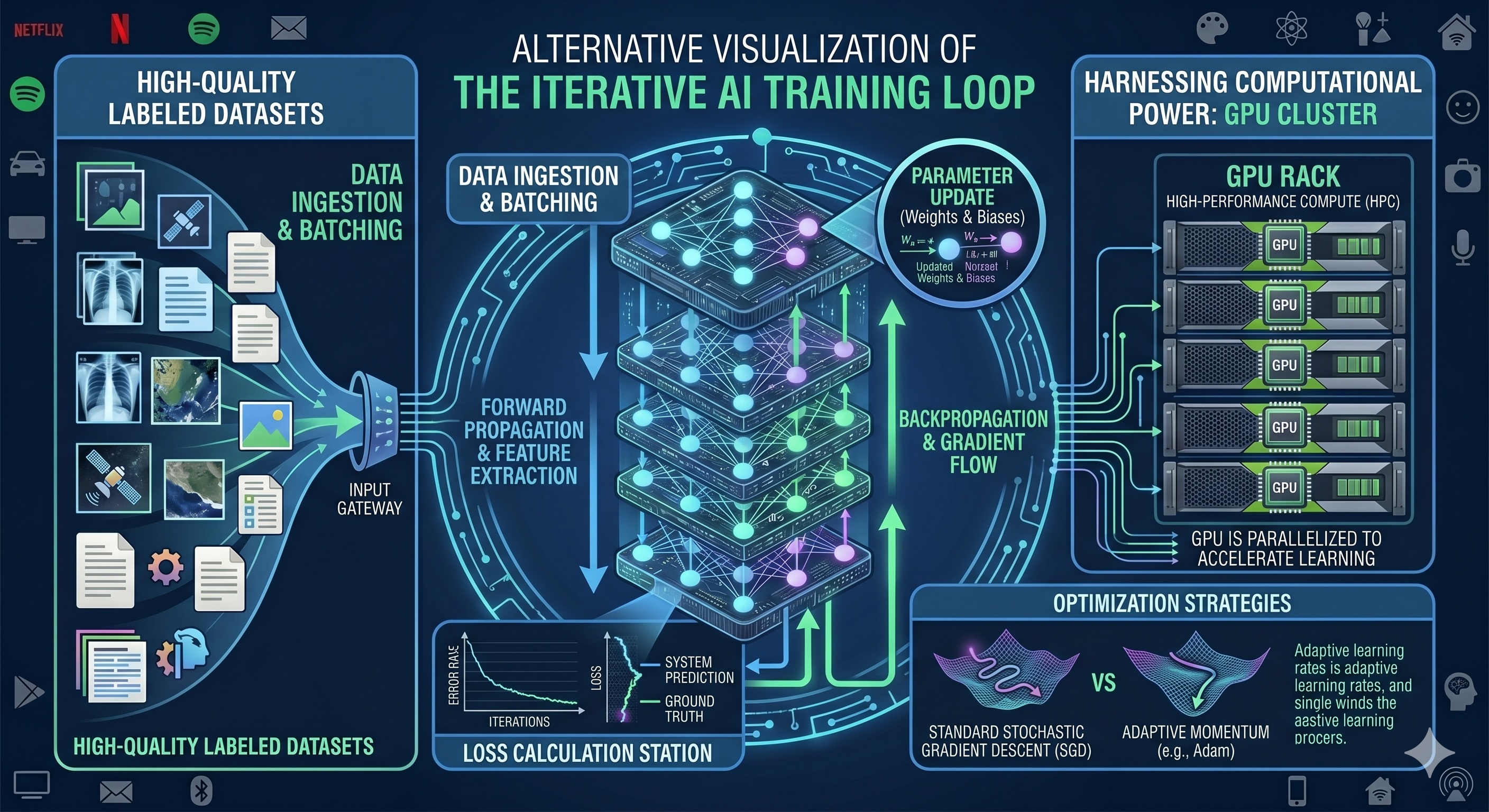
AI systems don't just "wake up" smart; they have to go through a computationally intensive training process. This involves three key stages:
- Gathering Data: Large amounts of diverse, high-quality, and (ideally) accurately labeled data are collected. The quality of this data directly impacts the resulting AI model.
- Feeding the Algorithm: This data is fed into a learning algorithm. The AI makes an initial prediction, compares it to the "ground truth" (the labeled answer), and calculates the "loss" or "error"—how wrong its prediction was.
- Adjusting Parameters: Using a process called optimization (like backpropagation in neural networks), the system works backward from the error, minutely adjusting millions of internal parameters and connections to reduce the loss. This entire process repeats millions of times, constantly "fine-tuning" its model until its predictions are accurate. This requires immense processing power, often provided by massive clusters of powerful Graphics Processing Units (GPUs).
Why It Matters: Reshaping Our World
Understanding the fundamentals of AI is no longer a niche technical skill. These systems are embedded in critical infrastructure and influence:
- Content and Information: Shaping the social media feeds, news, products, and movies we see.
- Opportunity and Access: Powering systems that filter resumes, evaluate loan applications, and affect who gets interviews or approvals.
- Healthcare: Advancing the detection of diseases in medical images, assisting in drug discovery, and predicting patient outcomes.
- Security and Ethics: Influencing everything from law enforcement tools to the creation of deeply convincing but false media (deepfakes).
By understanding how AI systems learn from data and where their capabilities (and limitations) lie, you are better equipped to critically evaluate the technology, spot potential biases, and navigate an increasingly algorithmic world.
Visualization of Key Concepts
Here are three images that visually illustrate the ideas discussed above.
Image 1: The Machine Learning Process
This image visualizes how raw data is transformed into intelligent output through a machine-learning algorithm. It shows the fundamental workflow: data goes in, learning happens, and a useful prediction or decision comes out.
Image 2: The Structure of a Deep Neural Network
This visualization illustrates a complex deep-learning neural network. Countless nodes (neurons) glow, connected by intricate, pulsing tendrils of light (synapses). It visually conveys the idea of information processing in deeply interconnected layers, mimicking the human brain's structure.
Image 3: AI Applications and Impact Across a Smart City
This photo shows AI in action. It is a futuristic cityscape where distinct, labeled bubbles highlight the real-world applications of AI, from facial recognition on a smartphone to autonomous navigation for a drone and advanced medical image analysis in a hospital. This demonstrates the varied ways these systems are reshaping diverse aspects of our world.





Comments