
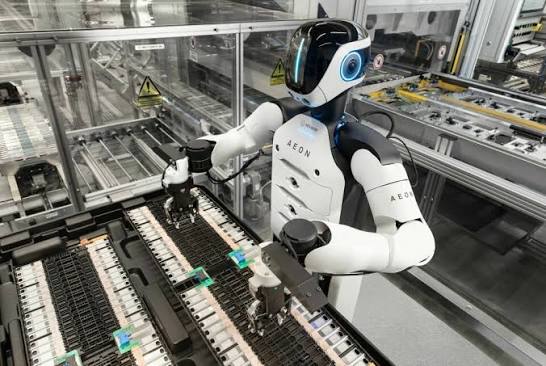
Artificial intelligence (AI) and advanced robotics are redefining the manufacturing industry by enabling smarter automation, improving operational efficiency, and supporting more flexible production environments. As manufacturers embrace digital transformation, AI-powered robotic systems are helping factories optimize workflows, improve product quality, reduce downtime, and respond more effectively to changing market demands.
Modern manufacturing increasingly relies on intelligent robots that can perform repetitive, precision-based, and physically demanding tasks while working alongside human operators. Unlike traditional industrial robots programmed for fixed operations, AI-enabled robots can analyze sensor data, recognize patterns, adapt to changing production conditions, and make informed decisions that improve overall manufacturing performance.
One of the most significant applications of AI robotics is automated assembly. Intelligent robotic systems can perform high-precision assembly tasks with consistent accuracy, helping manufacturers increase production speed while minimizing errors. These systems are particularly valuable in industries such as automotive, electronics, aerospace, and consumer goods manufacturing.
Quality control has also evolved through AI-powered computer vision. Advanced cameras and machine learning models inspect products in real time, identifying defects, dimensional variations, surface imperfections, and assembly issues with greater consistency than manual inspection alone. Early detection of quality issues helps reduce waste and improve customer satisfaction.
Predictive maintenance is another major advantage of AI robotics. By continuously monitoring equipment performance through connected sensors, AI systems can identify early signs of wear or operational anomalies. Maintenance teams receive timely insights that help prevent unexpected downtime, extend equipment life, and reduce maintenance costs.
Collaborative robots, commonly known as cobots, are becoming an integral part of modern manufacturing facilities. Designed to work safely alongside people, cobots assist with tasks such as material handling, packaging, machine tending, and repetitive assembly. Their flexibility allows manufacturers to adapt production lines quickly while supporting human workers rather than replacing them.
Machine learning is helping manufacturers optimize production planning by analyzing operational data, forecasting demand, balancing workloads, and identifying process improvements. AI-driven insights enable organizations to increase efficiency while making better use of labor, equipment, and raw materials.
Digital twins are also gaining importance in smart manufacturing. By creating virtual models of production lines, equipment, and factory operations, manufacturers can simulate processes, evaluate performance, and test improvements before implementing changes in physical environments. AI enhances these simulations by providing predictive analytics and optimization recommendations.
Cloud computing provides the scalable infrastructure needed to manage modern manufacturing operations. Cloud-connected AI platforms collect and analyze production data from multiple facilities, enabling centralized monitoring, remote diagnostics, software updates, and continuous process optimization across global manufacturing networks.
Edge AI is improving factory responsiveness by enabling robotic systems to process data locally. Real-time decision-making reduces latency and allows robots to respond immediately to changes on the production floor, making them well suited for environments where speed and reliability are critical.
Supply chain operations are benefiting from AI robotics through automated warehouse systems, inventory management, demand forecasting, and intelligent logistics. Autonomous mobile robots transport materials efficiently within manufacturing facilities, improving productivity while reducing manual handling requirements.
Sustainability is becoming an increasingly important objective for manufacturers. AI-powered robotics help optimize energy consumption, reduce material waste, improve resource utilization, and support environmentally responsible production practices. These improvements contribute to both operational efficiency and broader sustainability goals.
Cybersecurity and responsible AI remain key priorities as manufacturing systems become more connected. Organizations are investing in secure industrial networks, AI governance, system monitoring, and human oversight to protect critical infrastructure and ensure reliable operation of intelligent robotic systems.
Workforce development is evolving alongside automation. Manufacturers, universities, and technical institutions are expanding training programs in robotics, AI, industrial automation, and data analytics to prepare workers for advanced manufacturing environments where people and intelligent machines collaborate.
Collaboration between manufacturers, technology companies, robotics developers, and research institutions continues to accelerate innovation. Advances in computer vision, AI reasoning, autonomous robotics, and industrial software are expanding the capabilities of manufacturing automation while making intelligent systems more accessible to organizations of all sizes.
Industry experts expect AI robotics to play an even greater role in the future of manufacturing as technologies continue to mature. Improvements in adaptive learning, autonomous decision-making, collaborative robotics, and real-time analytics are expected to enhance factory productivity, improve product quality, and increase operational resilience across global industries.
As manufacturing enters a new era of intelligent automation, AI-powered robotics are becoming a cornerstone of industrial innovation. By combining advanced artificial intelligence with flexible robotic systems, manufacturers can create smarter factories, improve efficiency, strengthen competitiveness, and build more sustainable production environments for the future.





Comments