
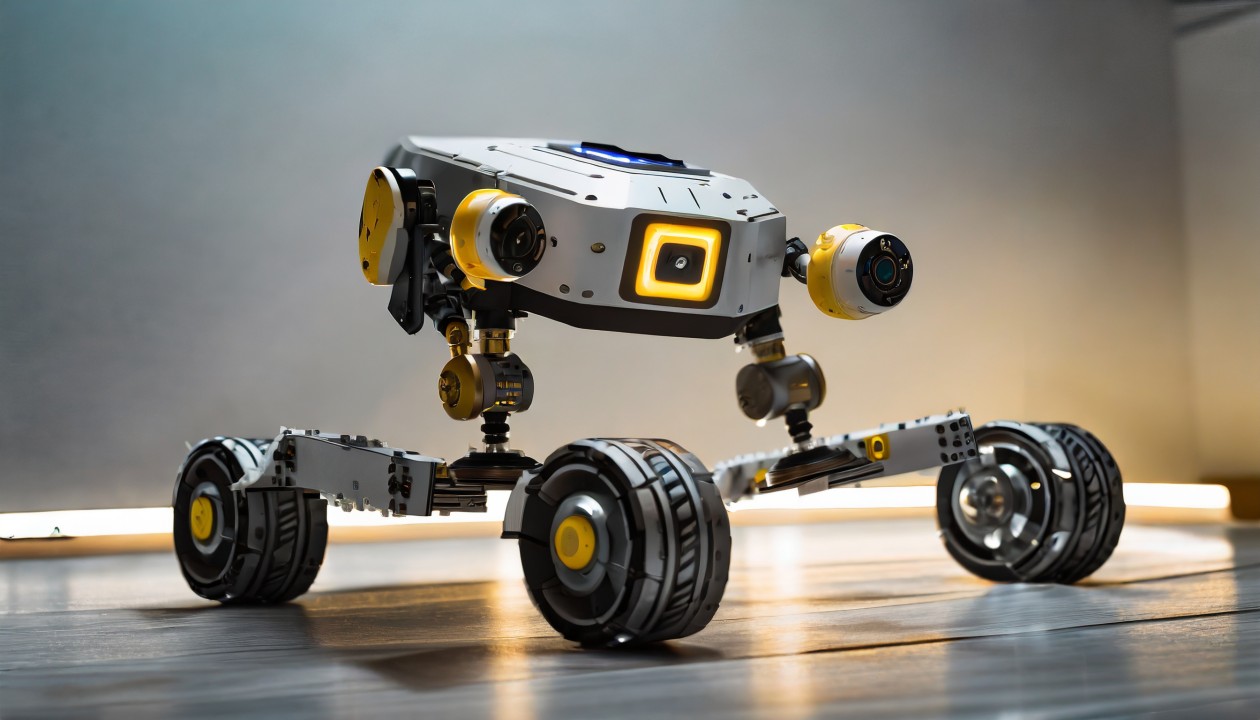
Artificial intelligence is significantly advancing robotic vision and navigation, enabling robots to better understand their surroundings, move safely through complex environments, and perform tasks with greater accuracy. By combining machine learning, computer vision, sensor fusion, and real-time data processing, AI-powered robots are becoming more capable across manufacturing, healthcare, logistics, agriculture, construction, and scientific research.
Traditional robotic systems relied on fixed programming and predefined movement paths. Modern AI-powered robots, however, can interpret visual information, recognize objects, avoid obstacles, and adapt to changing environments. These capabilities make robotic systems more flexible and suitable for dynamic real-world operations.
Computer vision is one of the key technologies driving robotic intelligence. High-resolution cameras, depth sensors, and AI models allow robots to detect objects, identify people, recognize patterns, read labels, and inspect products with remarkable precision. This visual understanding enables robots to perform tasks that previously required continuous human supervision.
Machine learning further enhances robotic vision by allowing systems to improve through experience. AI models learn from large datasets and operational feedback, enabling robots to recognize a wider range of objects, adapt to different lighting conditions, and improve detection accuracy over time without requiring extensive manual reprogramming.
Sensor fusion plays a critical role in robotic navigation. Modern robots combine information from cameras, LiDAR, radar, ultrasonic sensors, GPS, and inertial measurement units (IMUs) to create a comprehensive understanding of their environment. AI processes these diverse data sources to improve localization, mapping, and movement decisions.
Autonomous navigation has become increasingly reliable with AI-powered simultaneous localization and mapping (SLAM) techniques. These technologies allow robots to build maps of unfamiliar environments while continuously determining their own position, enabling safe navigation in warehouses, hospitals, factories, and outdoor environments.
Manufacturing facilities are deploying AI-powered robots for assembly, quality inspection, material handling, and warehouse automation. Intelligent navigation allows autonomous mobile robots to transport materials efficiently while avoiding obstacles and coordinating safely with human workers.
Healthcare organizations are using robots equipped with advanced vision systems for hospital logistics, laboratory automation, rehabilitation support, and medical assistance. AI-powered navigation enables these robots to move through busy clinical environments while maintaining awareness of people and equipment.
Logistics companies are benefiting from autonomous warehouse robots that use AI vision to identify products, scan inventory, optimize picking routes, and transport goods efficiently. These systems improve warehouse productivity while reducing manual handling and operational delays.
Agriculture is another sector where AI-powered vision is making a significant impact. Intelligent robots use cameras and sensors to monitor crop health, identify weeds, assess soil conditions, and support precision harvesting. These capabilities help farmers improve productivity while optimizing the use of water, fertilizers, and other resources.
Construction and infrastructure inspection are increasingly supported by autonomous robots and drones equipped with AI vision systems. These technologies assist with site surveys, structural inspections, equipment monitoring, and progress tracking while reducing risks for personnel working in hazardous environments.
Edge AI is improving robotic responsiveness by enabling onboard processing of visual and sensor data. Instead of sending all information to cloud services, robots can analyze data locally, reducing latency and allowing immediate responses during navigation, obstacle avoidance, and mission-critical operations.
Cloud computing complements robotic vision by supporting large-scale AI model training, fleet management, software updates, and centralized analytics. Organizations can continuously improve robotic performance while managing multiple robotic systems across different operational locations.
Safety remains a top priority in AI-powered robotics. Developers are integrating advanced collision avoidance, environmental awareness, redundancy systems, and secure communication protocols to improve reliability and ensure robots can operate safely alongside people in shared workspaces.
Collaboration between AI researchers, robotics companies, universities, and technology providers continues to accelerate innovation in robotic perception and navigation. Advances in multimodal AI, 3D vision, reinforcement learning, and autonomous decision-making are expected to further enhance robotic capabilities in the coming years.
Industry experts anticipate that AI-driven improvements in robotic vision and navigation will expand the use of autonomous systems across a growing range of industries. Smarter robots capable of understanding complex environments and adapting to changing conditions are expected to improve productivity, operational safety, and efficiency while supporting the next generation of intelligent automation.
As artificial intelligence continues to evolve, robotic vision and navigation technologies are becoming increasingly sophisticated. These advancements are enabling robots to interact more naturally with the physical world, opening new opportunities for automation, innovation, and economic growth across global industries.





Comments