
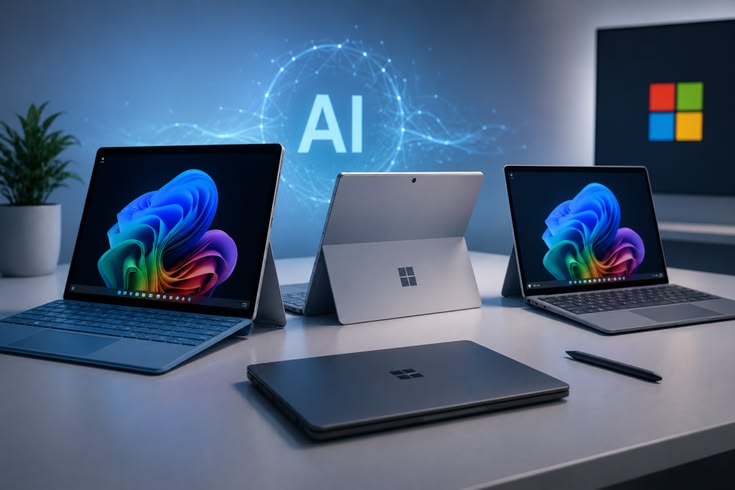
Microsoft has officially introduced Windows AI Foundry Local, a new developer platform that enables developers to build, test, and deploy artificial intelligence applications directly on Windows PCs. The platform provides a unified environment for running AI models locally using on-device hardware such as NPUs, GPUs, and CPUs, reducing reliance on cloud services while improving performance, privacy, and responsiveness. The announcement marks another major step in Microsoft's strategy to make Windows a leading platform for AI-powered software development. (learn.microsoft.com)
Windows AI Foundry Local is designed to simplify local AI development by offering a consistent API for deploying machine learning models across different hardware configurations. Instead of optimizing applications separately for each processor, developers can use a common framework that automatically selects the most suitable hardware accelerator available on the system.
One of the platform's biggest advantages is on-device AI processing. Running AI models locally reduces latency because data no longer needs to be transmitted to cloud servers for every request. Applications such as real-time translation, intelligent image editing, document summarization, speech recognition, and coding assistants can deliver faster responses while maintaining user privacy.
The platform supports multiple AI model formats, including those compatible with ONNX Runtime, making it easier for developers to bring existing machine learning models to Windows without extensive modifications. This compatibility allows organizations to reuse AI models developed using popular machine learning frameworks.
Microsoft has also optimized Windows AI Foundry Local for Copilot+ PCs, which include dedicated Neural Processing Units (NPUs). These specialized processors accelerate AI workloads while consuming significantly less power than traditional CPU-based processing, improving battery life on supported laptops.
Developer productivity receives a significant boost through integrated tools, sample projects, debugging capabilities, and performance profiling. Engineers can evaluate AI models locally, measure inference speed, identify bottlenecks, and optimize applications before deployment.
Privacy remains a central focus. Because AI models execute directly on the user's device, sensitive information such as documents, images, and voice recordings often does not need to leave the computer. This approach benefits enterprise organizations, healthcare providers, financial institutions, and government agencies that handle confidential information.
Windows AI Foundry Local also strengthens integration with Visual Studio, Visual Studio Code, and other Microsoft development tools, allowing developers to build AI-powered Windows applications within familiar development environments.
The platform supports a wide variety of AI scenarios, including natural language processing, computer vision, speech recognition, image generation, recommendation systems, and intelligent automation. Developers can build applications that continue functioning even without an internet connection, making local AI particularly valuable for mobile and remote work environments.
Enterprise organizations are expected to benefit from simplified deployment and centralized management of AI-enabled applications. Businesses can distribute optimized AI models to employee devices while maintaining governance, security policies, and compliance standards.
Cloud integration remains available when needed. Developers can combine local AI inference with Azure AI services, enabling applications to process routine tasks on-device while relying on cloud infrastructure for larger or more computationally demanding workloads.
Educational institutions and software engineering programs are also expected to benefit from the platform. Students learning artificial intelligence, machine learning, and Windows application development gain access to professional-grade tools for building local AI applications without requiring expensive cloud infrastructure.
Industry analysts believe on-device AI will become an increasingly important part of personal computing as dedicated AI hardware becomes more common. Running AI locally offers significant advantages in terms of speed, privacy, offline functionality, and operational cost compared with cloud-only approaches.
Looking ahead, Microsoft has indicated that Windows AI Foundry Local will continue expanding with broader hardware support, additional AI frameworks, improved developer tooling, and deeper integration with future Windows AI capabilities. These enhancements are expected to accelerate the adoption of AI-powered desktop applications across consumer and enterprise markets.
With unified local AI development, optimized hardware acceleration, ONNX Runtime compatibility, stronger privacy protections, seamless Windows integration, enhanced developer tools, and support for offline intelligent applications, Windows AI Foundry Local represents one of the most important developer platform announcements of the year. As AI increasingly moves from the cloud to personal devices, Microsoft is positioning Windows as a powerful foundation for the next generation of intelligent software.





Comments