
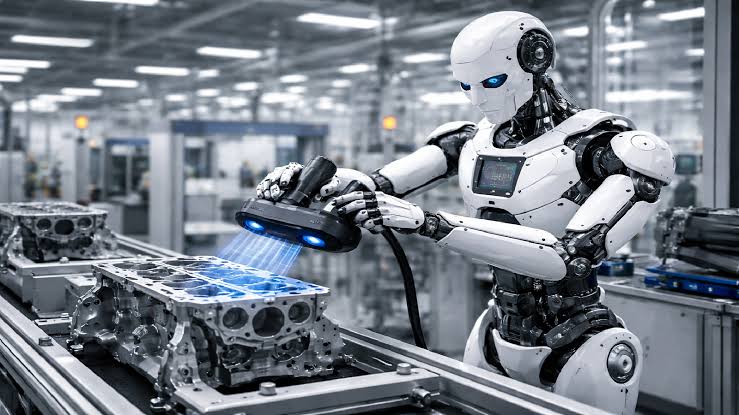
Robotics innovation is playing a central role in the evolution of smart factories, enabling manufacturers to improve productivity, enhance product quality, and build more agile production environments. By integrating artificial intelligence (AI), machine learning, industrial automation, and connected sensors, modern robotic systems are helping manufacturers optimize operations while supporting the transition toward digitally connected manufacturing.
Smart factories combine robotics, real-time data analytics, cloud computing, and Industrial Internet of Things (IIoT) technologies to create intelligent production environments. These connected systems continuously monitor equipment, analyze operational data, and automate manufacturing processes, allowing organizations to make faster and more informed decisions.
One of the most significant advances is the development of AI-powered industrial robots that can perform complex manufacturing tasks with high precision. Unlike conventional robots that follow fixed programming, intelligent robotic systems can adapt to changing production requirements, recognize different components, and adjust workflows to improve operational flexibility.
Collaborative robots, commonly known as cobots, are becoming increasingly important in modern factories. Designed to work safely alongside human operators, cobots assist with assembly, packaging, material handling, machine tending, and repetitive production tasks. Their flexibility enables manufacturers to increase productivity while maintaining safe human-robot collaboration.
Computer vision technology is enhancing robotic quality inspection. AI-powered cameras and machine learning algorithms analyze products in real time, identifying defects, dimensional variations, surface imperfections, and assembly errors with consistent accuracy. Automated inspection helps reduce waste, improve product reliability, and support continuous quality improvement.
Predictive maintenance is another key innovation supporting smart factory growth. Connected sensors installed on production equipment collect operational data that AI systems analyze to detect early signs of wear or performance degradation. Maintenance teams can schedule repairs proactively, reducing unexpected downtime and extending equipment lifespan.
Autonomous mobile robots (AMRs) are improving internal logistics within manufacturing facilities. AI-driven navigation systems allow robots to transport materials, deliver components, and move finished products between workstations while safely avoiding obstacles and adapting to dynamic factory environments.
Machine learning is helping manufacturers optimize production planning by analyzing historical data, equipment utilization, and demand forecasts. AI-generated insights assist with scheduling, resource allocation, inventory management, and workflow optimization, enabling factories to respond more effectively to changing production requirements.
Cloud computing provides the digital infrastructure that connects modern manufacturing operations. Cloud-based platforms collect and analyze production data from multiple facilities, support remote monitoring, enable software updates, and facilitate collaboration between engineering, operations, and maintenance teams.
Edge AI is strengthening factory automation by allowing robotic systems to process data directly on-site. Local processing reduces latency, supports immediate decision-making, and ensures robotic equipment continues operating efficiently even when internet connectivity is limited.
Digital twins are becoming increasingly valuable in smart manufacturing. Virtual replicas of production lines, machinery, and factory operations allow manufacturers to simulate changes, evaluate performance, and identify optimization opportunities before implementing modifications in physical environments.
Sustainability is also benefiting from robotics innovation. Intelligent automation helps manufacturers reduce material waste, optimize energy consumption, improve resource utilization, and streamline production processes. These improvements contribute to lower operating costs while supporting broader environmental objectives.
Cybersecurity remains an important consideration as factories become more connected. Manufacturers are implementing secure industrial networks, continuous monitoring, access controls, and AI-assisted threat detection to protect critical manufacturing systems and maintain operational resilience.
Workforce development continues to evolve alongside automation technologies. Manufacturers, universities, and technical training institutions are expanding programs focused on robotics, artificial intelligence, industrial engineering, and digital manufacturing to prepare professionals for increasingly automated production environments.
Collaboration among robotics manufacturers, AI developers, industrial equipment providers, and research institutions is accelerating innovation across the manufacturing sector. Advances in computer vision, autonomous robotics, intelligent control systems, and industrial software are enabling factories to become more connected, flexible, and efficient.
Industry experts expect robotics innovation to continue driving the growth of smart factories through improvements in autonomous systems, adaptive learning, human-robot collaboration, and AI-powered production optimization. These technologies are expected to enhance manufacturing resilience, improve operational performance, and support the next generation of industrial transformation.
As manufacturers embrace intelligent automation, robotics innovation is becoming a cornerstone of smart factory development. By combining advanced robotics with artificial intelligence and connected digital technologies, organizations can build more efficient, productive, and sustainable manufacturing operations that are well positioned for the future of global industry.





Comments