
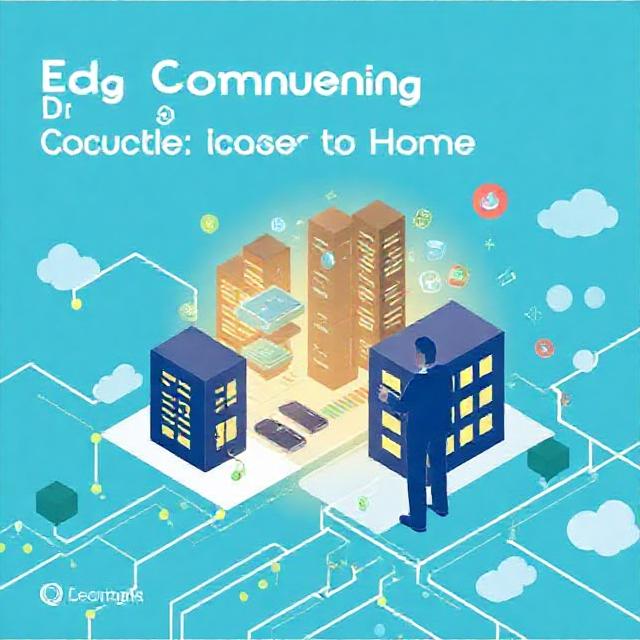
For years, the dominant model of computing involved sending data to centralized cloud servers, processing it there, and sending results back. This approach works well for many applications, but as the number of connected devices explodes and demand for instant responses grows, a different architecture has gained prominence: edge computing.
Edge computing processes data closer to where it's generated — on local servers, gateways, or even directly on devices — rather than routing everything through distant data centers. The benefits are significant for applications where milliseconds matter. A self-driving car cannot afford to wait for a round trip to a cloud server to decide whether to brake; that decision needs to happen locally, in real time, using onboard processing power.
This shift matters beyond autonomous vehicles. Manufacturing facilities use edge computing to monitor equipment sensors and detect anomalies instantly, preventing costly breakdowns before they happen. Retail stores use edge-based systems for real-time inventory tracking and personalized in-store experiences. Even smart home devices increasingly process voice commands locally rather than sending every request to a distant server, improving both speed and privacy.
Privacy is, in fact, one of the most compelling arguments for edge computing. When sensitive data — medical information, biometric data, financial details — is processed locally rather than transmitted to and stored on remote servers, the attack surface for data breaches shrinks considerably. Healthcare providers, in particular, are exploring edge architectures to keep patient data within secure local networks while still benefiting from AI-powered diagnostic tools.
Bandwidth efficiency is another driver. As the number of IoT devices proliferates — from agricultural sensors to industrial machinery to wearable health monitors — sending every byte of raw data to the cloud becomes impractical and expensive. Edge computing allows devices to filter, process, and summarize data locally, transmitting only the most relevant information upstream. This reduces network congestion and lowers costs associated with data transmission and cloud storage.
That said, edge computing isn't a replacement for cloud infrastructure; it's a complement. Cloud data centers remain essential for tasks that require massive computational power, long-term data storage, and complex model training. The emerging paradigm is a hybrid one, where edge devices handle time-sensitive, localized processing while the cloud handles heavier analytical workloads, historical data storage, and coordination across broader networks.
Telecommunications companies are betting heavily on this hybrid future, building edge data centers closer to population centers to support low-latency applications enabled by 5G networks. This convergence of edge computing and next-generation wireless technology is expected to unlock new categories of applications, from augmented reality experiences that respond instantly to head movements, to industrial robots that coordinate complex tasks without perceptible delay.
Challenges remain, particularly around managing and securing a distributed network of edge devices rather than a handful of centralized servers. Each edge node represents a potential vulnerability, and maintaining consistent software updates and security patches across thousands of distributed locations requires new operational approaches. Despite these challenges, the momentum behind edge computing suggests it will play an increasingly central role in how we design and deploy technology systems in the years ahead, quietly powering the instant responses we increasingly take for granted.





Comments