
Moore's Law Is Dead — What Comes Next for Computing?
For over five decades, Moore's
Law was the engine of the technology industry — reliably predicting that
computing power would double every two years. That era is ending. Here's what
it means and what's coming next.
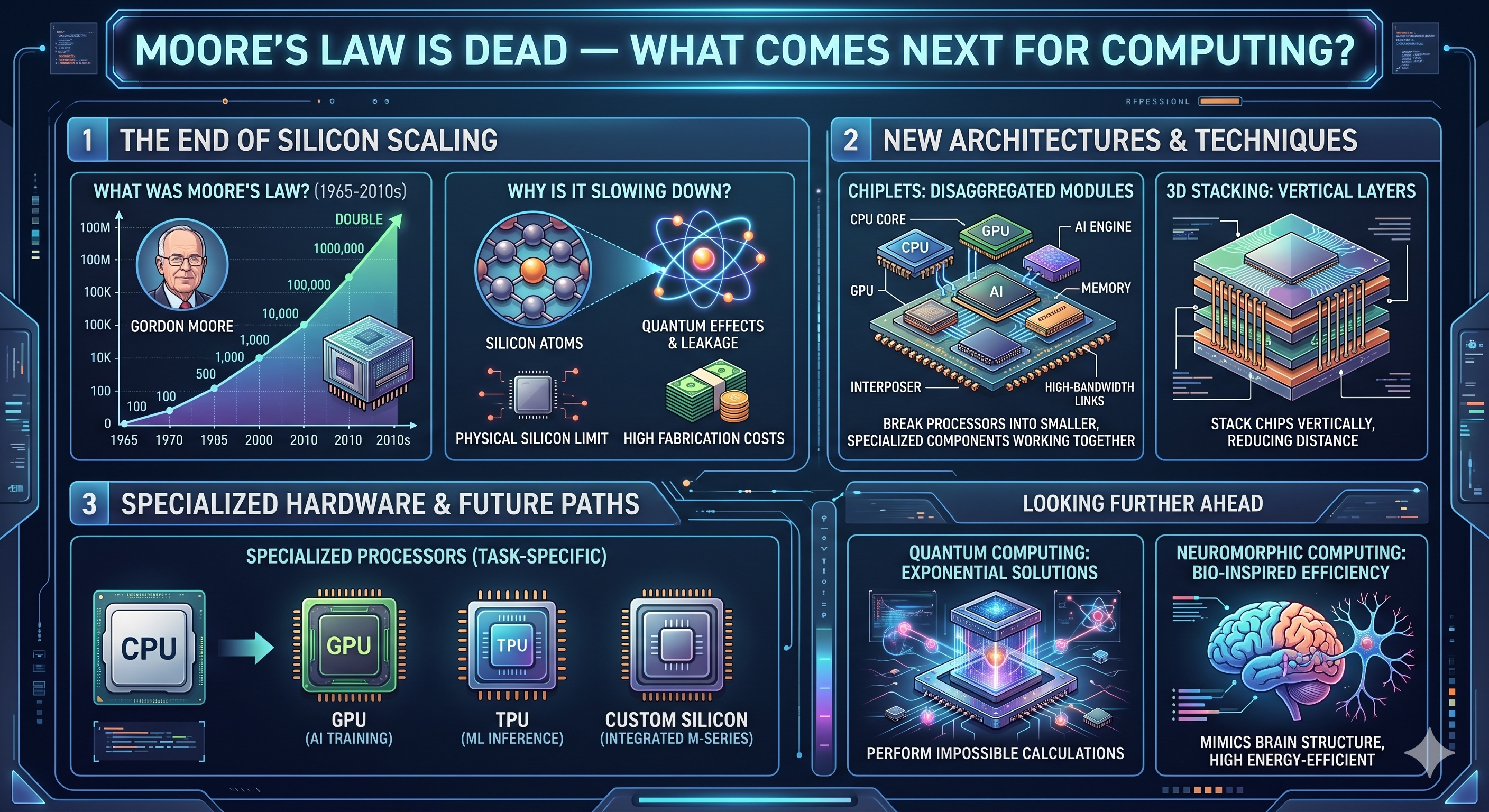
What Was Moore's Law?
In 1965, Intel co-founder Gordon
Moore observed that the number of transistors on a microchip was doubling
approximately every two years, while the cost remained constant. This
prediction — Moore's Law — held remarkably true for decades, driving exponential
improvements in computing power and cost.
Why Is It Slowing Down?
Transistors are now so small —
measured in nanometers — that they're approaching the physical limits of
silicon. At atomic scales, quantum effects make reliable transistor operation
increasingly difficult. The cost of fabricating chips at these scales is also
becoming astronomical.
What the End of Moore's Law Means
It doesn't mean computing stops
improving — it means the gains are becoming harder and more expensive to
achieve. The industry can no longer rely on process improvements alone. New
approaches are needed.
New Architectures: Chiplets and 3D Stacking
One response has been to rethink
chip design entirely. Chiplets break processors into smaller, specialized
components that work together. 3D stacking layers chips vertically, reducing
the distance data must travel. These approaches are delivering significant
performance gains without requiring ever-smaller transistors.
Specialized Processors
Rather than general-purpose
CPUs, the industry is increasingly turning to specialized chips designed for
specific tasks — GPUs for AI training, TPUs (Tensor Processing Units) for
machine learning inference, and custom silicon like Apple's M-series chips that
tightly integrate multiple functions.
Quantum and Neuromorphic Computing
Looking further ahead, quantum
computing promises to perform certain calculations exponentially faster than
classical computers. Neuromorphic computing mimics the structure of biological
brains and is extraordinarily energy-efficient. Both represent potential paths
beyond the silicon transistor era.





Comments