
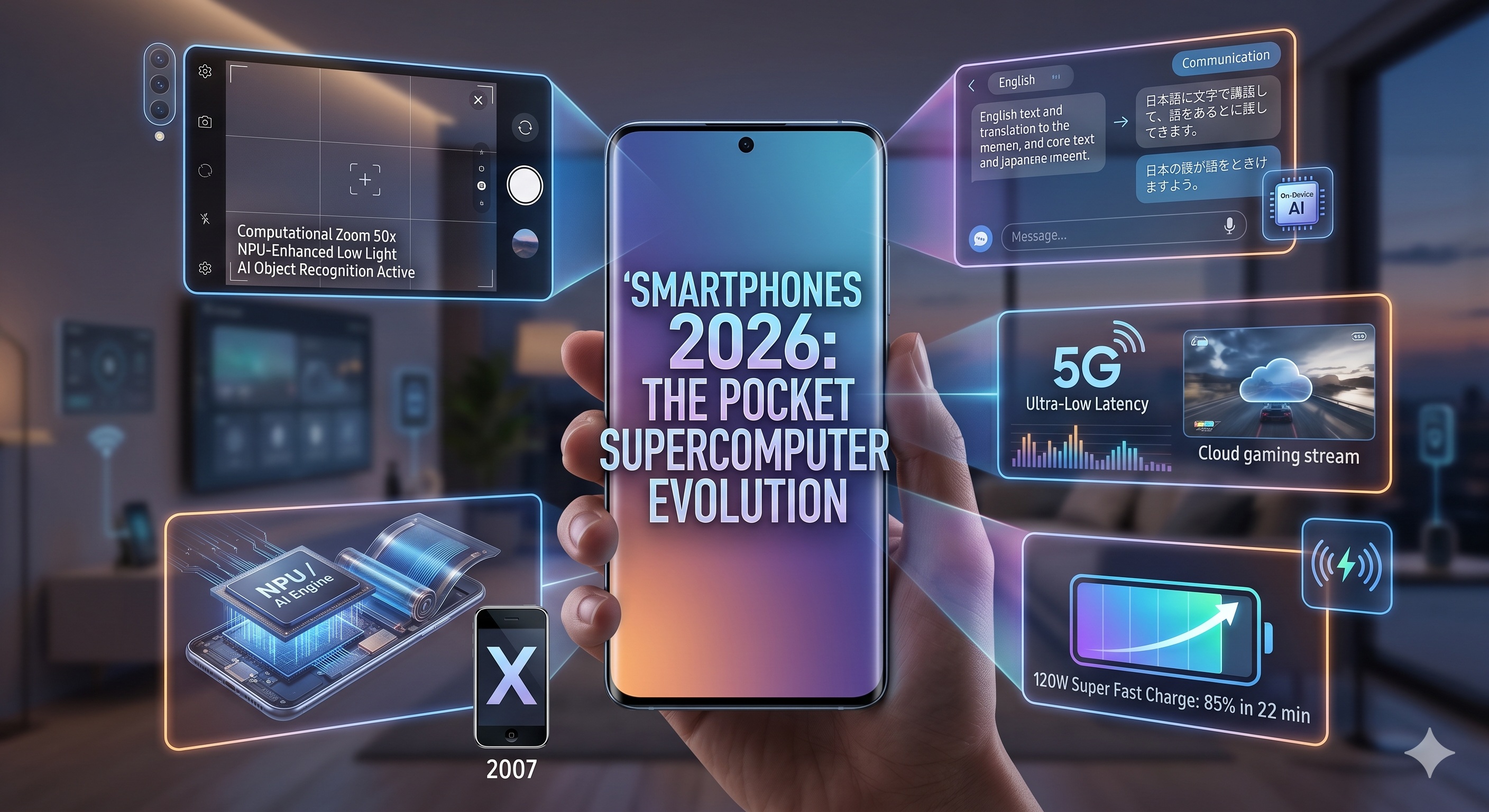
Smartphones in 2026: How Far Have We Really Come?
The first iPhone launched in
2007. Less than two decades later, the device in your pocket is more powerful
than computers that filled entire rooms just thirty years ago. Here's a look at
just how far smartphones have come — and where they're heading.
From Phone Calls to Pocket Supercomputers
Early smartphones were primarily
phones that could browse the web. Today's devices pack processors with billions
of transistors, cameras that rival professional photography equipment, and AI
systems capable of real-time translation, object recognition, and creative
generation.
The Camera Revolution
Perhaps nothing illustrates
smartphone progress more dramatically than the camera. Multi-lens systems,
computational photography, night mode, and AI-powered image processing have put
professional-quality photography in billions of hands. Dedicated cameras have
nearly disappeared from the consumer market as a result.
AI Built Into Every Layer
Modern smartphones have
dedicated AI chips (Apple's Neural Engine, Google's Tensor, Qualcomm's Hexagon)
that run on-device AI tasks without sending data to the cloud. Real-time
translation, predictive text, face recognition, and photo enhancement all happen
locally — instantly.
Battery and Charging Progress
Battery life has improved
significantly, and fast charging has transformed the experience. Many devices
now support 100W+ wired charging, filling a battery in under 30 minutes.
Wireless charging and reverse wireless charging (where your phone charges your
earbuds) are now standard features.
The Connectivity Leap
5G connectivity has matured
significantly, enabling download speeds and latency that were unimaginable on
4G. This connectivity underlies new use cases — from cloud gaming to real-time
AR applications to always-on AI assistants that stream processing from the
cloud.





Comments