
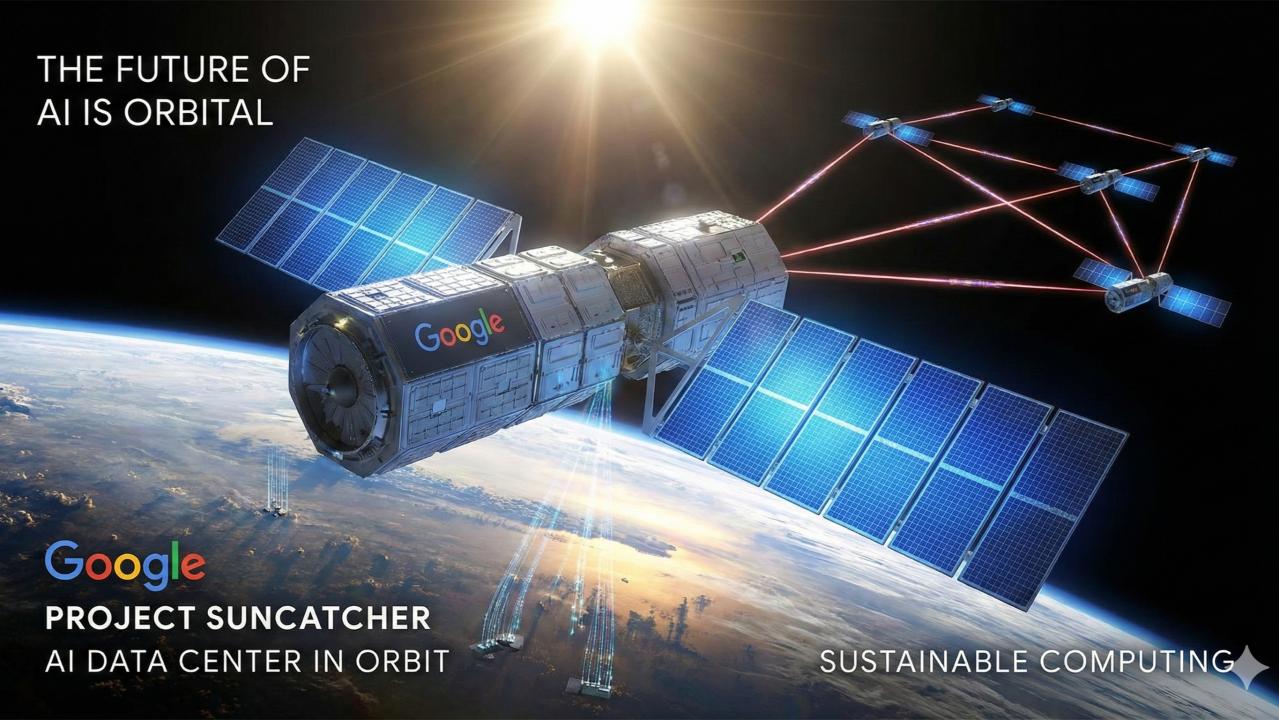
Google’s Project Suncatcher has taken its first major step toward testing whether artificial intelligence computing could eventually be carried out in space.
On October 1, 2026, Google’s prototype Suncatcher satellite was launched into orbit aboard SpaceX’s Transporter-18 rideshare mission. The satellite was developed in partnership with Planet and carries Google’s Tensor Processing Unit (TPU) technology for testing in real space conditions.
Google says its team has established contact with the satellite and confirmed that it is operating as expected.
WHAT IS PROJECT SUNCATCHER?
Project Suncatcher is a long-term Google research project exploring whether scalable machine-learning infrastructure could one day operate in space.
The concept involves placing AI computing hardware on solar-powered satellites and connecting multiple satellites together to process machine-learning workloads in orbit.
WHY DOES GOOGLE WANT TO PUT AI COMPUTING IN SPACE?
Google says satellites in low Earth orbit can receive significantly more sunlight than solar installations on Earth, creating an interesting possibility for powering energy-intensive computing systems.
Space-based infrastructure could potentially provide another way to generate and power large-scale computing capacity as demand for artificial intelligence continues to grow.
However, Google describes Project Suncatcher as a research moonshot rather than a ready-to-deploy space data-center system.
WHAT IS GOOGLE TESTING?
The first prototype mission is primarily focused on understanding how Google's TPU hardware performs under actual space conditions.
The company will collect data on how the hardware handles the physical stress of spaceflight as well as radiation and extreme thermal conditions.
Cooling is another major engineering challenge because conventional airflow-based cooling systems do not work in the vacuum of space. Google is therefore studying technologies such as heat pipes and radiators to remove heat from AI chips.
FUTURE SPACE-BASED AI COMPUTING
Google's longer-term vision involves interconnected satellites carrying larger amounts of AI computing hardware.
Future designs could potentially use laser communication links between satellites to exchange information at high bandwidth.
Google plans to use the lessons from the current prototype mission to refine its designs and continue testing the technology.
Project Suncatcher therefore represents an early experiment rather than a commercial AI data center in orbit. The current mission is focused on answering a fundamental question: Can Google's AI computing hardware reliably operate in space?
If the experiments are successful, the technology could eventually contribute to a new approach to large-scale AI infrastructure powered by solar energy in orbit.





Comments