
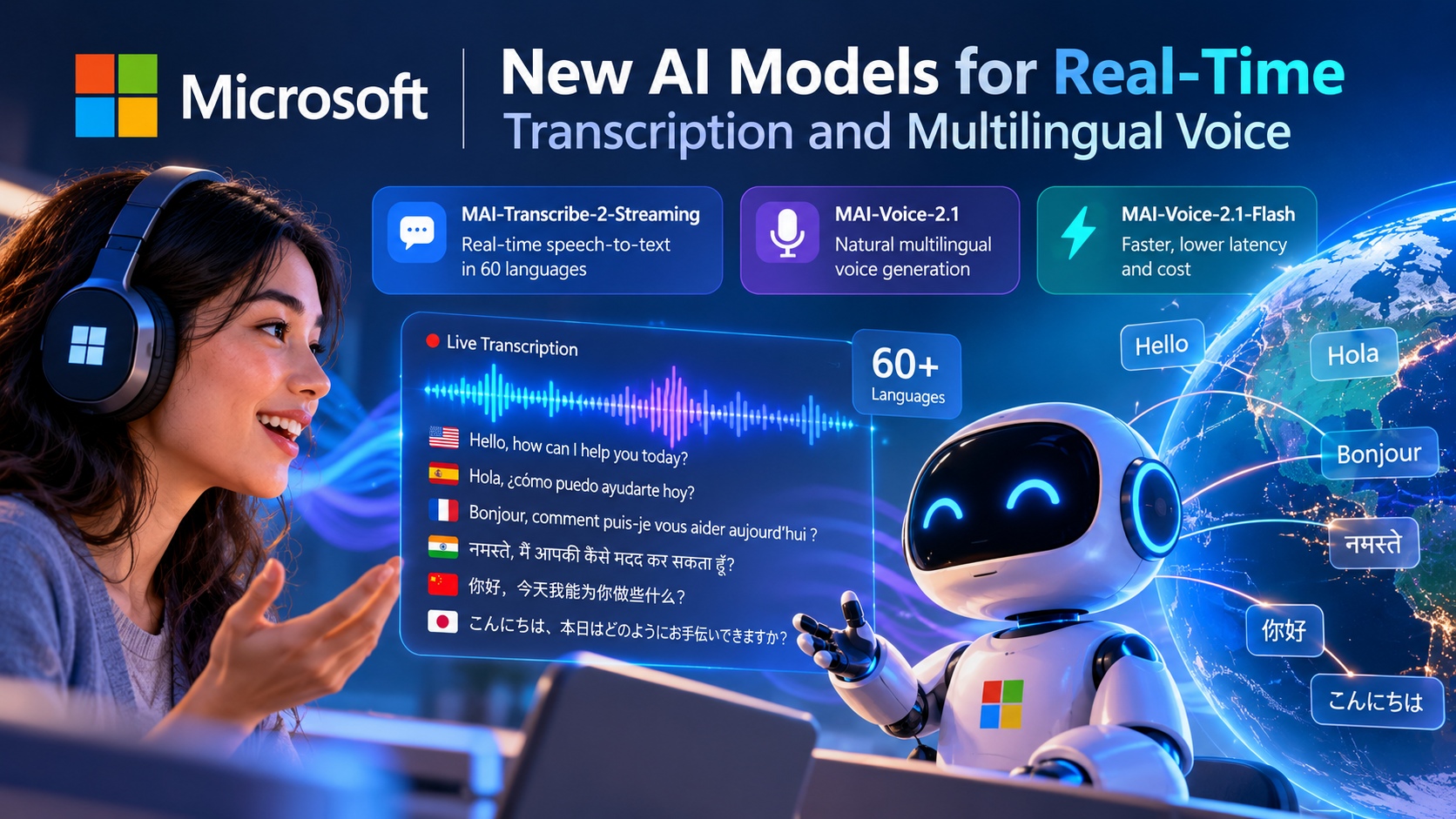
Microsoft has expanded its AI portfolio with three new models designed to make voice-based AI systems faster, more natural and more responsive. Announced on October 1, 2026, the lineup includes MAI-Transcribe-2-Streaming, MAI-Voice-2.1 and MAI-Voice-2.1-Flash.
The biggest addition is MAI-Transcribe-2-Streaming, Microsoft's new real-time speech-to-text model. It continuously converts speech into text across 60 languages, while automatically detecting the language being spoken. Instead of waiting for a person to finish speaking, the model begins producing partial transcription results in just over 100 milliseconds and refines them as more context becomes available.
Microsoft says the model ranks No. 1 for accuracy for both partial and final transcripts on Artificial Analysis. The company sees applications ranging from customer-service agents and voice assistants to live captions, meetings and real-time note-taking.
On the voice-generation side, MAI-Voice-2.1 supports 23 languages and 26 locales while maintaining the same recognizable voice identity across languages. The model can also adapt pronunciation and accents to the language being spoken.
For high-volume applications, Microsoft has introduced MAI-Voice-2.1-Flash, which targets lower latency and cost. Microsoft says it can generate 45 seconds of audio with around 150ms end-to-end latency, while offering 55% faster inference and roughly 60% lower cost than comparable models.
Together, the three models are designed to help developers build AI agents that can listen, understand, reason and respond naturally in real time.





Comments