
What Is 5G and Is It Actually Changing Your Life Yet?
5G was heralded as a
revolutionary technology that would transform everything from how we browse the
web to how surgeons perform remote operations. Years into its rollout, what has
5G actually delivered — and what's still to come?
What Is 5G?
5G is the fifth generation of
cellular network technology. It offers three key improvements over 4G:
dramatically higher speeds (theoretically up to 20 Gbps, compared to 4G's
theoretical 1 Gbps); lower latency (the time between sending and receiving data,
down to 1 millisecond in ideal conditions); and higher device density
(supporting many more connected devices per area).
The Three Bands of 5G
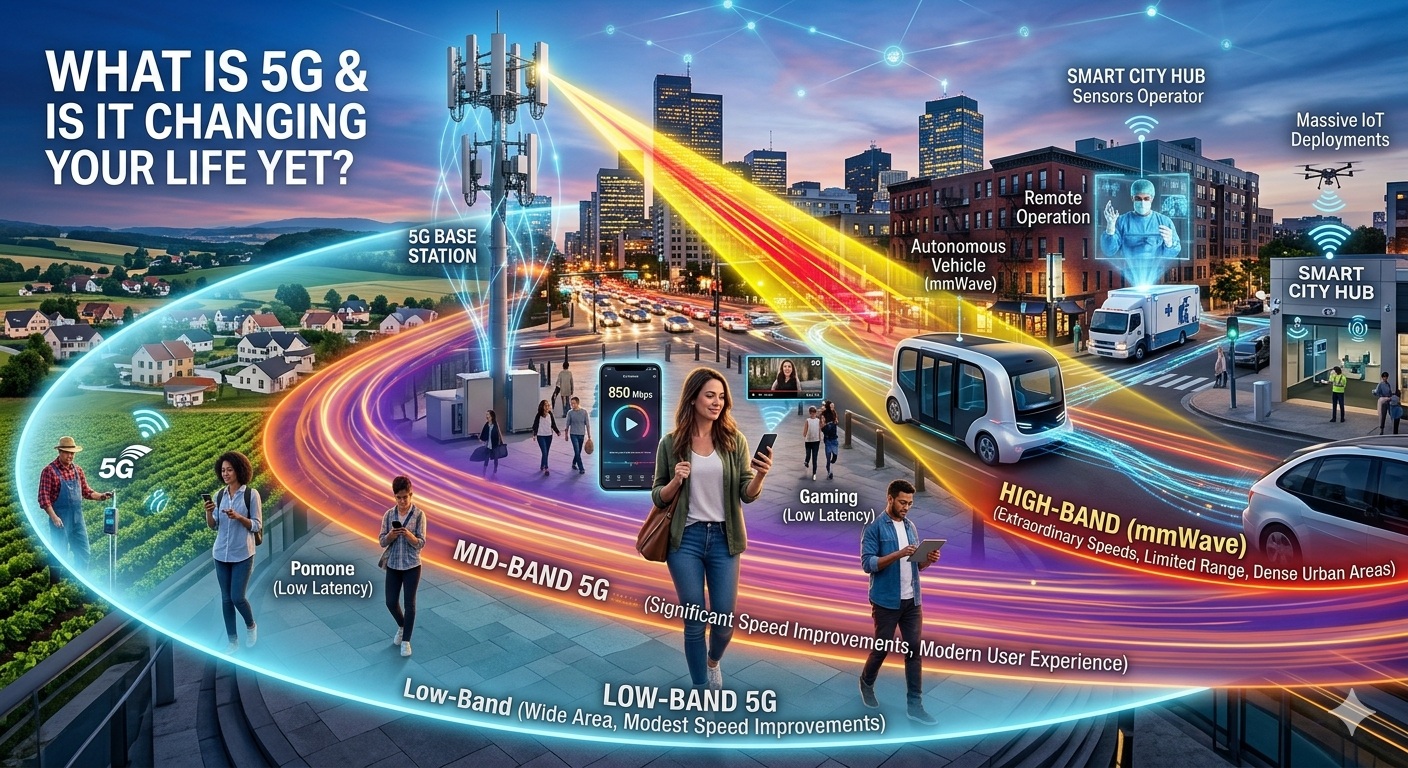
Low-band 5G covers wide areas
with modest speed improvements over 4G. Mid-band 5G (the sweet spot) offers
significant speed improvements with reasonable coverage — this is what most
users experience on modern 5G phones. High-band 5G (millimeter wave) offers
extraordinary speeds but has very limited range and struggles to penetrate
walls, making it practical mainly in dense urban environments.
What 5G Has Actually Delivered So Far
For most consumers, 5G has meant
faster download speeds on mobile devices — a genuine improvement, but not a
revolution in daily life. The more transformative applications — remote
surgery, fully connected autonomous vehicles, massive industrial IoT deployments
— are still in development or limited deployment.
Where 5G Is Making Real Impact
Fixed wireless access — using 5G
as a home internet replacement — has been a genuine success in areas where
wired broadband is poor. Industrial 5G applications in manufacturing,
logistics, and smart cities are showing real promise. And the low latency of 5G
is enabling new mobile gaming and augmented reality experiences.
The Role of 5G in the Connected Future
5G's most transformative
applications may depend on ecosystems that are still being built. Autonomous
vehicles need not just 5G but also roadside infrastructure, high-definition
maps, and regulatory frameworks. Smart cities need sensors, software platforms,
and governance structures. 5G is necessary but not sufficient for these
visions.
6G Is Already Being Developed
Research into 6G — targeting
deployment around 2030 — is already underway. It promises even higher speeds,
lower latency, integrated sensing capabilities, and native AI integration. The
wireless technology race never stops.





Comments