
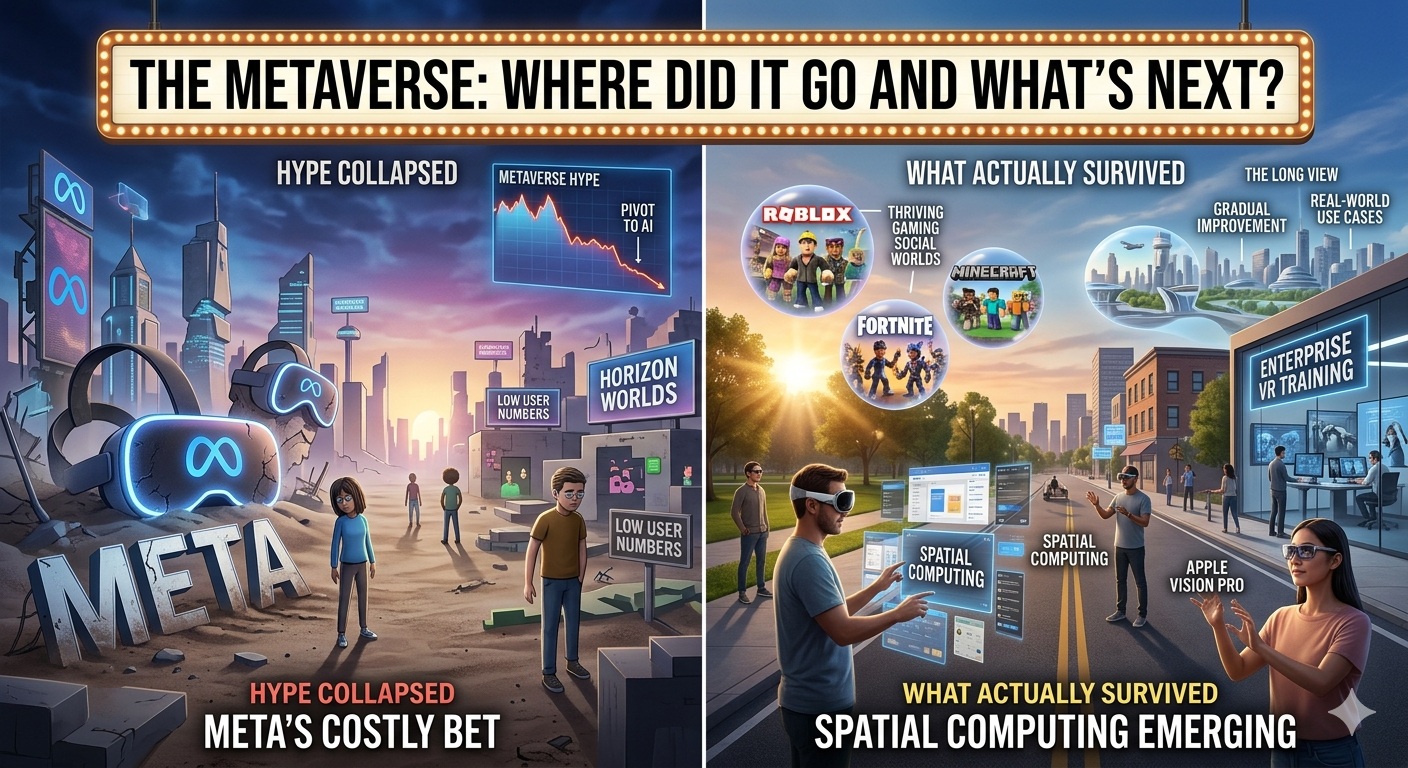
The Metaverse: Where Did It Go and What's Next?
In 2021 and 2022, the metaverse
was everywhere. Mark Zuckerberg renamed Facebook to Meta, billions were
invested, and breathless predictions suggested we'd all soon be living our
digital lives in persistent virtual worlds. Then the hype collapsed. What happened?
What Was the Metaverse Supposed to Be?
The metaverse concept —
popularized by Neal Stephenson's 1992 novel Snow Crash — envisioned persistent,
shared, three-dimensional virtual worlds where people would work, socialize,
shop, and play. It was sold as the successor to the smartphone and the internet
itself.
Why the Hype Collapsed
The technology wasn't ready. VR
headsets remain expensive, uncomfortable for extended use, and prone to motion
sickness. The virtual worlds that were built were sparse, awkward, and failed
to attract the critical mass of users needed to make them feel genuinely alive.
The value proposition for everyday users wasn't compelling enough to justify
the friction.
Meta's Costly Bet
Meta spent over $40 billion
developing its metaverse vision with minimal return. Its Horizon Worlds
platform struggled with poor graphics, low user numbers, and mockery. The pivot
to AI eventually shifted the company's priorities — and the market's attention
— away from virtual reality.
What Actually Survived
Gaming virtual worlds — Roblox,
Fortnite, Minecraft — continue to thrive as social platforms, particularly for
younger users. Enterprise VR for training simulations has found genuine
traction. And the underlying technologies — 3D graphics engines, spatial
computing, VR/AR hardware — have continued to improve.
Spatial Computing as the Successor Concept
Apple's Vision Pro, launched in
2024, reframed the conversation around spatial computing — blending digital
content with the physical world rather than replacing it with a virtual one.
This augmented rather than purely virtual approach may prove more palatable to
mainstream users.
The Long View
The metaverse isn't dead — it
was over-hyped on a five-year timeline. The underlying vision of persistent,
shared digital spaces is likely to become reality eventually. But the path
there runs through gradual improvement in hardware, software, and — most
importantly — use cases that genuinely improve people's lives.





Comments