
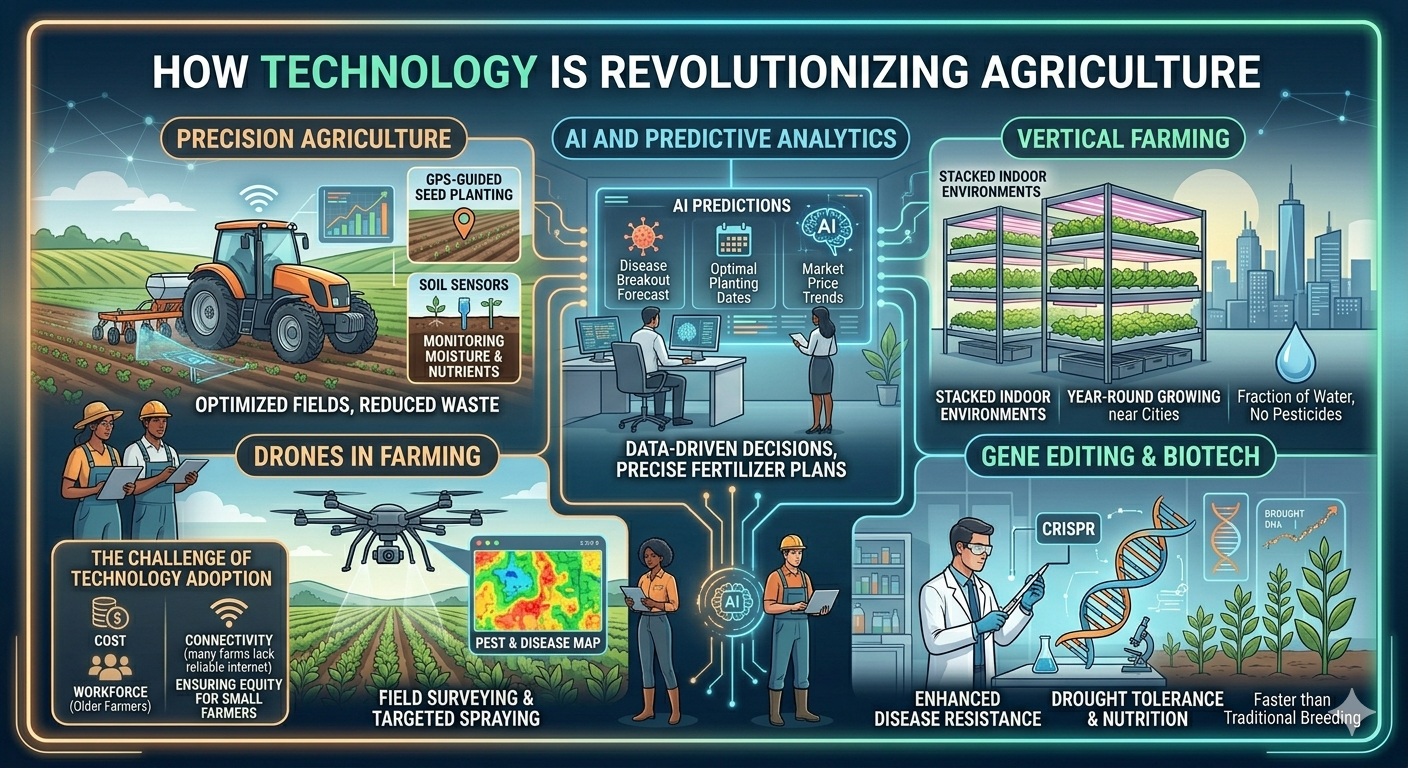
How Technology Is Revolutionizing Agriculture
Farming might seem like one of
humanity's most ancient pursuits — unchanged in its fundamentals for thousands
of years. But the agricultural sector is undergoing a technological revolution
that's transforming how food is grown, managed, and distributed.
Precision Agriculture
Precision agriculture uses data
and technology to optimize every aspect of crop production. GPS-guided tractors
plant seeds with centimeter-level accuracy. Soil sensors monitor moisture,
nutrient levels, and temperature across fields. Satellite imagery detects crop
stress before it's visible to the human eye. The result: reduced waste,
optimized input use, and higher yields.
Drones in Farming
Agricultural drones are
transforming field management. They can survey hundreds of acres in hours,
creating detailed maps of crop health. They spray pesticides and fertilizers
with precision that ground-based equipment can't match — using far less chemical
while achieving better coverage. And their cameras identify disease, pest
damage, and irrigation problems early.
AI and Predictive Analytics
Machine learning models analyze
weather patterns, soil data, market prices, and historical yields to help
farmers make better decisions. AI can predict disease outbreaks before they
occur, recommend optimal planting dates, and suggest precise fertilizer formulations
for specific field conditions.
Vertical Farming
Vertical farms stack crops in
controlled indoor environments, using LED lighting and hydroponic or aeroponic
growing systems. They use a fraction of the water of conventional farming,
require no pesticides, and can operate year-round regardless of climate. They
can be located near urban centers, dramatically reducing transportation
distance and emissions.
Gene Editing and Biotech
CRISPR gene editing is enabling
the development of crops with enhanced disease resistance, improved nutritional
profiles, drought tolerance, and longer shelf lives — often more precisely and
quickly than traditional breeding techniques. These developments have
significant potential to improve food security in a changing climate.
The Challenge of Technology Adoption
Technology adoption in
agriculture faces real barriers: cost, connectivity (many farms lack reliable
internet), a workforce that skews older, and the inherent conservatism of an
industry where a failed experiment can mean a lost harvest. Ensuring that agricultural
technology benefits small and subsistence farmers — not just large commercial
operations — is a critical equity challenge.





Comments