
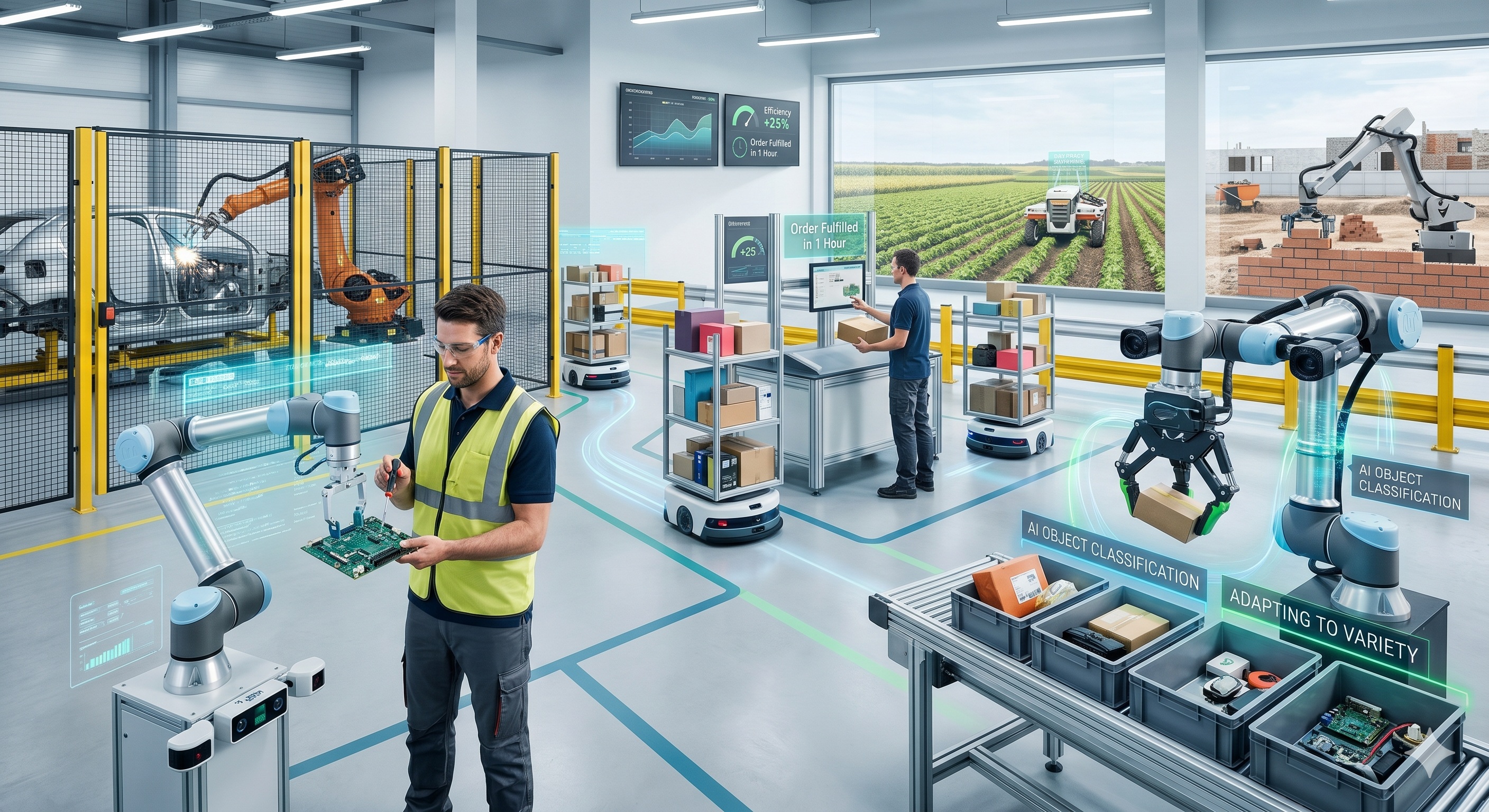
How Robots Are Transforming Manufacturing and Logistics
Robots have been part of
manufacturing for decades — welding car bodies and painting panels. But the
latest generation of robots is fundamentally different: more flexible, more
intelligent, more collaborative, and increasingly capable of working alongside
humans rather than behind safety cages.
Traditional Industrial Robots
Conventional industrial robots
are powerful, precise, and fast — but rigid. They're programmed to repeat
specific movements and work best in controlled environments where every object
is in a predictable location. They transformed automotive and electronics
manufacturing but required expensive, inflexible dedicated setups.
Collaborative Robots (Cobots)
Collaborative robots — cobots —
are designed to work safely alongside humans. They're lighter, easier to
program (often by physically guiding them through motions), and equipped with
sensors that stop them if they contact a person. They're bringing automation
within reach of small and medium businesses that couldn't afford traditional
industrial robots.
AI-Powered Vision and Adaptability
Modern robots equipped with AI
and advanced cameras can identify, pick, and sort objects they've never seen
before. Amazon's fulfillment centers use robots that can identify and grasp
millions of different product types. This adaptability — handling variety
rather than repetition — dramatically expands what robots can do.
Warehouse and Logistics Robots
The logistics revolution driven
by e-commerce has made warehouse automation a priority. Mobile robots navigate
warehouse floors, bringing shelves to human pickers. Robotic arms sort
packages. Automated guided vehicles move pallets. The result is dramatically
faster, more accurate order fulfillment — critical for same-day delivery
expectations.
Construction and Agricultural Robots
Beyond manufacturing, robots are
entering construction — bricklaying robots can work continuously and precisely.
Agricultural robots harvest crops, prune plants, and apply treatments with a
precision and consistency humans can't match. These sectors have historically
been resistant to automation, but that's changing.
The Human Dimension
Automation creates anxiety about
job displacement — and those concerns are legitimate for specific roles. But
robots also take on dangerous, physically damaging, and repetitive tasks that
harm human workers. The challenge is managing the transition thoughtfully —
ensuring displaced workers have pathways to new roles rather than leaving them
behind.





Comments