
Augmented Reality vs Virtual Reality: What's the Real Difference?
AR and VR are often lumped
together under the umbrella of 'immersive technology' — and both involve
digital content in relation to a user's visual field. But they're fundamentally
different experiences with different applications, challenges, and futures.
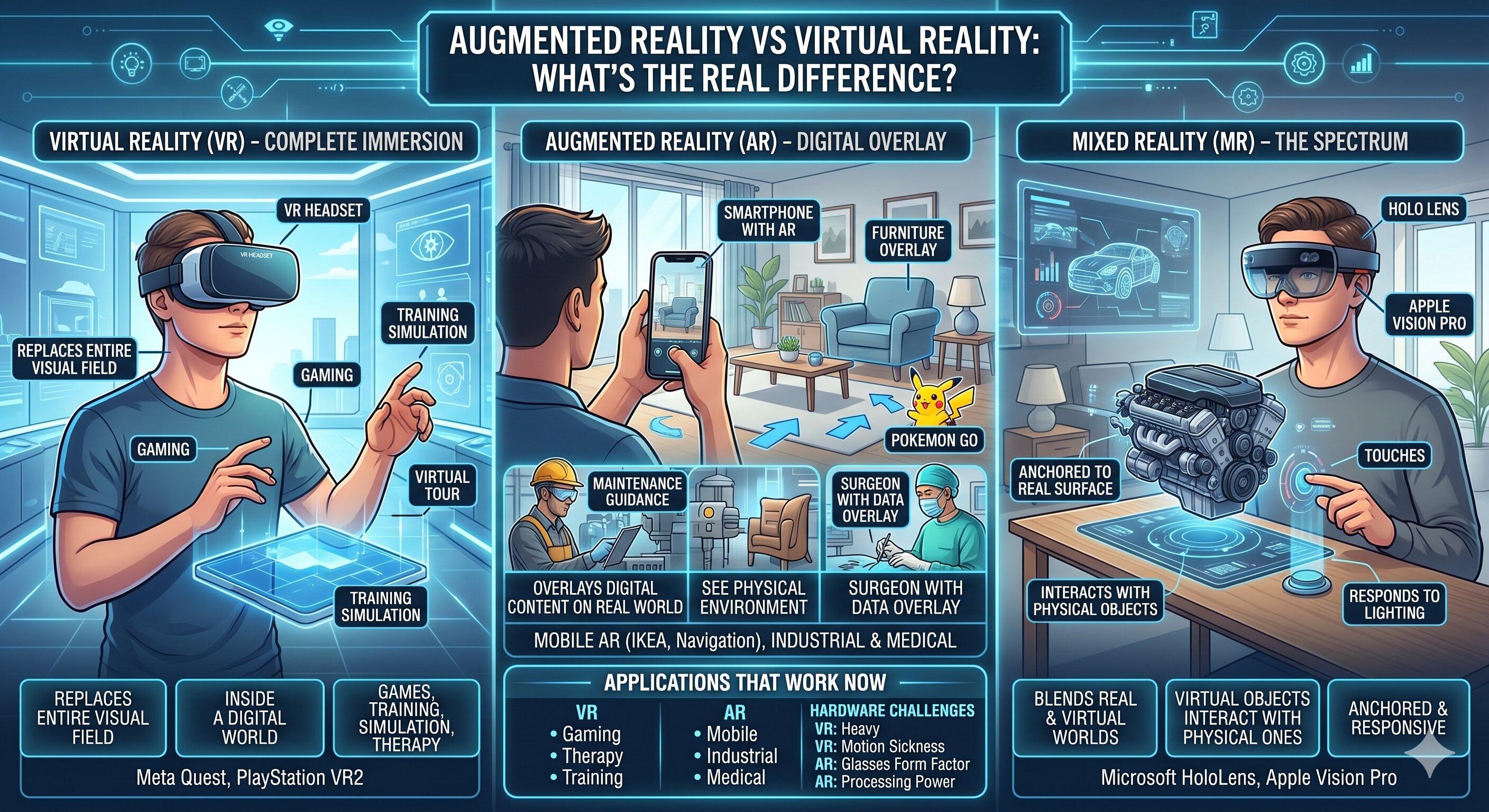
Virtual Reality: Complete Immersion
Virtual reality replaces your
entire visual field with a computer-generated environment. You put on a VR
headset and you're inside a digital world — the real world is completely
blocked out. Current leading VR headsets include the Meta Quest series and PlayStation
VR2.
VR is most compelling for
applications where complete immersion provides value: gaming, training
simulations, virtual tours, therapeutic applications, and social experiences.
Augmented Reality: Digital Overlay
Augmented reality overlays
digital content onto the real world — you can still see your physical
environment, but digital elements are superimposed on it. Your phone's camera
showing you how furniture would look in your room, or a surgeon seeing patient data
overlaid on their visual field during an operation, are AR applications.
Mixed Reality: The Spectrum In Between
Mixed reality (MR) blends real
and virtual worlds more sophisticatedly — digital objects can appear to be
anchored to real-world surfaces, interact with physical objects, and respond to
real-world lighting. Microsoft's HoloLens and Apple's Vision Pro are mixed
reality devices.
Current Applications That Actually Work
VR: Gaming (genuinely compelling
experiences exist), phobia treatment (therapy using VR exposure has strong
clinical evidence), training simulations (military, surgical, industrial),
architectural visualization.
AR: Mobile AR applications (IKEA
Place, Pokemon Go, navigation overlays), industrial AR for maintenance and
assembly guidance, medical imaging overlays.
The Hardware Challenge
Both VR and AR face significant
hardware hurdles. VR headsets are heavy, can cause motion sickness, and require
either powerful tethered computers or compromise on processing power. AR
devices that look like normal glasses with meaningful display capability remain
elusive — current smart glasses either look like headsets or have very limited
display capabilities.
Which Will Win?
They serve fundamentally
different purposes and will likely coexist. VR's complete immersion will retain
value for specific high-value applications. AR — woven seamlessly into
glasses-form-factor devices — has perhaps the broader potential for everyday use,
if the hardware challenges can be solved. The bet most tech companies are
making is on AR as the eventual mainstream platform.





Comments