
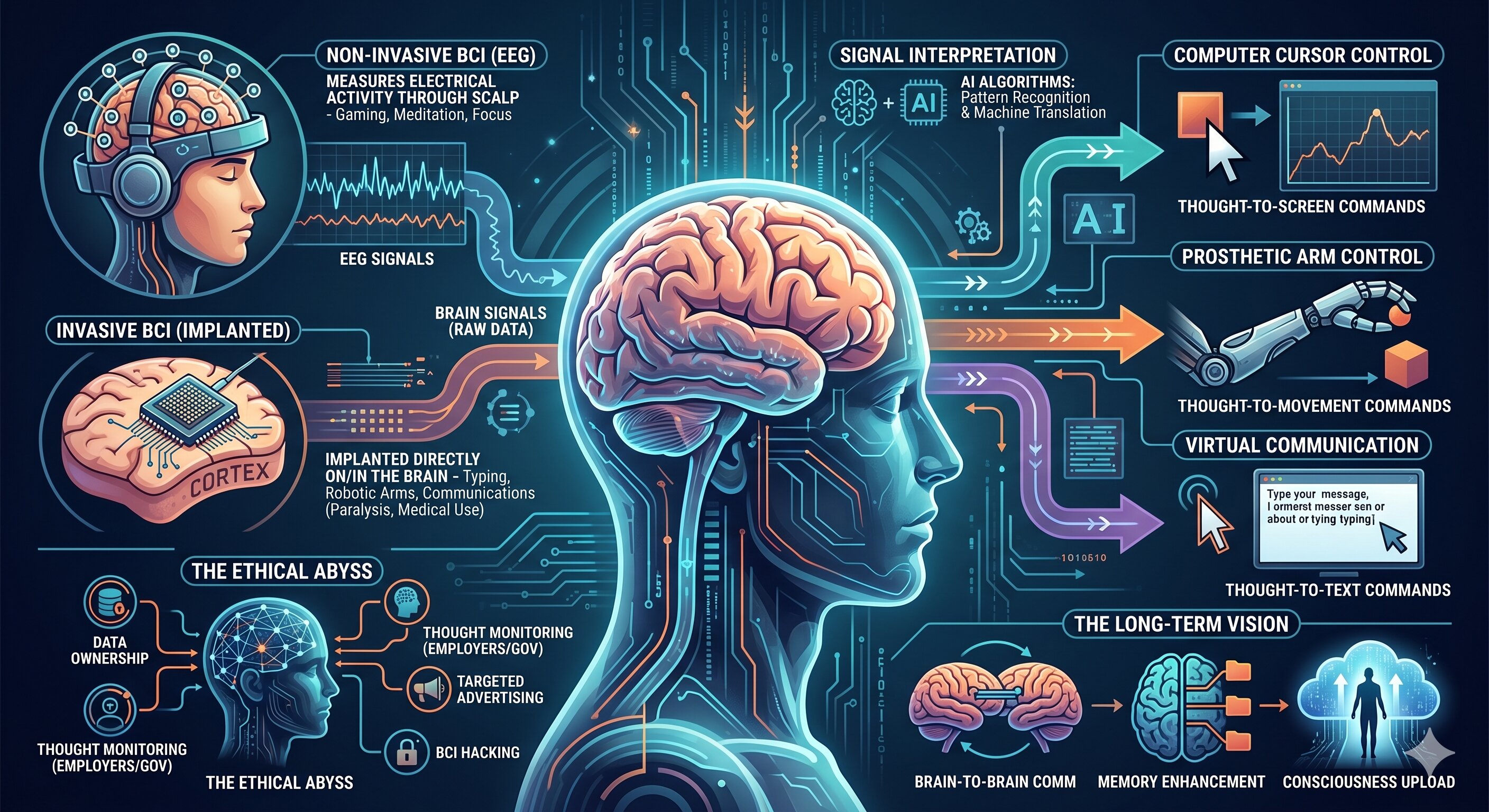
Brain-Computer Interfaces: The Science Behind Reading Your Mind
The idea of a direct connection
between the human brain and a computer seems like the domain of science
fiction. But brain-computer interfaces are real, they're advancing rapidly, and
they raise some of the most profound questions about human identity and the
future of technology.
What Is a Brain-Computer Interface?
A brain-computer interface (BCI)
is a system that establishes a direct communication pathway between the brain
and an external device — without requiring physical movement. BCIs read
electrical signals from the brain, interpret them, and translate them into
commands for computers, prosthetics, or communication devices.
Non-Invasive BCIs
EEG (electroencephalography)
headsets measure electrical activity through the scalp and have been used for
decades in medical research. Consumer-grade EEG devices are available for
gaming, meditation, and focus monitoring. While limited in resolution compared
to invasive methods, non-invasive BCIs require no surgery and carry no medical
risk.
Invasive BCIs and Medical Applications
For patients with paralysis,
locked-in syndrome, or severe neurological conditions, invasive BCIs implanted
directly on or in the brain have enabled remarkable outcomes. Patients have
been able to type, control robotic arms, and communicate — using only their
thoughts — after losing all motor function. This is already happening in
clinical settings.
Neuralink and the Consumer BCI Race
Elon Musk's Neuralink implanted
its first human subject in 2024, demonstrating the ability to control a
computer cursor with thoughts. While still early and limited to medical
applications, Neuralink's long-term vision is consumer-grade BCIs that could enable
high-bandwidth brain-to-computer communication for healthy users.
The Ethical Abyss
BCIs raise profound ethical
questions. Who owns the data generated by reading your brain? Could employers
or governments use BCIs to monitor thoughts? Could advertisers target you based
on your unconscious reactions? Could BCIs be hacked? The intimate nature of
brain data makes these questions uniquely serious.
The Long-Term Vision
The furthest-out BCI visions —
including Musk's — involve BCIs that could eventually enable direct
brain-to-brain communication, enhancement of memory and cognition, and even
uploading or backing up human consciousness. Whether these visions are achievable,
desirable, or even coherent is a debate that humanity needs to have urgently —
before the technology decides for us.





Comments