
EdTech: Is Technology Making Education Better or Worse?
Educational technology — EdTech
— has been promised as a revolution in learning for decades. From teaching
machines in the 1960s to MOOCs in the 2010s to AI tutors today, technology has
repeatedly been heralded as the solution to education's challenges. Is it
actually delivering?
The Genuine Successes
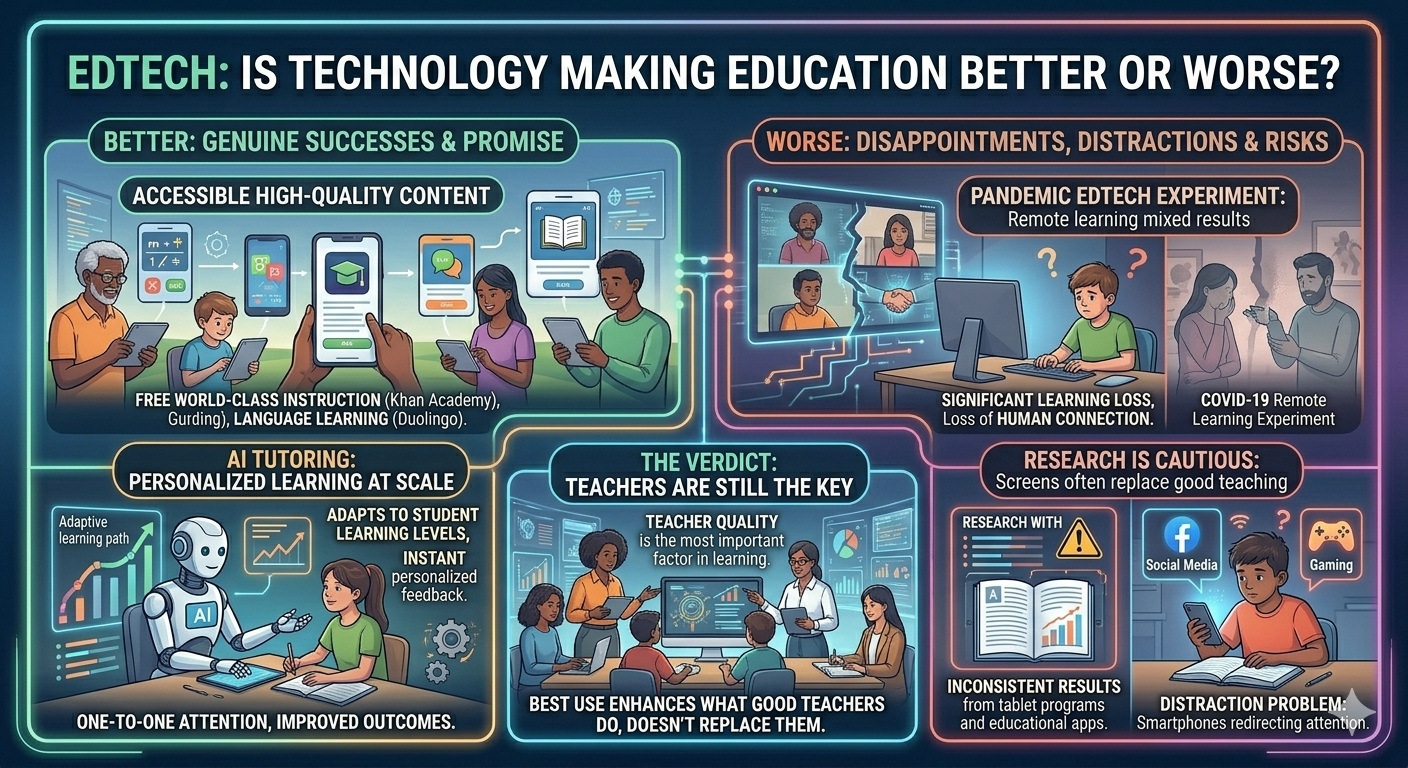
Technology has made high-quality
educational content more accessible than ever. Khan Academy provides free,
world-class instruction in mathematics and sciences to anyone with an internet
connection. Language learning apps like Duolingo have brought language
education to hundreds of millions. Online courses have enabled professionals to
acquire new skills throughout their careers. These are real, meaningful
impacts.
AI Tutoring: Genuine Promise
AI-powered tutoring systems that
adapt to individual student learning levels and provide instant, personalized
feedback represent perhaps the most exciting EdTech development. Research shows
that one-to-one tutoring dramatically improves learning outcomes — and AI can
theoretically provide this kind of personalized attention at scale.
The Pandemic EdTech Experiment
COVID-19 forced a global
experiment in remote and technology-mediated education. The results were mixed
at best. Learning loss was significant, particularly for younger students and
those from disadvantaged backgrounds. Technology partially bridged the gap —
but it also revealed how central in-person human connection is to effective
learning.
The Research Is More Cautious Than the Hype
Many EdTech products are
deployed with minimal evidence of effectiveness. Studies of tablet programs,
educational apps, and digital textbooks show inconsistent results. When screens
replace rather than supplement good teaching, outcomes often suffer. Technology
is a tool — its value depends entirely on how it's used.
The Distraction Problem
Technology in classrooms brings
distraction as well as opportunity. Smartphones and laptops can redirect
student attention from learning. Social media and gaming compete with
educational content. Schools worldwide are grappling with how to manage devices
in ways that maximize learning benefits while minimizing distraction costs.
The Teachers Are Still the Key
Decades of EdTech investment
have not changed the fundamental finding: teacher quality is the most important
in-school factor in student learning. The best use of technology in education
enhances what good teachers do — it doesn't replace them. EdTech that ignores
the teacher is EdTech that usually fails.





Comments