
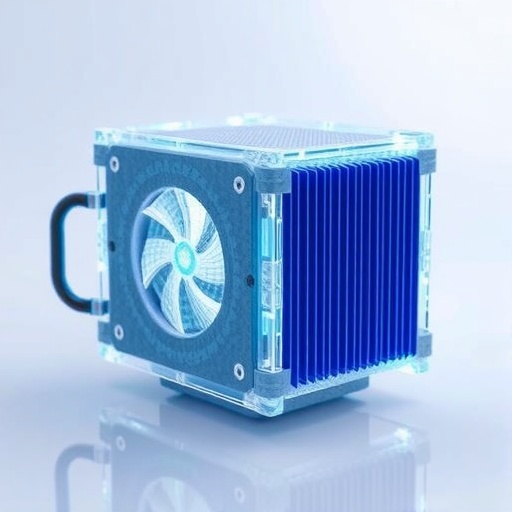
As artificial intelligence continues to drive demand for more powerful computing systems, researchers have developed an innovative liquid cooling technology that could make AI chips up to 10 times more efficient than conventional cooling methods. The breakthrough addresses one of the biggest challenges facing modern AI infrastructure—managing the enormous heat generated by high-performance processors.
AI models require massive computational power for training and inference tasks. As AI systems become larger and more complex, processors consume increasing amounts of electricity while producing substantial heat. Traditional air-cooling systems often struggle to maintain optimal operating temperatures, leading to reduced performance, higher energy consumption, and increased operational costs.
The newly developed liquid cooling solution directly removes heat from AI processors using advanced fluid-based thermal management systems. Unlike traditional cooling approaches that rely on circulating air around hardware components, liquid cooling transfers heat much more efficiently, allowing chips to operate at higher performance levels while consuming less energy.
Researchers report that the technology significantly improves heat dissipation, enabling AI chips to maintain stable operating conditions even during intensive computational workloads. By reducing thermal stress, the cooling system also helps extend hardware lifespan and improve overall system reliability.
One of the most notable benefits of the innovation is its potential impact on data centers, which are experiencing rapidly growing energy demands due to the expansion of AI applications. Data centers worldwide consume vast amounts of electricity, with cooling systems accounting for a substantial portion of overall energy usage. More efficient cooling technologies could help operators lower energy costs while reducing environmental impact.
The breakthrough comes at a time when organizations are investing heavily in AI infrastructure to support machine learning, generative AI, large language models, and advanced analytics. As demand for AI computing continues to grow, efficient thermal management solutions are becoming increasingly important for maintaining sustainable operations.
Industry experts believe liquid cooling could play a critical role in the future of AI hardware development. By enabling higher chip densities and improved computational efficiency, the technology may support the next generation of AI accelerators, graphics processors, and high-performance computing systems.
Beyond artificial intelligence, the cooling innovation could benefit a wide range of applications including cloud computing, scientific research, telecommunications, autonomous systems, and edge computing environments where performance and energy efficiency are essential.
The development highlights how advances in engineering and materials science are helping overcome physical limitations associated with modern computing technologies. As AI continues to transform industries worldwide, innovations such as advanced liquid cooling systems will be essential for building scalable, efficient, and environmentally sustainable computing infrastructure.
With further research and commercial adoption, liquid cooling technology could become a standard feature of future AI data centers, supporting faster computing performance while significantly reducing energy consumption and operational costs.





Comments