
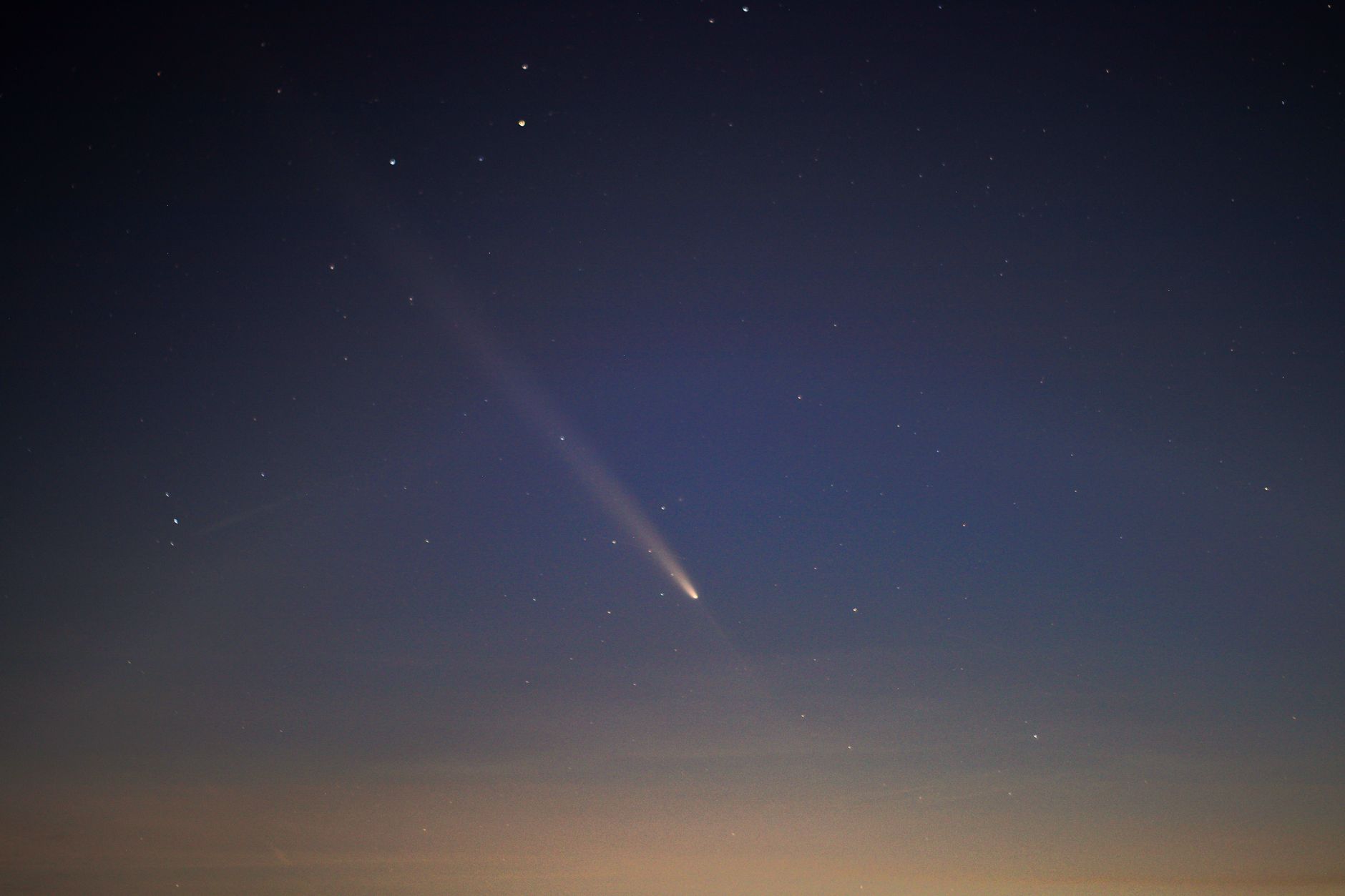
For generations, scientists leaned on a poetic hypothesis regarding the origins of life on our planet. Often described as cosmic snowballs, comets are packed with frozen gases, rock, dust, and crucial organic materials like carbon and nitrogen. Researchers long assumed these icy travelers served as a delivery service, depositing the building blocks of biology directly onto the primordial surface. A new study published in Scientific Reports disrupts that long-held narrative through advanced physical modeling.
Led by Cambridge University astronomer Richard Anslow, a team of researchers simulated how comets interact with Earth's atmosphere during impact. Their findings indicate that comets typically travel too fast and at angles too steep for fragile organic molecules to survive the violent entry. Instead of gracefully seeding a barren planet, incoming comets would likely subject their valuable cargo to extreme temperatures and vaporization. While the idea of comets acting as a universal transport system for prebiotic chemistry remains romantic, the physics simply does not support it for Earth.
The research team focused their simulations on hydrogen cyanide, a compound frequently found on solar system comets. To successfully deliver these compounds intact, a comet would need to travel at speeds below roughly 9 miles or 15 kilometers per second, ideally slowing down by bouncing between closely orbiting planets. In our solar system, however, such conditions are virtually non-existent. The models show that surviving organic compounds from comets would represent an insignificant fraction of the concentrated feedstock required for life.
With cometary delivery falling short, attention shifts back to endogenous synthesis originating within Earth's own atmosphere, or alternative exogenous sources like asteroids. Asteroids slammed into Earth much more frequently than comets, leaving open the possibility of other delivery mechanisms. Meanwhile, researchers note that planets with thinner atmospheres, such as Mars, might have presented more favorable conditions for cometary delivery, though the overall probability remains exceptionally low across the board.
New Physics Models Cast Doubt on Comets Seeding Life on Earth





Comments