
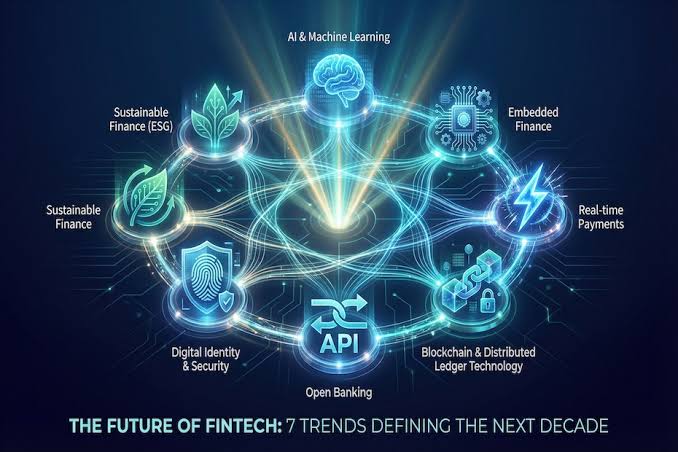
Money, at its core, is just data. It is a ledger of who owes what to whom. Because finance is fundamentally an information industry, it was inevitable that it would be entirely subsumed by the digital revolution. Yet, for decades, the global financial system ran on legacy mainframes, sluggish settlement periods, and opaque intermediary networks that extracted massive fees for simply moving data from point A to point B.
That era is ending. Financial Technology (FinTech) has evolved from sleek mobile banking apps into deep, systemic infrastructure overhauls. Driven by blockchain architecture, artificial intelligence, and open banking frameworks, technology is disintermediating traditional banks, automating global markets, and radically changing how humanity interacts with value.
Blockchain and Decentralized Finance (DeFi)
The most disruptive force in modern finance is Distributed Ledger Technology (DLT), commonly known as blockchain. Traditional finance relies on centralized authorities—banks, clearinghouses, and central reserves—to verify transactions and maintain the ledger. Blockchain decentralizes this trust. It creates an immutable, cryptographically secure, and publicly verifiable ledger maintained by a global network of computers.
- Elimination of Intermediaries: By removing the "middlemen," blockchain drastically reduces the friction, time, and cost of transferring assets. A cross-border remittance that traditionally takes three days and costs 5% in fees can be executed via blockchain in seconds for fractions of a penny.
- Smart Contracts: These are self-executing contracts where the terms of the agreement are written directly into lines of code. If condition A is met, action B is automatically executed. This removes the need for lawyers and escrow agents in complex financial agreements.
- The Rise of DeFi: Decentralized Finance uses smart contracts to recreate traditional financial instruments—lending, borrowing, and yielding interest—entirely outside of the traditional banking system. Users can lend their digital assets to a liquidity pool and earn interest algorithmically, without a bank taking a massive cut of the spread.
Algorithmic and High-Frequency Trading (HFT)
The image of frantic traders shouting on the floor of the New York Stock Exchange is an antiquated Hollywood trope. Today, global equity, commodity, and forex markets are dominated by algorithms.
- Speed is King: High-Frequency Trading firms use proprietary algorithms and hyper-fast communication networks (often relying on microwave towers rather than fiber optics to shave off microseconds) to execute millions of orders a second.
- Market Making: These algorithms provide immense liquidity to the markets. They constantly scan for microscopic price discrepancies between different exchanges—arbitrage opportunities—and capitalize on them before a human could even blink.
- Sentiment Analysis: Beyond just looking at price history, trading algorithms now utilize Natural Language Processing (NLP) to read news articles, earnings reports, and even social media feeds in real-time, instantly adjusting trading strategies based on global sentiment.
Artificial Intelligence in Risk and Fraud
Banks manage risk. Whether it is deciding who gets a mortgage or identifying a stolen credit card, assessing probability is the core function of financial institutions. AI has transformed risk assessment from a blunt instrument into a precision tool.
- Credit Scoring Evolution: Traditional FICO scores rely on a narrow set of historical data points. AI-driven credit models analyze thousands of alternative data points—including utility payments, cash flow patterns, and even how a user interacts with a digital interface—to assess creditworthiness. This opens up lending to millions of "thin-file" consumers who are historically unbanked.
- Fraud Detection: Legacy fraud systems rely on static rules (e.g., "flag if a transaction occurs in a foreign country"). Machine learning models analyze behavioral biometrics. They learn the exact way you type your password, the angle you hold your phone, and your typical spending locations. If a transaction deviates from these hyper-specific, dynamic patterns, the AI instantly flags it.
- Anti-Money Laundering (AML): AI network analysis maps complex webs of transactions globally, identifying the subtle, layered money movements used by cartels and illicit actors that human auditors would never spot.
Open Banking and API Integration
The days of a single bank controlling all of your financial data are over. Open Banking is a regulatory and technological shift that forces banks to open their internal data—securely and with customer consent—to third-party developers via Application Programming Interfaces (APIs).
- Financial Aggregation: Open banking allows FinTech apps to pull data from your checking account, your mortgage provider, and your brokerage to give you a holistic, real-time view of your net worth in one dashboard.
- Embedded Finance: Because of APIs, financial services are being embedded into non-financial platforms. When you use a ride-sharing app, the payment happens invisibly in the background. When you buy furniture online, a "Buy Now, Pay Later" algorithm assesses your credit and issues a micro-loan at checkout in milliseconds.
- Increased Competition: By breaking the banks' monopoly on customer data, Open Banking fosters massive competition. If a user is unhappy with their bank's savings rate, an AI-driven app can automatically move their idle cash to a different institution offering a higher yield without the user having to manually open a new account.
Central Bank Digital Currencies (CBDCs)
In response to the rise of decentralized cryptocurrencies, sovereign nations are developing their own digital currencies. A CBDC is not a cryptocurrency; it is a digital form of a country's fiat currency, issued and regulated directly by the central bank.
- Programmable Money: CBDCs allow governments to program money. For example, stimulus funds could be programmed with an expiration date to ensure they are spent immediately to boost the economy, or programmed so they cannot be spent on certain restricted goods.
- Financial Inclusion: Citizens would theoretically not need a commercial bank account to hold CBDCs; they could hold them directly in a digital wallet provided by the central bank, banking the unbanked instantly.
The Outlook
The financial sector is no longer just a place to store money; it is a highly programmable, data-driven ecosystem. As AI gets smarter and blockchain infrastructure scales to handle global volume, the financial systems of the future will be faster, cheaper, and entirely invisible to the end user.





Comments