
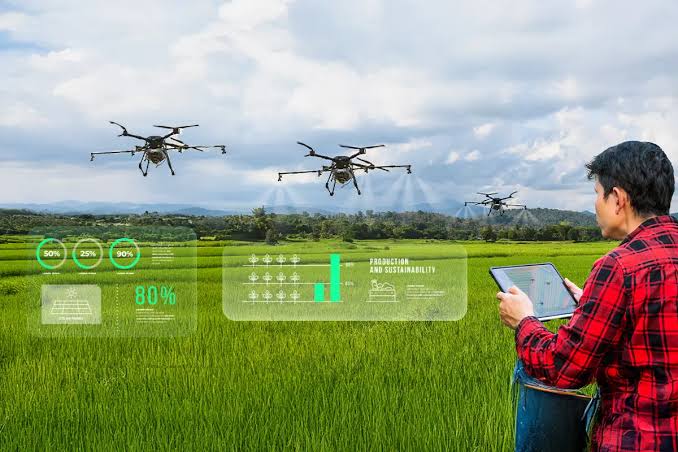
Agriculture is humanity's oldest and most foundational industry. For millennia, farming was an art of observation, weather prediction, and back-breaking labor. The relationship between the farmer and the land was intimate but limited by physical capabilities. We have passed through several agricultural revolutions—the mechanization age, the "Green Revolution" of high-yield crops—and are now in the midst of the fourth: Agriculture 4.0.
Driven by a global imperative to feed a population projected to reach 9.7 billion by 2050 using less land and water, the agricultural sector is undergoing a profound digital transformation. Technology is taking center stage, transforming farms into highly optimized, data-driven operational ecosystems. AgriTech is not just about automation; it is about precision, efficiency, and sustainability.
Precision Agriculture: The Art of Optimization
Traditional farming treats an entire field as a single, uniform entity. Every square foot receives the same amount of fertilizer, pesticide, and water. This is inherently inefficient. Precision Agriculture leverages data to treat every square centimeter with unique care, optimizing inputs and maximizing output.
- Variable Rate Technology (VRT): GPS-guided machinery equipped with VRT can dynamically adjust the rate of application for seeds, fertilizers, and herbicides based on prescription maps derived from soil testing and drone imagery. A farmer doesn't just plant a field; they map the field's variations and apply exactly what is needed, where it is needed.
- Reduced Inputs and Cost: By using precise, localized application, farmers can reduce the total volume of chemical inputs by up to 50%. This not only significantly lowers operational costs but also prevents excess nitrogen and phosphorus from leaching into groundwater supplies.
- Yield Monitoring: Modern harvesters come equipped with yield monitors that record the quantity and moisture content of the crop in real-time as it is processed. This data, when combined with VRT prescription maps, allows farmers to analyze the profitability of different areas of their land, creating a feedback loop of continuous improvement.
IoT and Sensor Networks: Real-Time Insights Below the Surface
The heartbeat of modern AgriTech is the Internet of Things (IoT). The farm is no longer a passive landscape but a living grid of interconnected sensors monitoring every variable that affects crop health and livestock welfare.
- Soil Monitoring: IoT sensors embedded throughout a field constantly measure soil temperature, volumetric water content (moisture), and nutrient levels (NPK). This data streams to a central dashboard, allowing farmers to predict potential crop stress days before it becomes visible to the naked eye.
- Smart Irrigation: Connected sensors feed data into automated irrigation systems. When soil moisture falls below a predetermined threshold, irrigation is triggered automatically. This prevents both overwatering (which saves resources) and underwatering (which protects yield). In areas facing extreme water scarcity, this technology is critical.
- Livestock Telemetry: "Connected cows" are becoming reality. GPS collars and ingestible bolus sensors track an animal's location, body temperature, movement patterns, and even rumination rates. AI analyzes this data to detect the early onset of illness, notify a rancher when an animal goes into labor, or identify the optimal time for artificial insemination.
Drones and Satellite Imagery: The Eye in the Sky
Aerial insights have fundamentally changed the scope and speed of farm management. Instead of walking entire fields to spot problems, a process known as scouting, farmers now rely on multi-spectral imaging to get a comprehensive view of the land.
- Crop Health Analysis: Both drones and low-orbit satellites utilize multi-spectral sensors. These sensors detect bands of light outside the visible spectrum, specifically Near-Infrared (NIR). Plants that are healthy absorb most visible light and reflect a lot of NIR. When plants are under stress (due to pests, drought, or disease), they reflect less NIR. This invisible "stress signature" can be detected algorithmically, creating a "normalized difference vegetation index" (NDVI) map.
- Aerial Spraying: Large-scale drones are increasingly being used for precision spraying. Using GPS coordinates derived from scouting, these drones can fly autonomously to specific hotspots in a field and apply localized doses of pesticide or fertilizer, leaving the healthy parts of the crop untouched.
- Stand Counts and Mapping: Drones can perform incredibly accurate plant stand counts to ensure optimal crop density after germination, map topographical features for drainage planning, and even perform thermal imaging to detect irrigation leaks.
Automation and Robotics: Addressing the Labor Shortage
As agricultural labor becomes increasingly difficult to source and costly, automation is stepping in to perform repetitive and physically demanding tasks.
- Autonomous Tractors and Implements: The industry's largest players have unveiled fully autonomous tractors. These machines are guided by high-precision GPS, LiDAR, and computer vision, capable of navigating fields and performing operations like planting, tilling, and cover cropping with minimal human intervention.
- Robotic Harvesting: The "holy grail" of automation is harvesting delicate specialty crops. Vision-guided robots equipped with delicate end-effectors are being deployed to pick strawberries, tomatoes, and citrus fruits. These robots navigate the greenhouse or field, assess ripeness using AI, and harvest only the fruits that meet specific quality standards.
- Mechanical Weeding: Vision-guided robotic weeders are capable of distinguishing between young crops and unwanted weeds. Once a weed is identified, the robot either uses precision micro-dosing of herbicide directly on the weed or utilizes a physical mechanism (like a small blade or laser) to destroy the weed, eliminating chemical usage entirely.
Vertical Farming and Controlled Environment Agriculture (CEA)
Perhaps the most significant departure from traditional agriculture is moving the entire process indoors. Vertical farming and CEA leverage technology to create optimized "plant recipes," removing the variability of weather and geography.
- Hyper-Localized Production: Vertical farms use nutrient-rich water solutions (hydroponics or aeroponics) and stacked growing racks. Because conditions are perfectly controlled, these systems can produce crops anywhere, including dense urban environments. A lettuce crop in a warehouse in a city can be harvested and delivered to a local restaurant in hours, eliminating thousands of "food miles."
- Resource Efficiency: Indoor farms can be up to 95% more water-efficient than traditional soil-based agriculture. LED lighting is precisely tuned to the spectrum required for photosynthesis (maximizing growth rates and crop quality), while HVAC systems cycle nutrients and CO2.
- Year-Round Growth: By removing the dependency on seasons, vertical farms can grow produce 365 days a year, achieving significantly higher yields per square foot and providing a stable, predictable food supply.
The Outlook
AgriTech is turning a low-margin, high-risk business into a precise engineering process. By leveraging the power of data, automation, and real-time insights, the agricultural sector is not just increasing profitability; it is building a more resilient, transparent, and sustainable food system capable of feeding the world.





Comments