
Education is one of humanity’s oldest social constructs, but the model most prevalent today—the "factory" model, where groups of same-aged students sit in rows of desks to receive the same information at the same pace—is a relic of the Industrial Revolution. It was designed for efficiency and mass production, not for optimal individual learning. Every student possesses a unique cognitive profile, a different baseline of knowledge, and a varied pace of absorption.
The digital revolution is finally disrupting this model. Educational Technology (EdTech) is shifting the center of gravity from the teacher's delivery to the learner's experience. This transformation is not about replacing teachers with screens; it is about leveraging technology, particularly Artificial Intelligence, to democratize access to world-class learning and to fulfill the ultimate pedagogical promise: hyper-personalization.
Artificial Intelligence: The Adaptive Tutor
The fundamental challenge in a traditional classroom of 30 students is that the material is only optimal for a small fraction. It is too fast for some, causing frustration, and too slow for others, leading to disengagement. AI is solving this through adaptive learning platforms.
- Personalized Learning Paths: AI-driven systems are "intelligent tutors." They start by assessing a student's current mastery level across different domains. As the student engages with content (reading material, quizzes, exercises), the algorithm analyzes their performance in real-time. If a student breezes through basic algebra but stumbles on quadratic equations, the system automatically slows down, breaks the concept into foundational steps, and provides personalized remedial content.
- Instant Feedback and Remediation: In a traditional setting, a student might complete a quiz on a Monday, and it is graded and returned on a Wednesday. By then, the student's opportunity for intrinsic correction is gone. EdTech platforms provide immediate feedback, explaining why an answer was incorrect and pointing the user toward the exact material required to correct the misunderstanding.
- Early Intervention: AI is not just for the student. Learning analytics dashboards provide teachers with powerful predictive insights. An AI can flag a student who is showing a decrease in engagement or who has performed consistently poorly in a key sub-domain, alerting the educator that intervention is needed before that student falls hopelessly behind.
Immersive Technology: Moving from Abstract to Tangible
Learning is fundamentally an active, not passive, process. The brain is not a sponge; it constructs meaning from experience. For centuries, abstract concepts (how a cell operates, the dynamics of an economy, the size of a galaxy) had to be learned through textbooks or lectures. Immersive technologies are breaking these barriers.
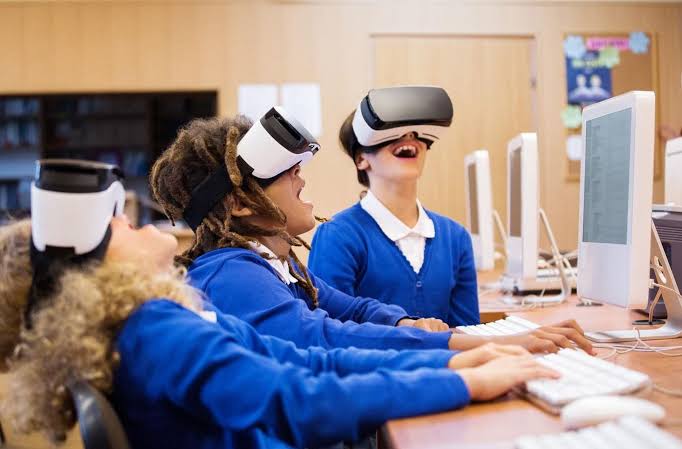
- Virtual Reality (VR): VR replaces passive observation with active presence. It can transport a student to any environment, safe or hazardous, past or future. Medical students can perform complex surgeries or "travel" inside a human artery to watch plaque form. History students can "walk" the streets of ancient Rome. Physics students can stand "outside" a black hole and observe gravitational lensing. These immersive experiences are proven to increase engagement, retention, and spatial reasoning.
- Augmented Reality (AR): While VR creates a completely virtual world, AR overlays digital content onto the physical world. Using a tablet or smartphone camera, students can "project" a complex 3D molecule onto their desk, manipulate its structure, and watch how it bonds. AR turns static textbook diagrams into interactive, dynamic models, bridging the gap between theory and reality.
Gamification: Hacking the Brain's Reward System
One of the biggest obstacles to education is motivation. Learning something new is often difficult and offers delayed gratification. Game developers have mastered the art of intrinsic motivation. EdTech is leveraging this "gamification" to make learning engaging, addictive, and safe.
- Immediate Feedback and Badging: Games rely on instantaneous feedback loops. EdTech platforms use a system of progress bars, digital badges, and competency-based leveling. This provides a continuous stream of low-stakes achievements that keep the learner motivated and clear about their progress toward a larger goal.
- Safe Failure: Traditional education often punishes mistakes (a bad grade). Game design view "failure" as a crucial part of the learning cycle. Students in gamified environments are encouraged to experiment and retry. This cultivates a "growth mindset," where the focus is not on being a "natural," but on effort, iteration, and improvement.
- Collaborative Problem Solving: Many educational platforms emphasize team-based quests or leaderboards. This taps into the brain's social drivers, encouraging students to work together to solve complex problems and shared challenges.
Global Access, MOOCs, and the New Credentialing
Education technology is also a powerful democratizing force, dismantling the geographic and economic barriers that have historically limited access to quality education.
- Massive Open Online Courses (MOOCs): Platforms like Coursera and edX have opened up the hallowed halls of elite universities (MIT, Harvard, Stanford) to anyone with an internet connection. A student in a rural community in India can take the exact same computer science course, from the exact same world-class instructor, as a student sitting in a classroom in Palo Alto.
- Synchronous and Asynchronous Learning: The traditional 9-to-5 school schedule does not work for everyone. The normalization of video conferencing (Zoom, Teams) for synchronous learning and robust Learning Management Systems (LMS) for asynchronous, self-paced learning, has made education "anytime, anywhere." This flexibility is essential for adult learners, working parents, and individuals in diverse time zones.
- The Skills Economy and Digital Credentials: As the nature of work changes, the "one-degree-for-a-career" model is collapsing. EdTech is fueling the shift toward micro-credentials and skill-based learning. Instead of (or in addition to) a general 4-year degree, learners can obtain specific, verifiable digital "badges" for specialized skills (e.g., Python programming, data analytics, project management) which can be added to their digital portfolios.
The Outlook
The integration of technology into education is not just about making learning more efficient; it is about making it more human. By offloading the repetitive tasks (grading, basic information delivery, progress tracking) to AI, and leveraging immersive tools for deep comprehension, we free up educators to do what only they can do: act as mentors, facilitators, and curators of critical thinking, fostering a generation of adaptive, lifelong learners.





Comments