
For over a century, the automobile was defined by mechanical engineering—pistons, transmissions, and fuel injection. The competitive advantage of a car company lay in its ability to bend metal and refine internal combustion. Today, that entire paradigm has flipped. The defining feature of a modern vehicle is not its engine, but its software.
The automotive sector is undergoing the most radical disruption since the invention of the assembly line. Driven by the dual imperatives of decarbonization and automation, cars are evolving into highly sophisticated, multi-ton computers on wheels. This transformation is grouped into three massive pillars: Electrification, Autonomy, and Connectivity.
Electrification and Advanced Battery Chemistry
The internal combustion engine is slowly being phased out globally. The shift to Electric Vehicles (EVs) requires a total reimagining of automotive supply chains and energy density physics.
- Lithium-Ion to Solid-State: Current EVs rely heavily on liquid-electrolyte lithium-ion batteries. However, the frontier of EV tech is the solid-state battery. By replacing the liquid electrolyte with a solid conductive material, automakers can achieve significantly higher energy densities (meaning far longer range), much faster charging times, and a drastically reduced risk of fire.
- Skateboard Platforms: Unlike gas cars, which have to work around bulky engines and drivetrains, EV architecture uses a "skateboard" chassis. The batteries are laid flat across the floorboard, with compact electric motors at the axles. This lowers the center of gravity for better handling and frees up massive amounts of interior cabin space, allowing designers to completely rethink the interior of the vehicle.
- Bidirectional Charging (V2G): EVs are essentially massive batteries on wheels. Vehicle-to-Grid (V2G) technology allows an EV not just to draw power, but to push power back into the electrical grid during peak demand, or to serve as a backup generator for a house during a power outage.
Autonomous Driving and Sensor Fusion
The quest for a fully autonomous, "Level 5" self-driving car is one of the most complex artificial intelligence challenges ever undertaken. It requires a vehicle to perceive, predict, and react to an infinitely chaotic physical world in real-time.
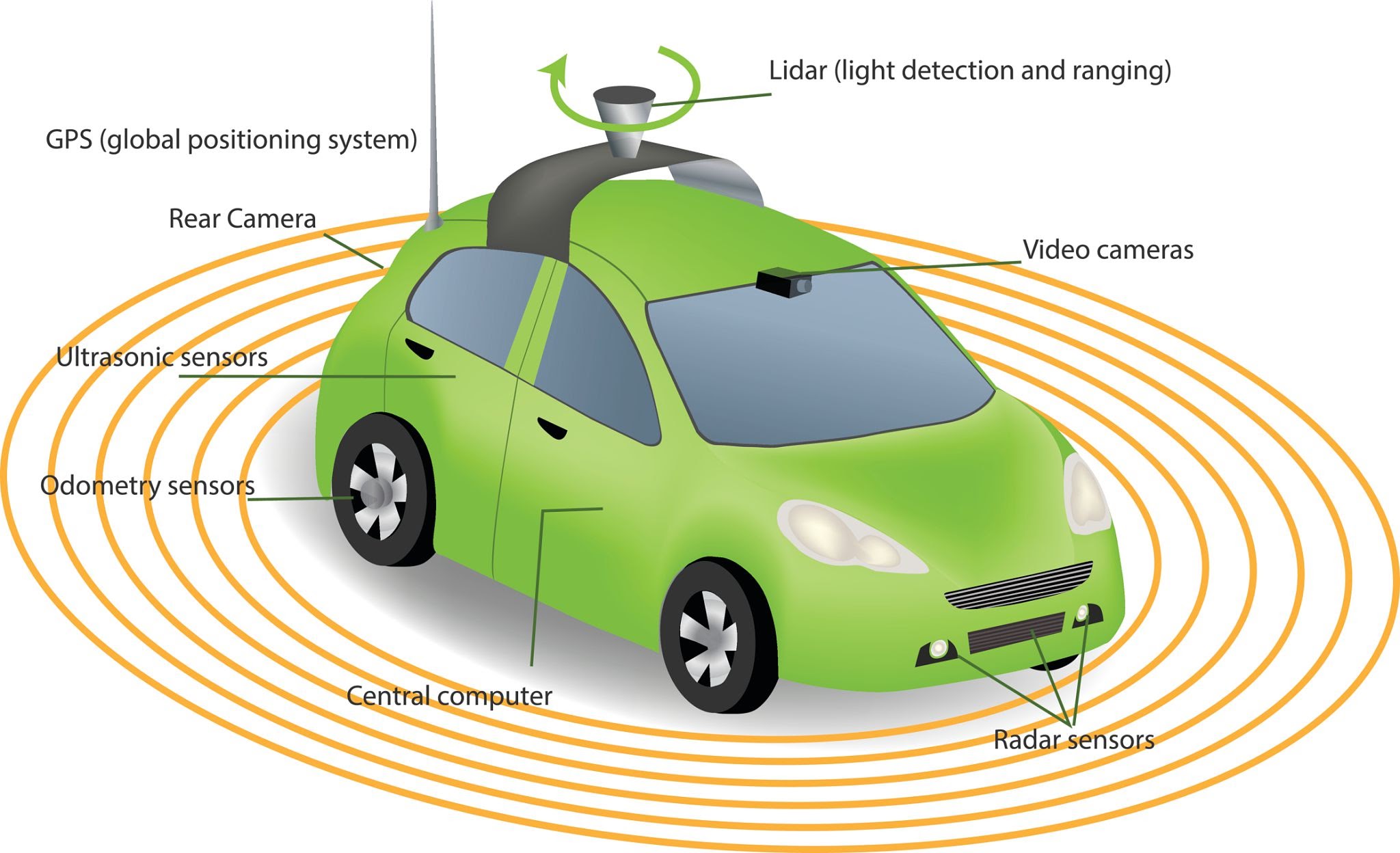
- The Sensor Suite: Autonomous vehicles rely on a redundant network of "eyes."
- LiDAR (Light Detection and Ranging): Spins lasers to create a hyper-accurate, 3D point-cloud map of the surrounding environment up to 300 meters away.
- Radar: Bounces radio waves to detect the speed and distance of objects, crucial for operating in heavy rain, fog, or snow where cameras fail.
- High-Resolution Cameras: Read traffic lights, lane markings, and stop signs using advanced computer vision.
- Sensor Fusion and Edge Computing: Generating gigabytes of data per minute, the car cannot wait to send this data to a cloud server for processing. It relies on massive, onboard "edge" supercomputers to instantly fuse the data from all sensors, classify objects (distinguishing a plastic bag from a rock), predict their future trajectories, and execute steering inputs in milliseconds.
V2X Communication and The Connected Car
A modern car is an IoT device. Vehicle-to-Everything (V2X) communication allows cars to talk not just to cellular networks, but to the world around them.
- V2V (Vehicle-to-Vehicle): Cars can share data with each other. If a car two miles ahead encounters black ice and its traction control engages, it can instantly broadcast a warning to all vehicles behind it to slow down, potentially preventing massive pile-ups.
- V2I (Vehicle-to-Infrastructure): Cars can communicate with smart city infrastructure. They can talk to traffic lights to optimize speed for a "green wave," or communicate with parking garages to be routed directly to an open spot, drastically reducing urban congestion caused by drivers circling for parking.
- Over-The-Air (OTA) Updates: Because the car is defined by software, it can improve over time. Just like a smartphone, a manufacturer can push an OTA update overnight that unlocks more battery range, improves the autonomous driving algorithm, or completely overhauls the infotainment UI, meaning the car is actually better a year after you bought it.
The Smart Cockpit and Mobility as a Service (MaaS)
As driving becomes automated, the interior of the car is shifting from a driver-focused control center into a mobile living room and entertainment hub.
- The Smart Cockpit: Physical buttons are being replaced by massive, high-definition touchscreens, augmented reality heads-up displays (HUDs) that project navigation arrows directly onto the windshield, and AI voice assistants that control climate, media, and scheduling.
- Mobility as a Service: The ultimate endgame of autonomy is the end of private car ownership. Instead of buying a car that sits parked 95% of the time, consumers will subscribe to MaaS networks. They will summon an autonomous pod via an app, use it for their commute, and the pod will automatically drive off to pick up the next passenger, fundamentally redesigning how cities are built and organized.
The Outlook
The automotive sector is shedding its mechanical past to become the ultimate intersection of clean energy, artificial intelligence, and advanced manufacturing. The cars of tomorrow will not just be modes of transportation; they will be autonomous, connected nodes in a much larger, intelligent mobility network.





Comments