
Bluetooth
Vulnerability Allows Attackers to Hijack Nearby Devices
Category:
Vulnerabilities & Exploits
A newly
discovered vulnerability in the Bluetooth specification affects billions of
devices worldwide, potentially allowing attackers within wireless range to take
full control of vulnerable devices without any user interaction. Researchers
have named the vulnerability "BlueHijack" and are warning that it
affects a wide range of devices, including smartphones, laptops, wireless
headphones, medical devices, and automotive systems.
The flaw
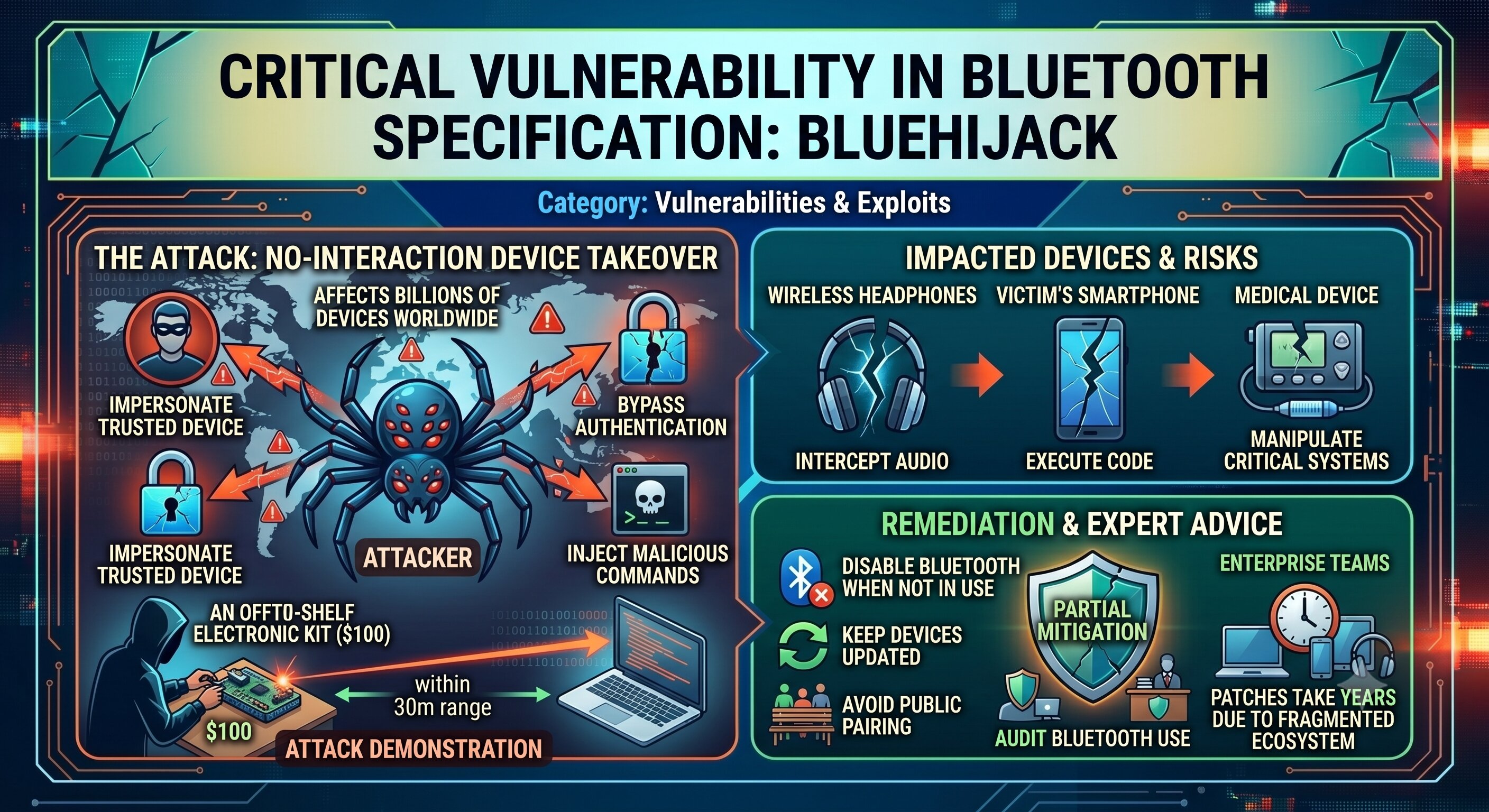
exists in the Bluetooth pairing protocol and allows an attacker to impersonate
a trusted device, bypass authentication, and inject malicious commands into the
target device's Bluetooth stack. In severe cases, this could enable attackers
to intercept audio from wireless headphones, execute code on a victim's
smartphone, or manipulate connected medical devices.
Demonstrations
conducted by the research team in a controlled environment showed that the
attack could be launched within seconds from up to 30 meters away using
off-the-shelf equipment costing less than $100. The attack leaves no obvious
trace on the victim's device, making it particularly dangerous.
The Bluetooth
Special Interest Group (SIG), the organization that oversees the Bluetooth
standard, has acknowledged the vulnerability and is working with device
manufacturers on patches. However, given the fragmented nature of the Bluetooth
device ecosystem, full remediation could take years.
In the
meantime, security experts recommend disabling Bluetooth when not in use,
keeping devices updated, and avoiding pairing devices in public places.
Enterprise security teams are also advised to audit the use of Bluetooth in
sensitive environments.





Comments