
The global economy was built on a linear model: "take, make, dispose." We extract raw materials, manufacture products, use them briefly, and bury them in the ground or dump them in the ocean. This model is mathematically unsustainable. As landfills reach absolute capacity and microplastics infiltrate the global food chain, the concept of "waste" is undergoing a radical redefinition.
Waste management is no longer just a municipal sanitation issue; it is a high-tech resource recovery sector. Driven by artificial intelligence, advanced chemistry, and IoT logistics, "WasteTech" is the engine of the new Circular Economy—a system where the end of a product's life is simply the beginning of its next iteration.
AI and Robotic Sorting Facilities
The bottleneck of global recycling has always been contamination. When consumers throw a greasy pizza box in with clean aluminum cans and mixed plastics, human sorters at Material Recovery Facilities (MRFs) simply cannot separate the materials fast enough, leading to entire batches being sent to the landfill.
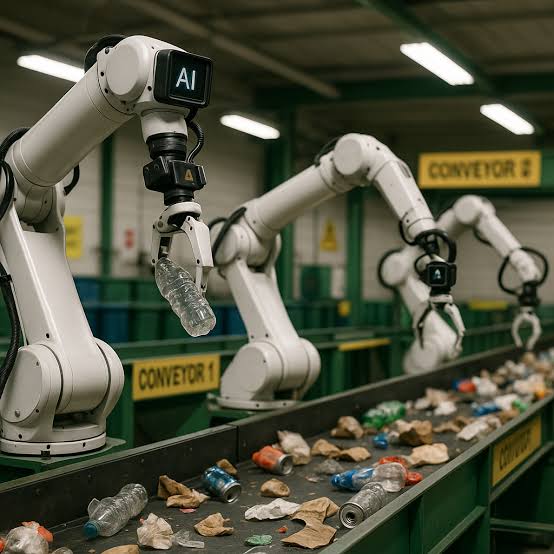
- Computer Vision Identification: Modern MRFs have replaced manual sorting lines with artificial intelligence. High-speed cameras running deep learning algorithms look at the chaotic blur of trash on a conveyor belt. The AI can instantly distinguish a clear PET water bottle from a clear HDPE milk jug—a task that is incredibly difficult for the human eye at speed.
- Robotic Extraction: Once the AI identifies the material, spider-like robotic arms equipped with suction cups or pneumatic grippers snatch the specific item off the belt in milliseconds. These robots can perform up to 80 picks per minute with 99% accuracy, operating 24 hours a day without the health hazards associated with human sorting.
Smart Bins and IoT Logistics
The logistics of collecting trash are historically incredibly inefficient. Garbage trucks drive rigid, pre-planned routes, stopping at bins whether they are overflowing or completely empty, wasting massive amounts of diesel fuel and increasing urban traffic.
- Ultrasonic Sensors: Smart trash cans are equipped with IoT sensors that measure the volume of waste inside using ultrasonic waves. They transmit this data in real-time to the municipal sanitation department via cellular networks.
- Dynamic Routing: AI routing software analyzes the data from thousands of bins across a city every morning. It generates a completely custom, hyper-optimized route for the garbage trucks, directing them to pick up only the bins that are over 80% full. This cuts fleet emissions by up to 40% and drastically reduces operational costs.
Chemical Recycling: Breaking the Plastic Barrier
Traditional "mechanical" recycling (shredding and melting plastic) has a fatal flaw: it degrades the polymer chains. A plastic bottle can only be mechanically recycled a few times before the plastic becomes too weak to use, eventually ending up in a landfill anyway.
- Depolymerization: Advanced chemical recycling technologies, such as pyrolysis and depolymerization, solve this. Instead of melting the plastic, these processes use extreme heat and chemical catalysts to break the plastic all the way back down to its fundamental molecular building blocks (monomers).
- Infinite Loops: Because the material is returned to its virgin molecular state, it can be rebuilt into a brand-new, food-grade plastic bottle with zero loss in structural integrity. This allows plastic to be recycled infinitely, fundamentally closing the loop on fossil-fuel-based plastic production.
Blockchain for Hazardous Waste Tracking
One of the darkest sides of the waste industry is the illegal dumping of hazardous materials (chemicals, medical waste, e-waste) by corrupt contractors to avoid expensive processing fees.
- Immutable Custody Chains: Governments and corporations are implementing blockchain to track high-risk waste. When a hospital produces biological waste, its exact weight and signature are logged on the blockchain. Every time custody changes hands—from the hospital to the truck, from the truck to the incinerator facility—it is digitally verified.
- Ensuring Compliance: If a truck leaves with 500 lbs of waste but only 200 lbs arrives at the facility, the immutable ledger instantly flags the discrepancy. This guarantees that toxic materials are disposed of ethically and provides corporations with verifiable proof of their ESG (Environmental, Social, and Governance) compliance.
The Outlook
Technology is proving that "trash" is simply a failure of imagination and infrastructure. By leveraging AI to sort chaos and advanced chemistry to rebuild molecules, the waste management sector is transforming our landfills from environmental disasters into the raw material mines of the 21st century.





Comments