
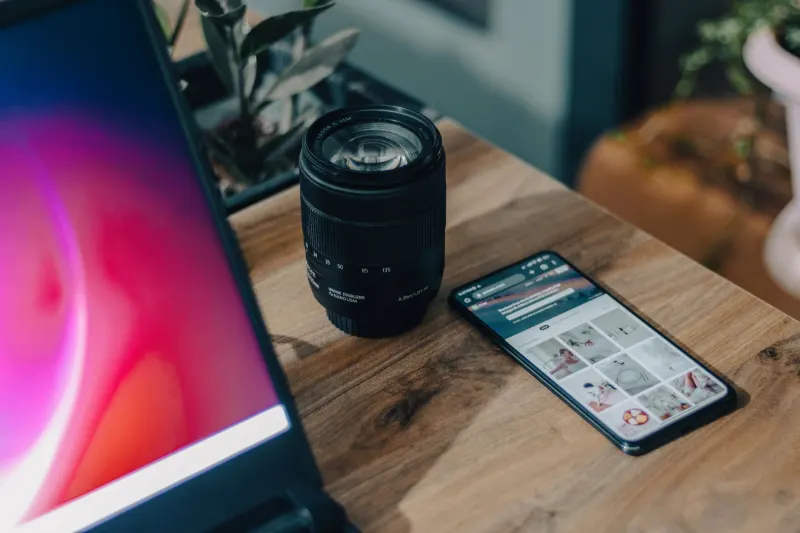
Smartphone photography could be on the verge of its biggest hardware shift in decades following a strategic acquisition in the optics sector. Boston-based Metalenz has acquired Israeli startup PxE Holographic Imaging, a move aimed at replacing the traditional color filter that has limited smartphone camera performance since 1974. The acquisition pairs Metalenz's commercialized metasurface flat-lens systems with PxE's microscopic diffractive optical layer, known as a HoloCoder, to capture significantly more light and data directly at the sensor level.
For half a century, standard digital cameras have relied on the Bayer filter, a red, green, and blue grid positioned above the image sensor. While this layer adds color to digital images, it absorbs and discards roughly 60 percent of incoming light before it ever reaches the sensor. To produce a single red pixel, the filter actively blocks out and wastes green and blue light waves. By contrast, PxE's HoloCoder uses a microscopic structure that sits directly on top of the image sensor to diffract and bend light waves rather than absorbing them.
Key takeaways
- Metalenz acquired Israeli startup PxE Holographic Imaging to integrate its HoloCoder optical layer technology.
- The traditional Bayer filter absorbs and wastes approximately 60 percent of incoming light.
- The HoloCoder redirects light waves to collect up to 2.5 times more light for enhanced low-light performance.
- The optical layer can capture simultaneous 3D depth information alongside color data.
How the HoloCoder Improves Low-Light Photography
By redirecting light waves toward the sensor pixels instead of blocking them, the HoloCoder allows camera sensors to collect up to a claimed 2.5 times more light. According to Metalenz CEO and cofounder Rob Devlin, major smartphone manufacturers including Apple, Samsung, and Google pour hundreds of millions of dollars into software algorithms to improve images. However, Devlin notes that once information is lost through light absorption, software cannot recover it.
The leap in light-gathering capability promises dramatic improvements for low-light photography and nighttime video capture. In high-contrast environments, such as capturing a portrait in front of a bright window, the sensor can gather sufficient light to accurately recreate the scene without blowing out highlights or drowning shadows in visual noise. Arka Majumdar, an opto-electronics researcher at the University of Washington, confirms that ditching traditional filters can meaningfully enhance low-light smartphone imaging, noting that other industry players like Samsung and startup Eyeo are also exploring alternatives called color routers.
Secondary Benefits and Future Integration
Beyond improving standard photos, the HoloCoder technology introduces a surprising secondary advantage by capturing 3D depth information simultaneously. Most modern smartphones currently rely on secondary cameras, dedicated depth sensors, or AI approximations to calculate distances for portrait mode depth effects. By merging light sensing and depth sensing into a single optical layer, the HoloCoder can simplify device electronics, reduce hardware footprint, and conserve processing power.
Metalenz launched publicly in 2021 and has already shipped over 300 million metasurface optics to consumer device makers. The company is also collaborating with Qualcomm on Polar ID, an Android facial biometric authentication system expected to arrive by late 2027. While Devlin states that Metalenz and PxE technologies will initially remain separate products for different markets, they could eventually fuse into a single system capable of capturing color, polarization, and depth data from one sensor. Devlin projects that PxE's HoloCoder could debut in consumer electronics as early as late 2027 or early 2028.


Comments