
NIST Releases Updated
Cybersecurity Framework 3.0 for Critical Infrastructure
Category:
Policy, Regulations & Industry
The National
Institute of Standards and Technology has published the much-anticipated
version 3.0 of its Cybersecurity Framework, the widely adopted voluntary
guidance document that has become a cornerstone of cybersecurity risk
management for organizations across the United States and internationally. The
updated framework significantly expands its scope and depth to address the
evolving threat landscape and lessons learned from major cybersecurity
incidents since the previous version was released.
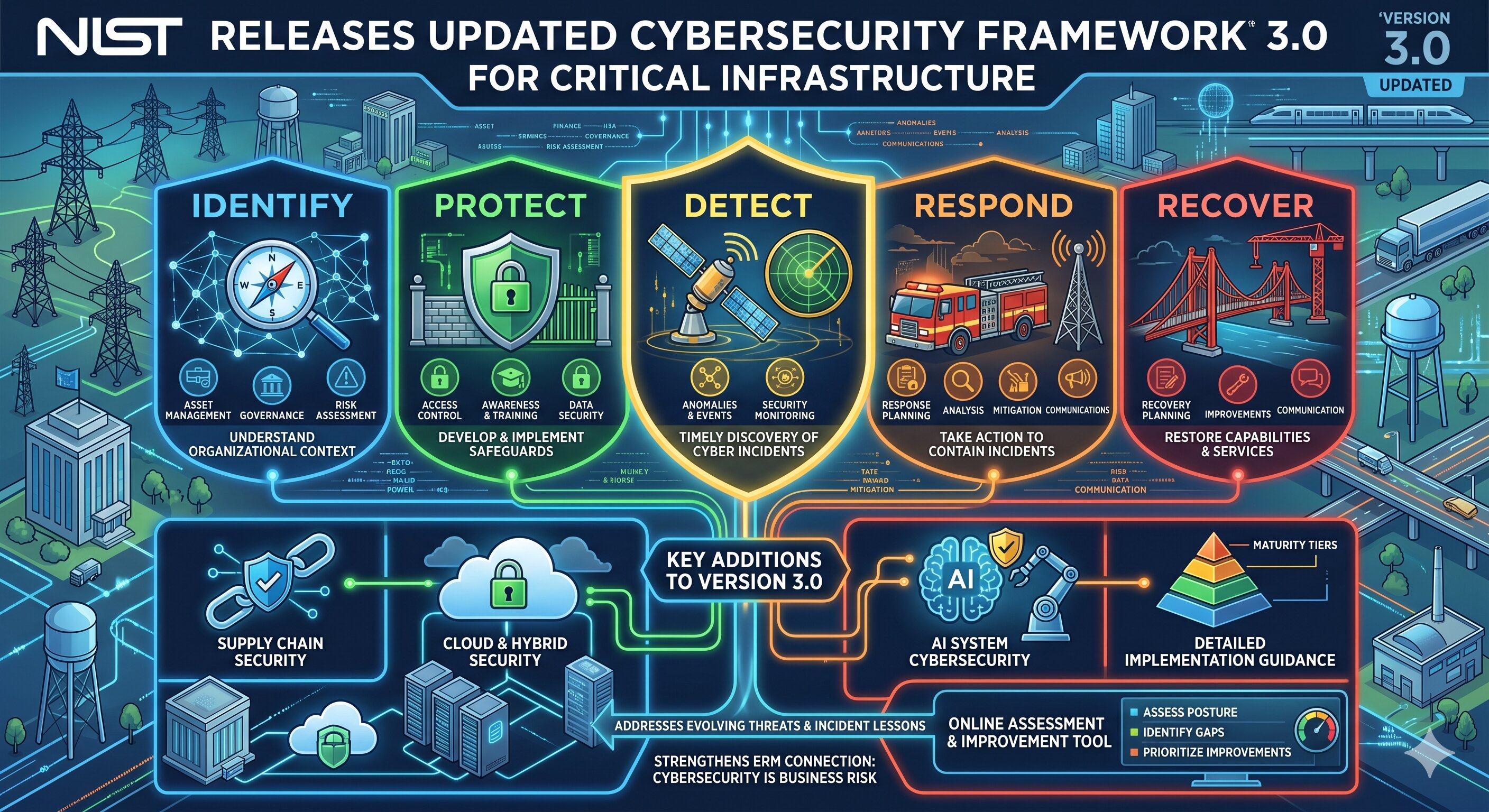
Key additions
to version 3.0 include new guidance on supply chain security risk management,
expanded coverage of cloud and hybrid environment security, a dedicated section
on AI system cybersecurity, and more detailed implementation guidance for
organizations at different maturity levels. The update also strengthens the
connection between cybersecurity and enterprise risk management, reflecting the
growing recognition that cybersecurity is a fundamental business risk issue.
"The
threat landscape has changed dramatically since we last updated the
framework," said NIST Director Dr. Sandra Holbrook. "Version 3.0 is
the result of extensive collaboration with thousands of organizations across
all sectors, and we believe it represents the most comprehensive and actionable
cybersecurity guidance we've ever published."
The framework
continues to be organized around its five core functions — Identify, Protect,
Detect, Respond, and Recover — but adds significantly more granular guidance on
implementation and measurement. A new online tool allows organizations to
assess their current posture, identify gaps, and develop prioritized
improvement plans.
Organizations
across all sectors are encouraged to begin reviewing the new framework and
assessing how it applies to their specific risk profiles and operational
contexts.





Comments