
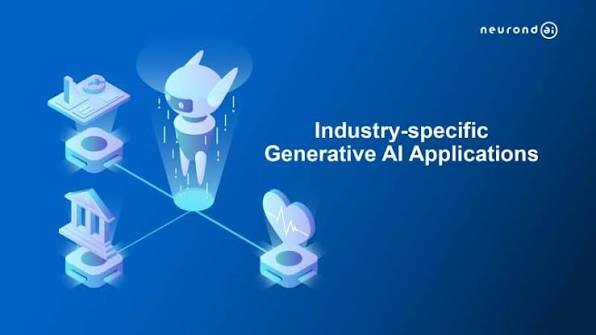
Generative artificial intelligence is entering a new phase of enterprise adoption as organizations increasingly develop industry-specific solutions tailored to unique operational challenges and business requirements. Rather than relying solely on general-purpose AI tools, businesses are implementing specialized generative AI applications designed to improve efficiency, automate workflows, enhance decision-making, and deliver greater value within their respective industries.
Industry-specific AI solutions combine advanced language models with domain expertise, proprietary data, and specialized workflows. This approach enables organizations to generate more accurate insights, improve operational performance, and meet regulatory requirements while addressing the unique needs of different sectors.
Healthcare organizations are among the leading adopters of specialized generative AI. AI-powered systems assist with clinical documentation, patient communication, medical research summaries, administrative workflows, and healthcare knowledge management. While healthcare professionals remain responsible for diagnosis and treatment decisions, AI helps reduce administrative burdens and improve operational efficiency.
Financial institutions are deploying customized AI applications for regulatory reporting, document analysis, customer support, fraud investigation assistance, risk management, and financial research. Industry-specific AI models are designed to understand financial terminology, compliance requirements, and complex operational processes, helping organizations improve both accuracy and productivity.
Manufacturing companies are integrating generative AI into product development, technical documentation, maintenance planning, quality assurance, and supply chain optimization. AI-generated recommendations help engineers identify opportunities for process improvements while supporting innovation across production environments.
Retail businesses are using specialized AI solutions to personalize customer experiences, generate product descriptions, optimize inventory planning, analyze consumer behavior, and support marketing campaigns. These intelligent applications enable retailers to improve customer engagement while streamlining operational workflows.
Legal professionals are increasingly adopting AI tools for contract review, legal research, document drafting, case summarization, and compliance support. Specialized legal AI platforms help professionals process large volumes of information more efficiently while maintaining human oversight for critical legal decisions.
Education providers are leveraging industry-focused AI to create personalized learning materials, develop curriculum content, generate assessments, provide tutoring support, and automate administrative communications. Adaptive learning experiences help improve student engagement while reducing educator workloads.
Insurance companies are implementing AI applications for claims documentation, policy analysis, customer communication, underwriting support, and fraud detection assistance. Intelligent automation helps accelerate claims processing while improving operational consistency and customer service.
Media and entertainment organizations are utilizing generative AI for content production, script development, localization, subtitle generation, creative brainstorming, and audience engagement. AI-assisted workflows help creators produce content more efficiently while supporting multilingual distribution across global markets.
The real estate industry is adopting AI to generate property descriptions, analyze market trends, automate documentation, assist customer inquiries, and support investment research. AI-powered insights enable professionals to make faster and more informed business decisions.
Software development teams continue expanding the use of industry-specific AI for code generation, technical documentation, testing automation, application modernization, and cybersecurity support. Specialized development assistants improve productivity while adapting to different programming environments and enterprise software requirements.
Human resources departments are exploring AI solutions designed specifically for recruitment, onboarding, workforce planning, employee communications, performance management, and learning development. Customized HR platforms help organizations improve talent management while enhancing employee experiences.
Cloud computing platforms continue to accelerate the adoption of industry-specific AI by providing secure infrastructure, scalable deployment options, and integration with enterprise software systems. Organizations can customize AI models using industry data while maintaining high standards for privacy and security.
Responsible AI governance remains essential as specialized applications become more widespread. Businesses are implementing policies focused on transparency, data protection, regulatory compliance, human oversight, and ethical AI usage to ensure responsible deployment within highly regulated industries.
Advances in multimodal AI are expanding the capabilities of industry-specific solutions. Modern systems can process text, images, audio, video, technical diagrams, and structured business data within unified workflows, providing more comprehensive insights and improving operational decision-making.
Industry experts anticipate continued growth in specialized generative AI as organizations seek solutions tailored to their unique business environments. Future developments in AI reasoning, autonomous agents, and domain-specific models are expected to further improve accuracy, efficiency, and enterprise value.
As businesses continue their digital transformation journeys, industry-specific generative AI applications are emerging as powerful tools for innovation and operational excellence. By combining intelligent automation with deep domain expertise, organizations are unlocking new opportunities to improve productivity, deliver better customer experiences, and remain competitive in an increasingly AI-driven world.





Comments