
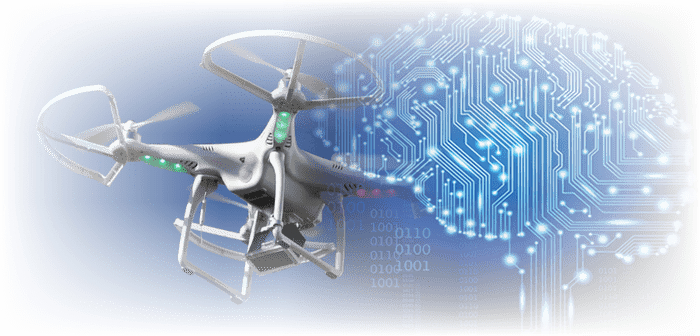
Artificial intelligence is transforming the commercial drone industry by enabling unmanned aerial systems to operate with greater autonomy, precision, and efficiency. By combining AI with advanced sensors, computer vision, GPS technology, and real-time analytics, modern drones are expanding their role across industries including agriculture, construction, energy, logistics, public safety, environmental monitoring, and infrastructure management.
Unlike conventional drones that require constant manual control, AI-powered drones can analyze their surroundings, identify objects, optimize flight paths, and adapt to changing environmental conditions. These capabilities improve operational efficiency while helping organizations collect accurate data and complete complex aerial tasks more effectively.
Infrastructure inspection has become one of the fastest-growing commercial applications for AI-powered drones. Energy companies, utility providers, telecommunications operators, and transportation agencies use drones to inspect power lines, bridges, railways, pipelines, wind turbines, and solar farms. AI-assisted image analysis helps identify maintenance issues, reducing inspection time while limiting the need for personnel to access hazardous locations.
Precision agriculture continues to benefit from intelligent drone technology. Equipped with multispectral cameras and AI-powered analytics, drones can monitor crop health, detect irrigation issues, assess soil conditions, identify pest activity, and support precision spraying. These insights help farmers make informed decisions while improving productivity and optimizing the use of agricultural resources.
Construction companies are integrating AI-powered drones into project planning, site inspections, surveying, and progress monitoring. High-resolution aerial imagery and automated mapping provide engineers and project managers with accurate, up-to-date information that supports better planning, resource allocation, and quality control throughout construction projects.
Environmental monitoring is another expanding application. Researchers and conservation organizations use intelligent drones to observe wildlife habitats, monitor forests, assess coastal regions, track environmental changes, and collect scientific data in areas that may be difficult or unsafe for field teams to access.
Logistics organizations are exploring AI-powered drones for inventory monitoring, warehouse inspections, and limited delivery operations where regulations and operational conditions permit. AI supports route optimization, obstacle detection, and autonomous navigation, helping improve efficiency in selected commercial workflows.
Public safety agencies are using AI-assisted drones to support search and rescue operations, disaster assessment, wildfire monitoring, and emergency response. Real-time aerial imagery and automated object recognition can help emergency teams evaluate conditions quickly and allocate resources more effectively while keeping responders informed.
Mining companies are deploying intelligent drones for surveying, stockpile measurement, equipment inspection, and site mapping. AI-powered data analysis enables more accurate terrain modeling and operational monitoring while reducing the need for manual inspections in challenging environments.
Computer vision plays a central role in commercial drone applications. AI models analyze live video and captured images to recognize objects, detect structural changes, identify anomalies, and generate actionable insights. These capabilities improve the value of aerial data for industries that rely on accurate visual information.
Cloud computing enhances drone operations by providing scalable storage, fleet management, AI model deployment, and collaborative data analysis. Organizations can process aerial imagery, generate reports, and manage multiple drones from centralized cloud platforms while supporting collaboration across geographically distributed teams.
Edge AI is further improving drone performance by enabling onboard data processing. Instead of transmitting all information to cloud services, drones can analyze sensor data locally, reducing latency and allowing faster decision-making during inspections, navigation, and environmental monitoring.
Safety and regulatory compliance remain key priorities in commercial drone development. Manufacturers and software providers are integrating features such as obstacle avoidance, geofencing, return-to-home functionality, flight monitoring, and secure communications to support safer and more reliable operations within applicable aviation regulations.
Collaboration among drone manufacturers, AI developers, research institutions, and industry organizations continues to accelerate innovation. Advances in autonomous navigation, battery technology, sensor integration, and intelligent flight management are expanding the capabilities of commercial drone platforms while opening new business opportunities.
Industry experts expect AI-powered drones to play an increasingly important role in sectors such as infrastructure management, renewable energy, agriculture, logistics, environmental science, and industrial inspection. As AI models become more capable and drone technologies continue to evolve, organizations will be able to automate more aerial tasks while improving efficiency, safety, and data quality.
As artificial intelligence reshapes the drone industry, AI-powered aerial systems are becoming valuable tools for modern businesses. By combining intelligent automation, advanced analytics, and autonomous flight capabilities, commercial drones are helping organizations streamline operations, improve decision-making, and unlock innovative applications across the global economy.





Comments