
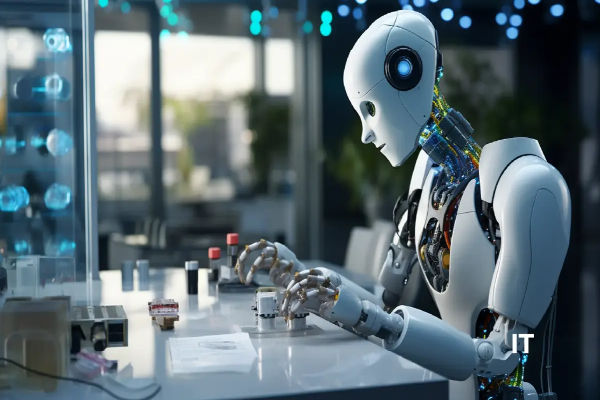
Artificial intelligence is accelerating the adoption of service robots across a wide range of industries, enabling organizations to improve customer experiences, streamline operations, and enhance workplace productivity. Advances in machine learning, computer vision, natural language processing, and autonomous navigation are making service robots more capable, adaptable, and practical for real-world commercial applications.
Unlike traditional robots designed for repetitive industrial tasks, service robots are built to interact with people and operate in dynamic environments. AI allows these robots to recognize objects, understand voice commands, navigate safely, and perform a variety of assistance and support functions with greater efficiency.
Healthcare has become one of the fastest-growing sectors for AI-powered service robots. Hospitals and healthcare facilities are using robots to transport medical supplies, deliver medications, assist with inventory management, support laboratory operations, and help with routine administrative tasks. These systems enable healthcare professionals to dedicate more time to direct patient care while improving operational efficiency.
The hospitality industry is increasingly integrating service robots into hotels, restaurants, and event venues. AI-powered robots assist with guest guidance, room deliveries, concierge services, and facility navigation, helping businesses improve service consistency while supporting staff during busy periods.
Retail businesses are deploying intelligent robots for inventory monitoring, shelf scanning, customer assistance, and store navigation. Equipped with computer vision and AI analytics, these robots can identify stock shortages, monitor product placement, and provide shoppers with helpful information, contributing to more efficient store operations.
Logistics and warehousing continue to benefit from service robots that transport goods, organize inventory, and support order fulfillment. Autonomous mobile robots navigate warehouses using AI-powered mapping and obstacle avoidance technologies, improving productivity while reducing manual material handling.
Airports, shopping centers, museums, and other public venues are exploring AI-powered service robots to provide visitor information, multilingual assistance, wayfinding, and operational support. These robots enhance visitor experiences while helping organizations manage routine information requests more efficiently.
Office environments are also adopting service robots to assist with mail delivery, meeting room logistics, facility monitoring, and administrative support. By automating repetitive workplace tasks, organizations can improve operational efficiency and allow employees to focus on higher-value activities.
Natural language processing has significantly improved human-robot interaction. Modern service robots can understand spoken language, respond to common questions, and communicate through conversational interfaces, making interactions more intuitive and accessible for users with varying levels of technical experience.
Computer vision enables service robots to identify people, recognize objects, interpret visual environments, and navigate complex indoor spaces. Combined with advanced sensors and machine learning, these capabilities allow robots to adapt to changing surroundings while operating safely alongside people.
Cloud computing supports service robotics by providing centralized AI model management, fleet coordination, remote software updates, and operational analytics. Organizations can monitor robot performance across multiple locations while continuously improving functionality through cloud-based services.
Edge AI is further enhancing service robots by enabling real-time processing directly on the device. Local data processing reduces latency, supports faster decision-making, and allows robots to continue operating effectively even when network connectivity is limited.
Responsible AI and robotics development remain central to industry growth. Manufacturers and technology providers are investing in safety systems, cybersecurity, privacy protection, transparency, and human oversight to ensure service robots operate securely and responsibly in public and commercial environments.
Collaboration between robotics companies, AI developers, universities, and enterprise technology providers continues to drive innovation. Advances in multimodal AI, autonomous navigation, adaptive learning, and energy-efficient computing are expanding the capabilities of service robots while making them more accessible to organizations of all sizes.
Industry experts expect AI-powered service robots to become increasingly common across healthcare, hospitality, retail, logistics, education, and public services as technology continues to mature. Future robots are expected to offer greater autonomy, more natural interactions, and improved collaboration with human workers, supporting a broad range of operational and customer-facing tasks.
As artificial intelligence continues to evolve, AI-powered service robots are becoming valuable tools for businesses seeking to improve efficiency and customer engagement. By combining intelligent automation with advanced robotics, these systems are helping organizations modernize operations, enhance service quality, and shape the future of human-machine collaboration.





Comments