
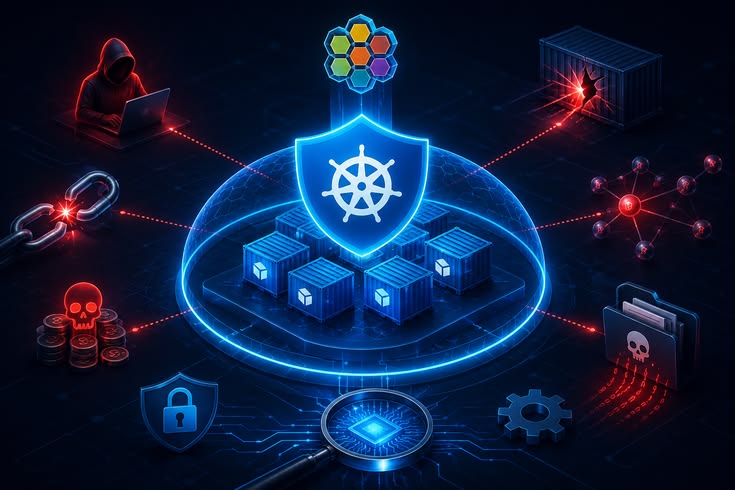
The Cloud Native Computing Foundation (CNCF) has officially announced the release of Kubernetes 1.34, introducing a wide range of enhancements focused on resource management, security, scalability, and developer productivity. The latest version delivers new features for dynamic resource allocation, workload scheduling, storage management, and cluster operations, making Kubernetes even more efficient for running modern cloud-native applications across enterprise and hybrid cloud environments. (kubernetes.io)
Kubernetes remains the world's leading open-source container orchestration platform, powering millions of applications across public clouds, private data centers, and edge computing environments. Organizations use Kubernetes to automate application deployment, scaling, networking, and infrastructure management while supporting microservices-based architectures.
One of the biggest highlights of Kubernetes 1.34 is the continued advancement of Dynamic Resource Allocation (DRA). The feature enables more intelligent management of specialized hardware resources such as GPUs, NPUs, high-performance storage, and networking devices. As AI workloads become increasingly common, DRA allows applications to access hardware resources more efficiently without requiring complex manual configuration.
The release also introduces improvements to workload scheduling. Kubernetes can now make more informed placement decisions based on resource availability, workload characteristics, and infrastructure conditions. These enhancements improve cluster utilization while reducing resource contention across large-scale deployments.
Security has received considerable attention in Kubernetes 1.34. The update strengthens authentication mechanisms, expands admission control capabilities, improves secret management, and introduces additional security hardening features for containerized applications. These improvements help organizations maintain secure cloud-native environments while meeting enterprise compliance requirements.
Storage management has also been refined. Kubernetes 1.34 enhances persistent volume provisioning, snapshot management, and storage lifecycle operations, allowing administrators to manage application data more efficiently across distributed infrastructure.
Networking capabilities continue to evolve with improved service discovery, better traffic management, and enhanced support for advanced networking scenarios. These improvements contribute to more reliable communication between microservices and improve application availability.
Developer productivity benefits from updated APIs, better debugging tools, enhanced observability, and expanded documentation. Application developers can build and deploy Kubernetes-native software more efficiently while platform engineers gain better visibility into cluster operations.
Artificial intelligence infrastructure is another area expected to benefit significantly from the release. Kubernetes continues strengthening support for GPU scheduling, AI model deployment, distributed training, and inference workloads, making it an increasingly popular platform for machine learning and generative AI applications.
Cloud-native ecosystems also receive improvements through tighter integration with projects such as Prometheus, OpenTelemetry, Helm, and container runtimes. These integrations simplify application deployment, monitoring, and lifecycle management across complex enterprise environments.
Edge computing deployments continue to grow in importance, and Kubernetes 1.34 introduces optimizations that improve cluster efficiency on distributed infrastructure. Organizations deploying applications closer to users or industrial environments can benefit from better resource management and operational reliability.
Enterprise IT teams are expected to benefit from improved cluster stability, simplified maintenance, and enhanced scalability. The latest release enables organizations to operate larger Kubernetes clusters while reducing administrative complexity and improving overall system resilience.
Educational institutions and training providers continue using Kubernetes as the primary platform for teaching cloud computing, DevOps, container orchestration, and distributed systems. The new features provide students with exposure to the latest cloud-native technologies widely used in modern enterprise environments.
The Kubernetes open-source community remains one of the largest collaborative software projects in the world, with thousands of contributors from technology companies, cloud providers, and independent developers continuously improving the platform. This collaborative development model ensures rapid innovation while maintaining production-grade reliability.
Industry analysts believe Kubernetes will remain the foundation of cloud-native infrastructure for the foreseeable future. As organizations increasingly deploy AI services, edge computing solutions, and distributed applications, intelligent container orchestration platforms will continue playing a central role in enterprise IT strategies.
Looking ahead, the Kubernetes project is expected to continue expanding AI infrastructure support, multi-cluster management, automation capabilities, and security enhancements. Future releases will further simplify operating large-scale cloud-native environments while improving performance and operational efficiency.
With Dynamic Resource Allocation, improved workload scheduling, stronger security, enhanced storage management, better networking, expanded AI infrastructure support, improved scalability, and continued open-source innovation, Kubernetes 1.34 represents one of the most significant open-source software releases of the year. As cloud-native computing continues evolving, Kubernetes remains the industry standard for building, deploying, and managing modern containerized applications at scale.





Comments