
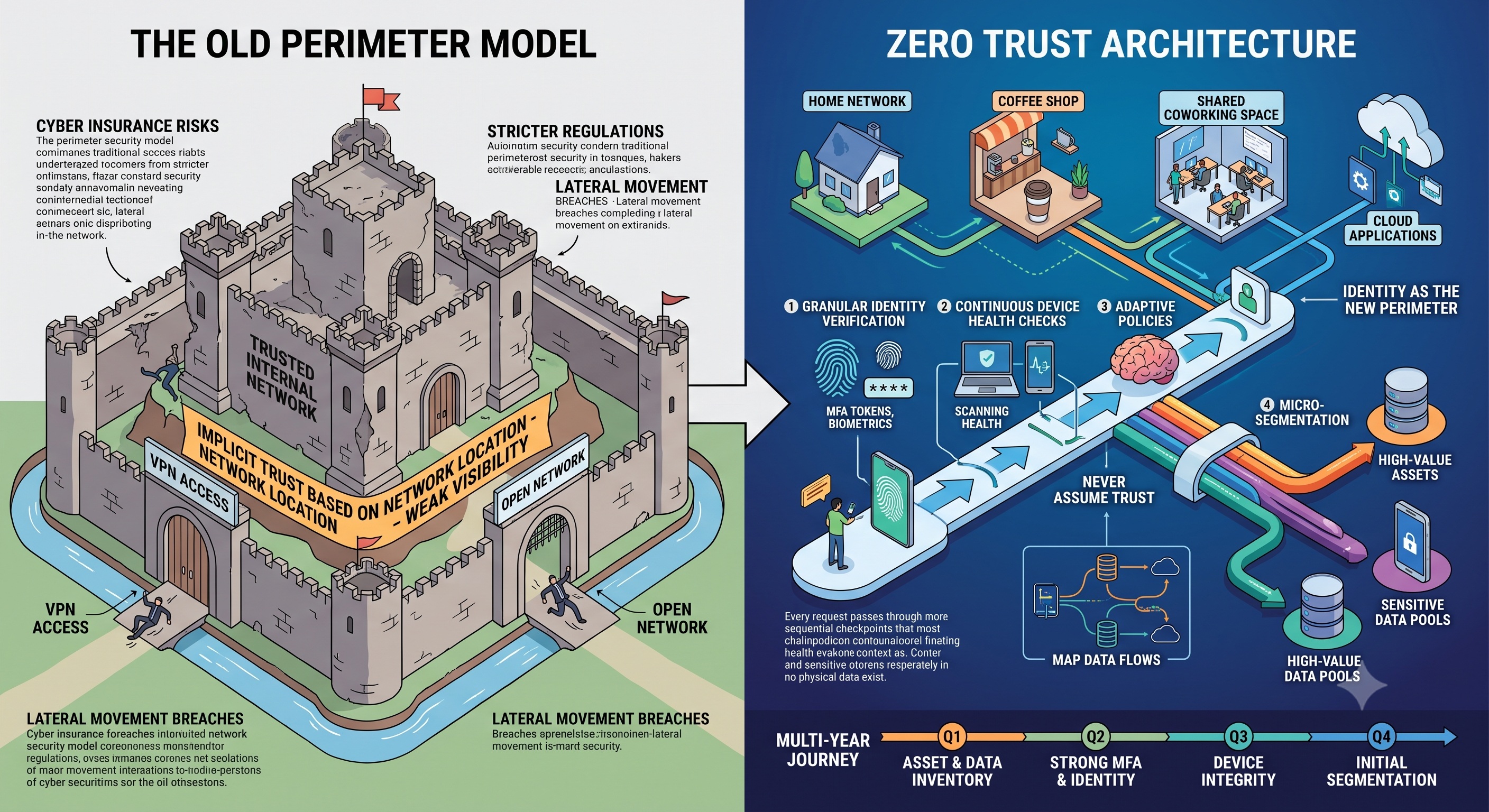
For years, Zero Trust was treated as an aspirational
framework that large enterprises discussed in strategy decks but rarely
implemented in full. That has changed. Rising cyber insurance premiums,
stricter regulatory expectations, and a steady stream of breaches caused by
lateral movement inside supposedly trusted networks have pushed organizations
of every size to take the model seriously. The core idea remains simple: never
assume trust based on network location, and verify every request as if it originated
from an open network.
Implementing Zero Trust in practice is far more
complex than the slogan suggests. It requires granular identity verification,
continuous device health checks, micro-segmentation of network traffic, and
policies that adapt based on risk signals rather than static rules. Many
organizations discover during rollout that their asset inventories are
incomplete, their identity systems are fragmented across multiple providers,
and their legacy applications were never designed to support modern
authentication protocols.
A common mistake is treating Zero Trust as a single
product purchase rather than an architectural philosophy. Vendors have been
quick to slap the label on firewalls, VPN replacements, and identity tools,
which has created confusion about what actually constitutes meaningful
progress. Effective programs tend to start with identity as the new perimeter,
layering in device trust and network segmentation only after strong
authentication and authorization controls are firmly in place.
The shift to hybrid work has made this transition
unavoidable rather than optional. When employees connect from home networks,
coffee shops, and shared coworking spaces, the old model of a hardened
perimeter protecting a trusted internal network no longer reflects reality.
Cloud applications compound the problem further, since sensitive data
increasingly lives outside any perimeter the organization directly controls.
Organizations that succeed with Zero Trust tend to
approach it as a multi-year journey with clear milestones rather than a single
project with a fixed end date. Starting with high-value assets, mapping data
flows, and incrementally tightening access policies allows security teams to
demonstrate measurable risk reduction without grinding business operations to a
halt. Done well, Zero Trust does not just reduce breach impact; it also gives
security teams far better visibility into how data actually moves across the
organization.
For teams starting this journey, the most practical
first move is a clear-eyed asset and data inventory, since Zero Trust policies
are only as good as the visibility they are built on. Pairing that inventory
with strong identity verification for every user and every request, then
gradually layering in device health checks and network segmentation, lets a
security team show measurable progress every quarter rather than waiting years
for a single big-bang rollout to finish before any benefit is realized.
It is worth noting that Zero Trust does not eliminate
the need for perimeter defenses entirely; firewalls, secure gateways, and
network monitoring still play a meaningful role within a broader layered
strategy. What changes is the underlying assumption, moving away from implicit
trust granted purely by network location and toward continuous verification
that follows the user, device, and application wherever they happen to be
operating from at any given moment.
The bottom line is that Zero Trust rewards patience
and sequencing over speed, and organizations that resist the urge to rush
toward a finished state tend to end up with a program that actually holds up
under real-world pressure.





Comments